Although there are no statutory limitations on the length of time that a prior citation was issued as a basis for a repeated violation, the following policy shall generally be followed.
Extending the look back period policy was just one of several actions OSHA took early during the Obama Administration to deliberately seek and cite more Repeat violations. David Michaels, Obama’s Assistant Sec’y of Labor for OSHA, complained frequently that OSHA’s enforcement teeth were not sharp enough. Without being able to change OSHA’s civil penalty authority, OSHA changed numerous policies and practices with the specific intent to find and cite more Repeat violations, because Repeat violations carried 10 times higher penalties than Serious and Other-than-Serious violations. In other words, finding ways to characterize more violations as Repeat was a way to raise OSHA penalties without being granted any new authority from Congress—so that is precisely what OSHA did.
In addition to expanding the look-back period to 5 years, the Obama Administration’s OSHA also broke down barriers between individual establishments, so that a violation at one location of a multi-establishment company could be used as the basis for a Repeat violation at any other location in fed OSHA state within that organization. OSHA also became more proactive in how it selected targets for inspections, which made it more likely for an employer to be visited multiple times during the look-back period.
Those policies were “successful,” in that the percentage of OSHA violations characterized as Repeat doubled during the Obama Administration. Citations characterized as Repeat now make up more than 5% of all OSHA citations.
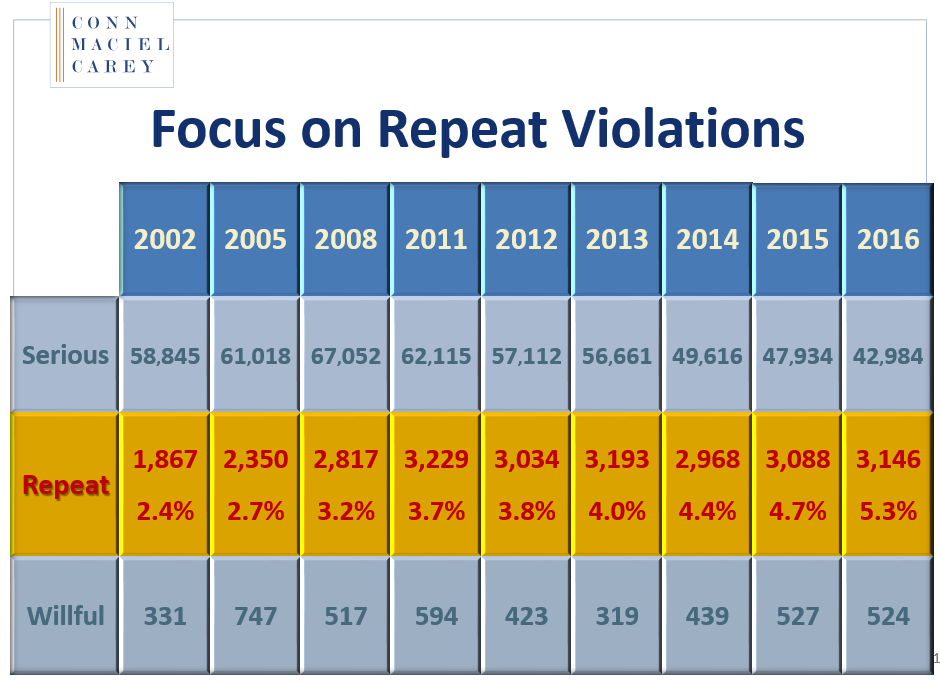
That trend continued even after Congress gave OSHA new penalty authority, increasing the max price tag for a Repeat violation from $70,000 per violation to approx. $130,000. As a result, we are seeing more $100K+ and $1M+ OSHA enforcement actions than ever before.
In light of OSHA’s Repeat violation philosophy, particularly in the context of the Second Circuit’s ruling in the Triumph case, employers need to be extra vigilant in defending against initial citations if the cited standard presents a risk of future Repeat violations, even if the initial penalty is very low. Paying the fine for a Serious or Other-than-Serious citation today may seem like no big deal if it carries a relatively small fine, but if can easily lead to a Repeat citation in three or four years (or eight years now that OSHA knows its look-back period is unlimited) could turn that initial violation into a costly burden.
Employers also need to understand the numerous other ways that Repeat violations can harm employers beyond just the 10x higher penalties. First, even under the Trump Administration, OSHA is continuing to issue inflammatory and embarrassing press releases about OSHA citations in significant cases, which includes most enforcement actions involving Repeat violations. So reputational harm can come to an employer just for being alleged to have committed a Repeat violation. Worse still is falling into the dreaded Severe Violator Enforcement Program (SVEP). The qualifying criteria for SVEP include Repeat and Willful violations in certain categories, but the data shows the vast majority of employers “sentenced” to SVEP are there because of Repeat violations.
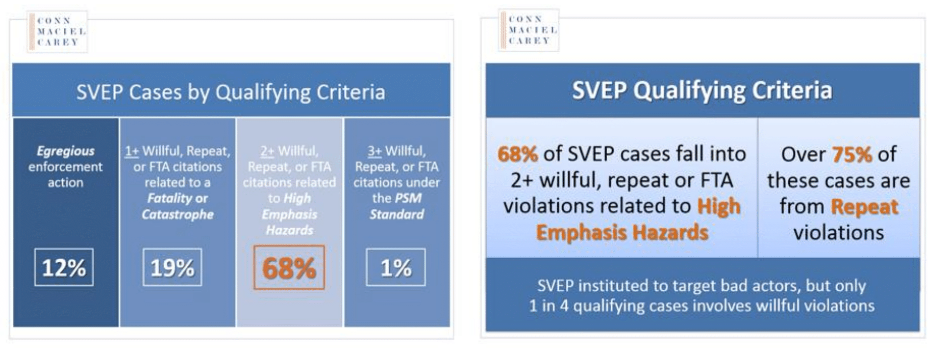
Even more reason to fight the initial violation, regardless how low that initial penalty may be.
Finally, a Repeat citation could increase insurance premiums and disqualify contractors and subcontractors from government and private contracts. There are potentially costly consequences for accepting a citation that has a high potential to become a Repeat citation. Therefore, employers should strongly consider contesting OSHA citations if a settlement cannot be reached that mitigates the risk of future Repeat violations.
Contesting a citation, however, is a post-hoc solution. The best way to avoid a Repeat citation is to understand the hazards most commonly found in your workplace, develop a program to regularly inspect for and correct them, and track your efforts to comply the applicable requirements.
In the hospitality industry, the most frequently cited OSHA standards include Hazard Communication, Electrical Safety, Wiring Methods and Components, Lockout/Tagout, Fire Extinguishers, Respiratory Protection, Walking/Working Surfaces, Bloodborne Pathogens, Protective Equipment, and Exit Routes.
OSHA Penalties
Below are the maximum penalty amounts adjusted for inflation as of Jan. 23, 2019. (See OSHA Memo, Jan 23, 2019).
| Type of Violation | Penalty |
| Serious Other-Than-Serious Posting Requirements | $13,260 per violation |
| Failure to Abate | $13,260 per day beyond the abatement date |
| Willful or Repeated | $132,598 per violation |
State Plan States
States that operate their own Occupational Safety and Health Plans are required to adopt maximum penalty levels that are at least as effective as Federal OSHA’s.
This article is part of our Conference Materials Library and has a PowerPoint counterpart that can be accessed in the Resource Libary.
HospitalityLawyer.com® provides numerous resources to all sponsors and attendees of The Hospitality Law Conference: Series 2.0 (Houston and Washington D.C.). If you have attended one of our conferences in the last 12 months you can access our Travel Risk Library, Conference Materials Library, ADA Risk Library, Electronic Journal, Rooms Chronicle and more, by creating an account. Our libraries are filled with white papers and presentations by industry leaders, hotel and restaurant experts, and hotel and restaurant lawyers. Click here to create an account or, if you already have an account, click here to login.
]]>Vaccinations and Herd Immunity
While vaccinations are important to protect individual human capital, they are critical for broader, continued corporate productivity. Vaccinations have a direct effect on individuals by providing them with a defense, or immunity, against disease. Yet, vaccinations also have an indirect protective effect on other individuals in the corporate setting. For example, when a high proportion of employees are vaccinated, they potentially prevent the spread of disease within the workplace by establishing a protective barrier around those who are not vaccinated and/or have not built up sufficient defenses against disease. In the science community, we call this concept herd immunity.
The modern corporate workplace is threatened by local and international infectious diseases. Local disease outbreaks have the potential to expose a high proportion of employees to an infectious disease; therefore, herd immunity is extremely important for maintaining a corporate protective barrier against outbreaks. Corporate health is equally jeopardized by international disease threats when unprotected individual employees travel abroad. Upon return, those employees can threaten productivity by exposing others to the imported infectious agent.

International Travelers & Recommended Vaccinations
International travelers regardless of their destination should ensure that they are up to date on the vaccines listed below. It is important to note that healthcare providers will likely add additional vaccinations to those listed below, such as yellow fever and Japanese encephalitis, if these vaccines are required by the traveler’s host country and/or if the disease is endemic in the destination country. Furthermore, employers should encourage all international travelers to contact a physician who has expertise in travel medicine four to six weeks prior to travel. This will allow enough time for the traveler to complete any vaccine series as well as give their body time to build up immunity.
- Chickenpox (Varicella): Recommended for travelers without a history of chickenpox or evidence of immunity to chickenpox by blood test. This vaccine is administered as a two-dose series.
- Hepatitis A: This vaccine is included in routine children’s immunizations. The Hepatitis A vaccination is most important for travelers who are traveling to countries with an intermediate to high prevalence of Hepatitis A. This vaccine is administered as a two-dose series. A Hepatitis A/Hepatitis B combined vaccine is also available.
- Hepatitis B: Recommended for all unvaccinated persons who might be exposed to blood or body fluids, have sexual contact with the local population, or be exposed through medical treatment, such as for an accident, even in developed countries, and for all adults requesting protection from HBV infection. The Hepatitis B vaccination is most important for travelers who are traveling to countries with an intermediate-to-high prevalence of Hepatitis B. This vaccine is administered as a three-dose series. A Hepatitis A/ Hepatitis B combined vaccine is also available.
- Influenza: Recommended for all travelers over the age 50, very young children, and/or travelers of all ages who have a chronic disease such as diabetes or emphysema. This vaccination is administered annually.
- Measles, mumps, rubella (MMR): Recommended for travelers born after 1957, and those who did not have these diseases as children. People born before 1957 generally acquired immunity to these diseases in childhood. This vaccine is administered as a two-dose series.
- Pertussis (Whooping Cough): This vaccine is included in routine children’s immunizations with tetanus and diphtheria (see below). It is also now available for adults in combination with the tetanus/ diphtheria booster.
- Pneumococcal pneumonia: Recommended for all adults over age 65, and anyone with chronic disease. Physicians in the US also recommend this vaccination for smokers and anyone with asthma.
- Tetanus and diphtheria: A booster is recommended every 10 years after initial immunization series.
Infectious diseases have the potential to greatly impact business productivity by eroding and diminishing human capital on an individual and corporate level. Since infectious diseases are a constant threat to the bottom line of every business, it is imperative that businesses monitor local and international disease threats, and adopt proactive healthcare measures. For that reason, thoughtful proactive disease prevention protocols are key to eliminating threats posed by local and international infectious diseases.
To learn more about how health inelligence can help protect your corporate workplace and global travelers from disease threats, download a copy of our white paper, The Value of Health Intelligence.
]]>Because there was no damage, these near miss incidents are often ignored or not investigated as thoroughly as a recordable workplace injury or illness on the premise of “no harm, no foul.” However, by doing so, businesses fail to take advantage of a zero cost learning tool that might prevent a serious injury or illness from occurring in the not-so distant future. Indeed, experience has shown there is little question that most loss producing events were preceded by warnings or near miss incidents.
Take the real life example of a business that many years ago installed a number of small venting systems at its operations. A piece of one of the venting systems fell and almost hit an employee which almost certainly would have caused a serious injury and possibly death. The business determined that (essentially) a screw came loose causing the part to fall. It then checked the remaining venting systems and learned that other screws had starting becoming loose as well and was able to resolve the issue before anyone got hurt.
It is with little creativity that one can imagine countless scenarios whereby performing a root cause analysis on a near miss incident would result in similar finding that could be used to prevent a future accident(s) from occurring. More often than not, these investigations may be smaller in scale, easier to conduct, and may not have the immediate deadlines associated with investigations conducted when OSHA is involved.
Even if the investigation results in a finding that human error caused the near miss, and they often do, this provides the employer an opportunity to revisit training. In fact, documentation of these proactive efforts could be used to reduce OSHA penalties and/or would be powerful evidence establishing an employee misconduct defense to OSHA citations or in defense of negligence and wrong death litigation.
Accordingly, businesses should ensure that their reporting policies include near miss incidents and should cultivate an environment of encouraging and supporting employees who report such incidents even if anonymously. As with any effective policy, this means a demonstrated commitment that begins with management and is communicated to all employees and includes their active involvement.
]]>The problem was that there were no witnesses to the accident and the employee did not report it. Instead, he went home and told his wife that he had fallen off a ladder and into the “pit” at work. The decedent went to the hospital and was diagnosed with fractured ribs, was given painkillers and sent home. Three days later he went back to the hospital and was diagnosed with a ruptured spleen and a punctured lung and was admitted but died the next day following complications from “blunt impact injuries.”
The court found that testimony of a supervisor that he had witnessed the decedent holding his stomach and indicating that he was not feeling well the day after the accident combined with the declarations of the deceased employee to his wife concerning the accident presented sufficient evidence that the accident occurred in the course of employment.
Clearly the cost, time, and pain of this litigation would have been avoided if the deceased had reported the injury. So why didn’t he report it? Was he afraid he would be disciplined for getting hurt? In addition, although no witnesses came forward to testify they witnessed the accident, the court noted that the widow testified at the decedent’s funeral that she was told by individuals that a coworker had picked the decedent up out of the pit but did not want to come forward with information for fear of losing his job. As we discussed in a previous blog, OSHA’s new recordkeeping rule also requires employers to inform employees of their right to report work-related injuries and illness free from retaliation. This can be done by posting the already-required OSHA workplace poster. The new rule also clarifies the implicit requirement that an employer’s procedure for reporting work-related injuries and illness must be reasonable and not deter or discourage employees from reporting. The decision is devoid of any information about whether anti-retaliation information for reporting workplace accidents was communicated to employees or the terms of the Transit Authority’s reporting procedure, if any, but such evidence may have been useful in this litigation.
This case serves as a good reminder that employers should ensure they are complying with the anti-retaliation requirements and that anytime an employer learns about a workplace accident that part of its root-cause analysis should also incorporate reviewing whether its reporting procedure is effective.
]]>Some may be of the opinion one complaint of workplace harassment is not a big deal because it is not reflective of the entire workforce or the values of the company generally. While this may be true in some cases, it is important to investigate any such complaints because the root of the problem may be broader, such as poor workplace culture, weak management, and/or ineffective workplace policies restricting harassing behavior. The recent high-profile cases that have surfaced within just this last year – Uber and Fox News to name a few – serve as a reminder an employer’s workplace culture and actions in addressing complaints of workplace harassment can have a significant impact on employee perception and behavior, and reduce the potential for costly and damaging lawsuits.
Employers should be acutely aware that the modern-day workforce is becoming more diverse, which in turn requires greater tolerance, respect, and sensitivity when dealing with workplace issues, especially discrimination and harassment. For example, the workplace behavior highlighted in AMC’s hit series “Mad Men” – a modern day TV series depicting American business in the 1960’s – must be viewed as far from the norm in 2017. In fact, workplace decorum and culture today should be quite the opposite.
While managers and executives cannot be expected to know every single thing that occurs during the day-to-day operations of a company, it is critical that they hold employees accountable and maintain a professional workplace that is inclusive and respectful of all employees. Employers should have robust policies and procedures in place that expressly prohibit discrimination and harassment, and ensure that they are reinforced through strong leadership and educating employees. Such a workplace culture should limit the potential for a costly and damaging lawsuit as well as strengthen the company’s defenses against potential harassment claims, increase employee morale and productivity, and protect against unfavorable publicity that severely damages an employer’s reputation, or, in extreme cases, could force it to shut its doors.
Management, Leadership, and Workplace Culture
A company’s culture is the cornerstone to a positive workplace environment for all employees. The more congenial and inclusive a company’s work environment, the more productive its employees. In our experience, a positive workplace culture, is most effectively established through a top-down approach.
The behavior and actions of a company’s leadership should reflect the ideals of the company and serve as a guidepost that employees will ultimately follow. Employers need to have strong leaders that can translate their influence into productivity and enable employees’ success. Interactions between managers and their subordinates should reflect an employer’s values and commitment to providing a harassment-free work environment. Management should be trained to immediately respond to complaints when they are received, and should be cautioned against any appearance of retaliatory behavior in response.
Employers should be vigilant when making hiring decisions, particularly in regards to management who will positioned as the voice of a company, and resist the rush to fill a position quickly. To maintain a positive workplace culture, every single employee should be hired for reasons that are compatible with the company’s mission and values. The benefits of taking your time in hiring the right employee outweighs the costs of high turnover or a lawsuit.
Implement Effective Workplace Policies
Workplace discrimination and harassment can cost employers millions of dollars every year through low employee morale and productivity, and expensive lawsuits. Creating a positive workplace culture that is led and staffed by like-minded individuals can be further reinforced by strong policies and employee training.
The content of discrimination and harassment policies should clearly explain the kinds of conduct that are prohibited, explicitly announcing that the company does not permit and will not tolerate harassment or discrimination based on sex, race, color, religion, national origin, age, disability, citizenship, familial status, pregnancy, veteran status, genetic information and/or any other legally protected status provided under applicable state law. For example, the DC Human Rights Act makes discrimination and harassment illegal under 19 protected categories, including personal appearance, sexual orientation, and gender identity or expression.
Discrimination and harassment policies should also explain that they apply to acts committed by anyone in the workplace, including executives, managers, coworkers and non-employees, and that employees will not be retaliated against for reporting harassment. To further explain how the policy operates, employers should include definitions and examples of harassment, an explanation of an employee’s right to a workplace free of discrimination and harassment, a clear statement that the company has zero tolerance for such conduct, and an anti-retaliation provision related to reports of discrimination or harassment.
Finally, these policies should also clearly explain the complaint procedure and an employee’s duty to report harassment to the appropriate supervisor, upper level management, or Human Resource Officer, who is responsible for handling employee complaints. The reporting procedure should encourage employees to report complaints promptly, remove all potential obstacles from the reporting process by providing clear instruction on how to report alleged discrimination or harassment, provide several ways in which employees can make a report of harassment (i.e., if your harasser is your supervisor, contact Human Resources directly to complain), and reassure employees that the company will investigate the complaint diligently.
Harassment Training and Enforcing Harassment Policies
Placing a policy in a handbook is a necessary first step to disseminate anti-discrimination and harassment policies and limit the potential liability, however, policies are only effective to the extent that they are followed by employees and enforced by the employer. Therefore, it is equally important to provide appropriate training to employees and supervisors on the company’s discrimination and harassment policies and the reporting procedures.
In addition to detailing the content of an anti-discrimination and harassment policy and emphasizing the company’s expectations and workplace culture, training should provide a comprehensive overview of the procedures to report complaints of discrimination or harassment. Specific training on the roles and responsibilities of employees on how to report complaints of discrimination and harassment validates an employer’s commitment to enforcing its policy.
Similarly, as mentioned above, supervisors, Human Resource officers, and other company officers who handle and investigate employee complaints, should be trained on their responsibilities to enforce the policy. Supervisors are important to the reporting procedure because they are typically the first line of defense, and their actions can be a major factor for liability purposes. Therefore, training for supervisors and company officers responsible for handling employee complaints should emphasize their role in monitoring workplace behavior, upholding company values and workplace culture, and properly addressing employee complaints.
Training your workforce on your discrimination and harassment policy is also essential to defending harassment claims. The Supreme Court holdings in Burlington Industries, Inc. v. Ellerth, 524 U.S. 742 (1998) and Faragher v. City of Boca Raton, 524 U.S. 775 (1998) generally require employers to create and implement zero tolerance policies to prevent, deter and remedy complaints of harassment. Employers are automatically liable for a hostile work environment created by a supervisor if the harassment results in a tangible employment action, such as a demotion or termination. An employer also is liable for a supervisor’s actionable harassment even if no tangible employment action occurs, unless the employer can establish the affirmative defense developed in the aforementioned case law.
To establish the affirmative defense, employers must demonstrate that they have satisfied two elements:
- the employer exercised reasonable care to prevent and promptly correct harassment; and
- the employee unreasonably failed to take advantage of any opportunities provided by the employer or to avoid harm otherwise.
However, even the best harassment policy and complaint procedure may not satisfy the affirmative defense if the employer fails to enforce its policy. Employers must ensure that the policies and procedures set forth in the employee handbook are consistently enforced throughout the company. This is, again, where comprehensive training plays an important role. Additionally, documenting the investigation, outcome, and any corrective action is important to demonstrate that the policy is followed. If the conclusion of the investigation is that harassing and/or discriminating conduct occurred, appropriate discipline should be applied to the offending party that aligns with the company policy.
Additionally, although Title VII does not specifically require that employers provide discrimination and harassment training, some states specifically require harassment training. For example, in California (Cal. Gov. Code § 12950.1) and Connecticut (Conn. Gen. Stat. § 46a-54(15)(B)), employers with 50+ employees must provide two hours of sexual harassment training to all supervisory employees within 6 months of being hired. Additionally, California law requires two hours of re-training on sexual harassment to supervisory employees every two years. Employers should consult applicable state law and ensure that they are following any specific state or local requirements when it comes to harassment and training your employees.
Conclusion
Ultimately, sexual harassment is still a very real problem in the modern-day workplace. Employers need to provide employees the appropriate channels to report harassment, free of retaliation, and make a commitment to upholding its zero-tolerance policy. Although creating effective policies and conducting employee training can be expensive, the cost of taking preventative measures to avoid exposure for claims of discrimination and harassment pales in comparison to the costs of defending a lawsuit and the damages that could be assessed. Finally, promoting and enforcing a workplace culture free of harassment will pay dividends in worker productivity. Given the recent string of news stories highlighting workplace harassment at major companies throughout the United States, there is no better time for employers to evaluate their workplace culture, and take the appropriate steps to ensure that employees and management alike are committed to promoting and upholding a positive workplace free of harassment.
]]>Slip, trip, and fall injuries are accidents; however, they could be the result of not providing a safe floor. Although each case is unique, there have been found to be “common factors” in these situations. Anthony Shinsky of Robson Forensic explores what defines slips and trips as well as standard expectations of a “walking surface.” Learn the most common causes of these incidents Discover the primary factors you should consider “in determining whether or not the flooring in any given environment is ‘safe’.”
Read the full article here.
]]>I talked with another company about protecting its high visibility executives where third parties are publically vilifying and with other employers about whether to allow employees to carry arms at work. And we’ve talked with a near countless number of employers about “Surviving Active Shooter Training.”
Today’s tragic Kansas shooting will increase the demand for improved strategies to protect our workers, but several points occurred to me;
1. Yes, the sheer number of recent mass shootings demands employer response but mass shootings are not our main workplace security concerns. These incidents are, however, a business destroying event, and even if rare, must be planned against.
2. Everyday risks due to estranged couples, muggers, robbers, and sexual assailants cause me more concern and statistically are bigger worries. A shooting is nightmarish but an employee being assaulted is also bad. Check these outstanding Infographics from HR Daily Advisor Illustrating Workplace Violence Areas.
3. Society doesn’t (yet) have great solutions and we’re all repeating formulaic solutions and responses. Every worker ought to at least view the DHS “Run, Hide, Fight” videos about surviving an active shooter, but we also have to evaluate our workplaces for hazards as we would for any safety hazard and devise solutions.
4. We must develop training for specific work settings and for general situational awareness.
5. Employers need to evaluate not only their fixed sites but the safety concerns posed by deliveries, home health providers, and realtors alone in offices, retail workers, and travelling employees.
Here’s a few initial observations and we’ll discuss these issues further in a two-part webinar series on March 29, 2016 and April 14, 2016.
The facts we know so far about the Kansas shooting are instructive ….
• He shot up his workplace, but his rampage started elsewhere and may have been triggered by being served with a Temporary restraining Order based upon allegations of abuse by a girlfriend. From an AP Story:
…. the woman, whose name is not being published, wrote that she and Ford were living together but broke up. He was moving out.
She wrote that on Feb. 5, she and Ford “were verbally fighting” when “it became physical by him pushing me and then grabbing me.”
“He placed me in a chokehold from behind,” she wrote, saying that she couldn’t breathe. “He then got me to ground while choking me-finally releasing me.”
The woman describes Ford as an “alcoholic,” “violent” and “depressed,” according to the order of protection from abuse.
• Employers don’t want to become involved with employee’s domestic disputes, but what about when the person is physically violent with their spouse or girlfriend … or makes threats?
Walton said Ford, 38, a Newton resident, was served with the order about 90 minutes before the first shooting, at about 3:30 p.m.
“It’s normal when someone gets served a protection of abuse order” to be upset, Walton said this morning, explaining that Ford’s behavior wasn’t abnormal when he was served.
• Maybe employers need to require or encourage employees to advise them when they are involved in a domestic or other dispute where violence may be a risk. Does obtaining a TRO trigger such a response? Maybe so.
• If an employer does ask employees to alert them to potential workplace violence concerns which could spill over to the workplace, the employer is taking on some level of duty toward the employee, coworkers and the public, depending on the facts.
• An incompetent or inadequate response may demonstrate that the employer was on notice of the hazard and responded inadequately. Recall the recent Missouri decision where an employer was on notice of threats from an employee’s spouse and formed ad hoc groups of employees to walk her to her car instead of using professional security?
• OSHA is serious about issuing 5(a)(1) General Duty citations, especially in certain settings, such as hospitals. Check OSHA’s Workplace Violence page and their Press Release, Healthcare Violence Page and Guidance about Inspecting Hospitals, especially for ergonomic and workplace violence issues.
• From an OSHA defense position, when challenging OSHA’s issuance of a 5(a)(1) citation, it’s harder for OSHA to cite your efforts as inadequate than to cite you for having taken few concrete steps.
So join us on March 29, 2016 and April 14, 2016 as we flesh out these difficult questions.
Tough Questions about Workplace Violence – Panel Discussion
February 26’s tragic Kansas workplace shooting further raised the anxiety of employers, employees and OSHA about workplace violence. Numerous companies have hired consultants to perform Active Shooter Training. This is a good step but mass shootings are not the most common workplace violence situations. Join Howard Mavity and Travis Vance for two panel discussions featuring F & P attorneys, security providers, law enforcement and other professionals as we discuss a wide range of issues, including Evaluating Your Workplace, Protecting Isolated Workers or Employees at Customer sites, OSHA’s Emphasis efforts on Workplace Violence and especially on Hospitals, Executive Protection, and dealing with the angry employee.
]]>Do you and your employees know what to do if you hear shooting? The most common reactions are freezing in place or dropping to the floor, and neither action is generally a sound survival strategy. Dropping to the floor or hiding in a place with no escape route may simply make the shooter’s job easier because he is not faced with moving targets. Honestly; have you ever thought about what you and your employees should do if a shooter is stalking through your workplace?
The good news is that it doesn’t take much effort to provide at least basic active shooter trining. The bad news is that few employers do so. The analysis is that a workplace shooting is unlikely, so why train employees about how to respond. The answer is simple risk analysis …
- A workplace shooting is unlikely;
- But if a workplace shooter appears, the results will be horrific.
- Training is simple and short;
- So simple risk analysis suggests that you should provide the damned training.
The training will probably never be needed, but if an incident does occur, your training may save your employees. The instruction might also save them or their family outside of work.
Resources
The Department of Homeland Security maintains a site with plenty of information, including a 90 video.
But you don’t need 90 minutes … show your employees this five minute YouTube video by DHS.
I’ll share a brief summary of suggestions. If you hear shooting, RUN! If you cannot run, only then should you hide. If you have no other option, fight.
More importantly, teach yourself to practice “situational awareness.” I fought for many years, and as I aged, I had to deal with guys half my age. “Situational awareness” and quick reflexes were survival skills when one is in their late 40s fighting with guys in the 20s. My fighting, combined with other training and experiences, resulted in me always considering my environment. When I’m in a theater, I note the exits. I ponder what I would do in certain circumstances. It’s second nature. It doesn’t take a lot of time. I simply stay alert. Do you?
]]>