Although there are no statutory limitations on the length of time that a prior citation was issued as a basis for a repeated violation, the following policy shall generally be followed.
Extending the look back period policy was just one of several actions OSHA took early during the Obama Administration to deliberately seek and cite more Repeat violations. David Michaels, Obama’s Assistant Sec’y of Labor for OSHA, complained frequently that OSHA’s enforcement teeth were not sharp enough. Without being able to change OSHA’s civil penalty authority, OSHA changed numerous policies and practices with the specific intent to find and cite more Repeat violations, because Repeat violations carried 10 times higher penalties than Serious and Other-than-Serious violations. In other words, finding ways to characterize more violations as Repeat was a way to raise OSHA penalties without being granted any new authority from Congress—so that is precisely what OSHA did.
In addition to expanding the look-back period to 5 years, the Obama Administration’s OSHA also broke down barriers between individual establishments, so that a violation at one location of a multi-establishment company could be used as the basis for a Repeat violation at any other location in fed OSHA state within that organization. OSHA also became more proactive in how it selected targets for inspections, which made it more likely for an employer to be visited multiple times during the look-back period.
Those policies were “successful,” in that the percentage of OSHA violations characterized as Repeat doubled during the Obama Administration. Citations characterized as Repeat now make up more than 5% of all OSHA citations.
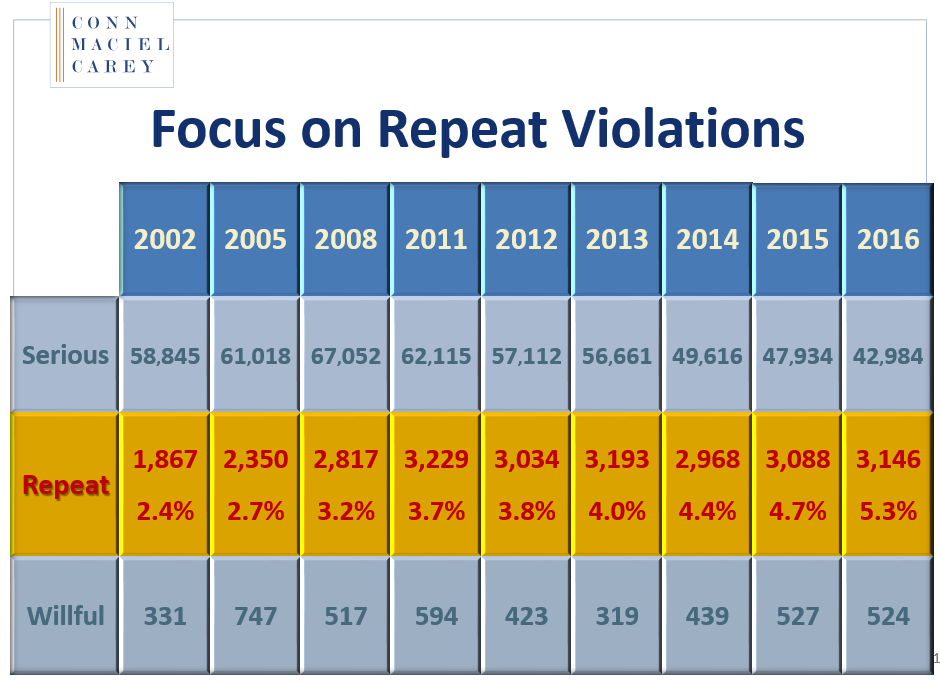
That trend continued even after Congress gave OSHA new penalty authority, increasing the max price tag for a Repeat violation from $70,000 per violation to approx. $130,000. As a result, we are seeing more $100K+ and $1M+ OSHA enforcement actions than ever before.
In light of OSHA’s Repeat violation philosophy, particularly in the context of the Second Circuit’s ruling in the Triumph case, employers need to be extra vigilant in defending against initial citations if the cited standard presents a risk of future Repeat violations, even if the initial penalty is very low. Paying the fine for a Serious or Other-than-Serious citation today may seem like no big deal if it carries a relatively small fine, but if can easily lead to a Repeat citation in three or four years (or eight years now that OSHA knows its look-back period is unlimited) could turn that initial violation into a costly burden.
Employers also need to understand the numerous other ways that Repeat violations can harm employers beyond just the 10x higher penalties. First, even under the Trump Administration, OSHA is continuing to issue inflammatory and embarrassing press releases about OSHA citations in significant cases, which includes most enforcement actions involving Repeat violations. So reputational harm can come to an employer just for being alleged to have committed a Repeat violation. Worse still is falling into the dreaded Severe Violator Enforcement Program (SVEP). The qualifying criteria for SVEP include Repeat and Willful violations in certain categories, but the data shows the vast majority of employers “sentenced” to SVEP are there because of Repeat violations.
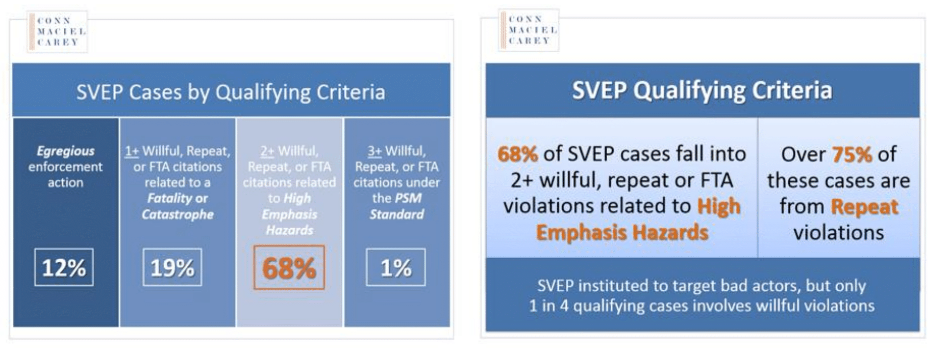
Even more reason to fight the initial violation, regardless how low that initial penalty may be.
Finally, a Repeat citation could increase insurance premiums and disqualify contractors and subcontractors from government and private contracts. There are potentially costly consequences for accepting a citation that has a high potential to become a Repeat citation. Therefore, employers should strongly consider contesting OSHA citations if a settlement cannot be reached that mitigates the risk of future Repeat violations.
Contesting a citation, however, is a post-hoc solution. The best way to avoid a Repeat citation is to understand the hazards most commonly found in your workplace, develop a program to regularly inspect for and correct them, and track your efforts to comply the applicable requirements.
In the hospitality industry, the most frequently cited OSHA standards include Hazard Communication, Electrical Safety, Wiring Methods and Components, Lockout/Tagout, Fire Extinguishers, Respiratory Protection, Walking/Working Surfaces, Bloodborne Pathogens, Protective Equipment, and Exit Routes.
OSHA Penalties
Below are the maximum penalty amounts adjusted for inflation as of Jan. 23, 2019. (See OSHA Memo, Jan 23, 2019).
| Type of Violation | Penalty |
| Serious Other-Than-Serious Posting Requirements | $13,260 per violation |
| Failure to Abate | $13,260 per day beyond the abatement date |
| Willful or Repeated | $132,598 per violation |
State Plan States
States that operate their own Occupational Safety and Health Plans are required to adopt maximum penalty levels that are at least as effective as Federal OSHA’s.
This article is part of our Conference Materials Library and has a PowerPoint counterpart that can be accessed in the Resource Libary.
HospitalityLawyer.com® provides numerous resources to all sponsors and attendees of The Hospitality Law Conference: Series 2.0 (Houston and Washington D.C.). If you have attended one of our conferences in the last 12 months you can access our Travel Risk Library, Conference Materials Library, ADA Risk Library, Electronic Journal, Rooms Chronicle and more, by creating an account. Our libraries are filled with white papers and presentations by industry leaders, hotel and restaurant experts, and hotel and restaurant lawyers. Click here to create an account or, if you already have an account, click here to login.
]]>Unfortunately, a significant number of employers are not aware of all the changes to the recordkeeping standard. Many employers think their OSHA recordkeeping logs and procedures are fully compliant, only to learn after an OSHA inspection and, in some cases, hundreds of thousands of dollars in penalties, that they were not. Under OSHA’s recordkeeping regulation, covered employers are required to prepare and maintain logs for serious occupational injuries and illnesses as well fatalities, using the OSHA 300 log.
With OSHA’s expanded view of recordkeeping, particularly applicable to the use of temporary employees, every employer who is inspected by OSHA can anticipate that the inspector will review all their 300 logs for the past five years as part of any inspection.
This webinar, presented by Edwin G. Foulke, Jr., co-chair of the Workplace Safety and Catastrophe Management Practice Group at Fisher & Phillips LLP and former Assistant Secretary of Labor for OSHA, will examine the many recordkeeping pitfalls that employers face, especially those dealing with temporary employees and multiple locations. The program will cover how to coordinate your injury and illness recordkeeping with other recordkeeping requirements and how employers can effectively use recordkeeping to improve their current safety and health management program. In addition, the webinar will examine in detail the changes made by the revised rule and, in particular, the increased employer reporting requirements for all employers.
Who should attend:
HR and safety professionals, plant managers, company attorney
What you will learn:
- What events are required to be reported directly to OSHA under the new rule
- What injuries and illnesses are recordable and why
- The scope of the first aid exemption
- How to coordinate injury and illness recordkeeping requirements, especially dealing with temporary employees
- How to use recordkeeping to improve current safety and health management program
- How to analyze each injury or illness to ensure they are properly recorded
January 26, 2016
1:30 pm – 2:30 pm Eastern
OSHA’s Recordkeeping Posting Required on February 1: Are You Ready? (60 minutes)
Cost: Free of charge
Click here to register.
**This webinar is eligible for SHRM and HRCI credits.
]]>The Federal Civil Penalties Inflation Adjustment Act amends a 1990 law to provide a “catch-up” adjustment that allows OSHA to raise penalties by the amount of inflation that has occurred since 1990. OSHA had previously been exempted from the inflation adjustment provision of the 1990 law, but can now raise the maximum penalty amounts for “Other than Serious,” “Serious,” “Repeat,” and “Willful” violations. For example, although the OSH Act provides for a maximum penalty of $7,000 for “Other than Serious” or “Serious” violations, under the new law, maximum penalties for these types of violations could be increased to about $12,744. For “Repeat” and “Willful” violations, the current maximum penalty of $70,000 could be increased to $125,438.
The new law does not require OSHA to increase the maximum penalty amounts by the authorized 82 percent, but simply allows OSHA to increase penalties by that amount. The law requires that these penalty changes be announced by the publication of an interim final rule by July 1, 2016, with the adjusted penalties going into effect by August 1, 2016. These changes will be made through new regulations, with opportunity for public comment.
At first. After the one-time “catch-up” to capture the amount of inflation that has occurred since 1990, OSHA can annually increase the maximum penalties for each type of violation consistent with the inflation rate for the prior fiscal year, as determined by the federal government’s Consumer Price Index.
Interested stakeholders in the safety community have uniformly acknowledged that OSHA penalties will be increasing as a result of the new law, with Congress explicitly directing OSHA to raise the penalties. Unless Congress repeals the law through legislation and the repeal survives a veto, higher OSHA penalties will shortly be a way of life.
No one is immune from OSHA citations. With this year’s new requirement to report to OSHA all admissions to a hospital, amputations, and loss of an eye within 24 hours, and with 37 percent of those reports resulting in on-site inspections, the stakes have clearly been raised. Although OSHA’s announced goal is to ensure that employers provide a safe workplace, citations are typically issued as a result of failing to comply with the provisions of OSHA Standards. As you all know, having a safe workplace does not necessarily mean that you have complied with all of the OSHA Standards that are applicable in your workplace. Enhanced enforcement as a result of the last seven years of the present OSHA Administration has become the norm, including “regulation by shaming” through press releases issued when high-penalty cases occur, and now the increased penalties about to go into effect. In this climate, we strongly encourage you to make sure that your safety programs and physical site conditions are fully compliant.
]]>