While New Jersey is the first state to enact such a law, which will go into effect in January 2020, it follows a growing trend in cities throughout the country – particularly in Chicago, Miami, Sacramento, and Seattle – that have seen the passage of ordinances requiring panic devices for certain hotel employees, among other protections. Other cities, such as Las Vegas and New York City, have seen the introduction of panic devices in the wake of union negotiations. The introduction of panic devices will likely go beyond major metropolitan areas, however, as executives at some of the largest hotels have reportedly revealed their plans to provide panic buttons to their employees across the country by 2020.
If you have operations in New Jersey, you need to immediately familiarize yourself with this new law and take compliance steps. And if you don’t have operations in the state or one of the other areas with such a law, you should still be aware of this trend, as it not only presents some concepts for best practices in a hotel setting, but may soon arrive in your own area.
Coverage And Scope
The New Jersey Panic Device Law defines hotel to include not just hotels, but also inns, boarding houses, motels, and other similar establishments that offer and accept payment in exchange for rooms, sleeping accommodations, or board and lodging and that retain rights of access and control over their premises. Regardless of the type of “hotel,” the establishment must also have at least 100 guest rooms in order to be subject to the Panic Device Law. If your business has fewer than 100 guest rooms, compliance with the Panic Device Law is unnecessary.
The Panic Device Law defines an employee as one who performs housekeeping and room service functions on a full or part-time basis at a hotel for, or under the direction of, a hotel employer or any subcontractor of the hotel employer. The law therefore covers and protects hotel employees, contractors, and subcontractors, sweeping them together under an expansive definition of an employee.
The definition of an employer is as broad or broader and includes any person, including corporate officers and executives, who directly, through an agent, or another person (e.g., a staffing agency) employs or exercises control over a hotel employee’s wages, hours, or working conditions. Awareness of and compliance with the Panic Device Law is thus essential by directors, managers, supervisors, and anyone else who may exercise sufficient control over hotel employees.
Provision And Use Of Panic Devices
Employers of covered hotels must provide employees that work in a guest room by themselves with a panic device. Employers are prohibited from charging employees for the panic device and must purchase and furnish them at their expense. The Panic Device Law defines a panic device as a two-way radio or other electronic device that can be used by the employee to call for immediate assistance from a security officer, manager, supervisor, or other appropriate person.
Employees are permitted to use their panic device whenever they believe there is ongoing crime, an immediate threat of assault or harassment, or some other emergency in their presence warranting the use of their panic device. Once used, employees may stop their work and leave the area for safety and assistance.
Employers’ Duties When A Panic Device Is Used
Employers are forbidden from taking adverse action against an employee for using a panic device. After a panic device is used, aside from promptly responding to the call, employers must also:
Note an accusation against a guest to for “violence” – which is broadly defined to include sexual assault, sexual harassment, and other inappropriate conduct – toward an employee and put the guest’s name on a list and retain it for five years from the date of the reported incident, along with details of the accusation.
Report any alleged crime by a guest or other person to law enforcement and cooperate in any investigation by law enforcement.
Reassign the employee who activated the panic device to a different work area away from the accused guest’s room for the duration of the accused guest’s stay.
Notify employees assigned to a guest room where a reported incident has occurred of the presence and location of the accused guest named on the hotel’s list and provide them with the option of servicing the accused guest’s room with a partner or declining to serve the accused guest’s room for the duration of the accused guest’s stay.
If an employer later learns that the accused guest is convicted of a crime as a result of the activation of a panic button, the employer may prohibit the guest from staying at the hotel.
Programs For Employees
Employers must develop and maintain programs to educate employees about the use of panic devices and their rights in the event they use their panic devices. The programs should also encourage employees to use their panic devices. Written information may supplement, but not substitute, training programs for employees.
Information For Guests
Covered hotels must also inform their guests about panic devices in one of two ways. They may either require guests to acknowledge a panic device policy as part of the terms and conditions of checking into a hotel, or they may prominently place a sign on the interior side of guest room doors, in large font, detailing their panic device policy and the rights of their employees.
Collective Bargaining Agreements
The Panic Device Law provides a carveout for collective bargaining agreements. If a collective bargaining agreement addresses the issuance of panic devices to hotel employees or addresses employee safety in guest rooms and the procedures for reporting questionable conduct, the collective bargaining agreement controls and hotel employers are not required to provide panic devices to employees.
Penalties For Noncompliance
Hotel employers who fail to provide panic devices or respond as required when a panic device is activated are subject to fines of $5,000 for the first violation and $10,000 for each subsequent violation. The fines are recoverable by the Commissioner of the New Jersey Department of Labor and Workforce Development.
Next Steps For Employers
Covered hotel employers in New Jersey that are not governed by a collective bargaining agreement should begin taking steps to comply with the Panic Device Law and watch for regulations promulgated by the Commissioner, particularly since the Panic Device Law grants the Commissioner with the authority to develop regulations to facilitate its implementation.
Covered hotel employers should budget for panic devices and obtain a sufficient number of them, develop employee training programs, and update your terms and conditions or create signs for guest rooms regarding their panic device policies. Covered hotel employers should likewise review their handbooks and other policies to ensure cohesion with the Panic Device Law.
Hotel employers outside of New Jersey and cities with similar ordinances should be on the lookout for the adoption of similar panic device measures in their localities—or for their inclusion in collective bargaining agreements, if they are not there already. The more widespread introduction of panic devices seems all the more probable in the #MeToo era.
]]>What Are Predictive Scheduling Laws?
Predictive scheduling laws are generally straightforward. In short, they require employers to post employee work schedules a set number of days in advance of when the work is to be performed. Once posted, however, employers are penalized for making any scheduling changes.
In theory, these laws seek to balance respective interests between employers and employees—a balance that was recently addressed in the landmark California decision, Ward v. Tilly’s. In that case, the court assumed the role of the employee’s champion and explained that schedule predictability was an absolute necessity that allowed employees to plan around second jobs, make child-care arrangements, coordinate school schedules, or commit to social plans, among other things. Glaringly absent from this analysis, however, was the employer’s perspective and concurrent recognition that scheduling changes and fluctuating staffing needs are often caused by unforeseeable market realities such as inclement weather, employee call-outs, and unposted community events.
In practice, unfortunately, legislators have expressed wide disagreement over how to address this problem, causing many jurisdictions to take wildly different approaches. For example, in New York City, certain employers are only required to post schedules 72 hours in advance, with changes thereafter being completely prohibited. In contrast, San Francisco requires employers to post schedules not less than two weeks in advance. Once posted, however, any changes require the employer to pay the affected employee anywhere between one and four hours of additional “Predictability Pay,” depending on how last-minute the change actually was. As these examples demonstrate, legislators have yet to agree on any centralized model for predictive scheduling laws, creating a potential minefield for those employers that attempt to apply consistent scheduling practices throughout multiple jurisdictions.
What Industries And Jurisdictions Have Been Most Affected?
Since the first predictive scheduling law arose in San Francisco several years ago, other states and major U.S. cities have contributed to a precipitous rise in these laws. Places like Oregon, New York City, Chicago, Seattle, and Philadelphia have all since participated in this rising regulatory experiment by respectively proposing and implementing their own unique frameworks.
Simultaneously, other states have actively sought to combat the rise of these practices. In the wake of San Francisco’s law, states like Georgia and Tennessee quickly implemented legislation that prohibited their own major cities from enacting similar predictive scheduling laws at the local level, seeking to stifle an already-emerging trend.
To date, however, the retail and hospitality industries have taken the brunt of the regulatory force, with the vast majority of predictive scheduling laws targeting these industries exclusively. As justification for this disparate treatment, legislators have pointed to the disproportionate number of low-wage workers present in these industries who they believe warrant greater protection. For these employees, securing a reliable schedule through traditional means, such as direct negotiation, is far less likely. Accordingly, in these industries, the employer-employee tension between scheduling flexibility and predictably is at its zenith.
So What Should You Do Now?
Unfortunately, compliance with predictive scheduling laws is far from easy. Larger employers with locations throughout multiple jurisdictions tend to be the most affected, although even smaller employers can find themselves in a position that requires a full overhaul of their current staffing model. Accordingly, it’s important to keep a few points in mind.
First, you should audit your locations. The piecemeal framework of predictive scheduling laws means that you may have multiple locations subject to different predictive scheduling requirements. As a result, a centralized staffing model can quickly become outdated, or even worse, a liability. Location-specific policy changes may need to be made, and managers may require retraining on how to handle staffing shortages.
Second, avoid the related pitfalls. No employment law exists in a vacuum, and predictive scheduling laws are no exception. Implementing predictive scheduling models will often impact other aspects of your business and, in some cases, could create unforeseen liability traps. For example, in San Francisco, forgetting to tell your payroll company to separately delineate the “Predictability Pay” scheduling change penalty on your employees’ wage statements could saddle you with a host of unexpected labor code violations and class action demand letters—all for a simple oversight.
Third, consider novel and creative approaches. To address the rise of these laws, some large companies have implemented the use of scheduling apps. In addition to viewing pre-posted schedules, employees can use the apps to swap shifts with coworkers or sign up for unfilled shifts in upcoming weeks. Although, even without apps, voluntary schedule swapping and sign-up policies are both phenomenal ways to reduce, and even eliminate, the need for last-minute scheduling changes—all while boosting employee morale.
Conclusion
Ultimately, when it comes to employment policies, there is rarely a “one size fits all” approach. What’s right for one company may not be right for another. As a result, it’s important to keep up to date on the newest changes in both law and compliance strategies. In the modern day, employment laws are changing at an ever-increasing pace; if the recent rise in predictive scheduling laws hasn’t hit your state or city just yet, it soon may.
For more information, contact the authors at CCook@fisherphillips.com (415.490.9032) or AGuzman@fisherphillips.com (415.490.9028).
]]>- in the last 10 years, Title VII filings involving harassment have increased by nearly 700%;
- nearly 50% of women report experiencing some form of harassment at work at least once;
- according to a recent NY Times poll, nearly 1/3 of men reported doing something at work within the past year that would qualify as objectionable behavior or harassment; and
- on October 15, 2017, Alyssa Milano tweeted a request to reply if you have been sexually harassed or assaulted, and she received over one million mentions – by the next day.
And one can hardly forget the steady stream of business executives, entertainment moguls, and political leaders scandalized their organizations with outrageous details of men behaving badly. So where have employers, and those who work with them to get it right, gone wrong? Why are the herculean efforts of HR departments calming the rising tide of harassing behavior?
The answer is that we are focusing too much on what not to do under the law (and what we have to do to have a potential defense to liability), rather than providing employees and their managers with tools on how to create positive work relationships and foster psychological safety in their work groups. To be sure, harassing behavior is more than the product of a bad employee; it is symptomatic of a toxic work environment. In such environs we often find:
- An obsession with making the numbers, where outcomes are uncritically adopted;
- Recruitment, promotion, and reward systems focus on individuals’ “strength of personality” or interpersonal aggressiveness while ignoring emotional intelligence;
- Short-term planning governs operations;
- Executives give higher priority to personal friendships than to legitimate business interests; and
- Fear is a dominant, desired workplace emotion, whether deliberately engineered or inadvertently created.
Although there can be much discussion on the cultural causes of sexual harassment, what is clear is that workplace harassment allowed to ferment is the source of serious liability to business. It can be a sales dropping, share price lowering, brand tarnishing business killer. The #Metoo movement is a paradigm shift and call for a new approach to tackle this problem.
The good news is that we have a number of innovators who are solving parts of the problem, and their work can be brought together to form a new training regime that works to prevent harassment. I commend to you Professors Christine Pearson and Christine Porath and their work, “How incivility is damaging your business and what to do about it.” Leonardo Inghilleri’s work on training empathic skills to hospitality employees, and of course Google’s Project Aristotle and its steps for developing effective teams.
So, what is working? Training that includes protocols which teach employees and more importantly managers on how to foster good working relationship in their workgroups. We recommend revamping sexual harassment avoidance training to include 6 protocols.
- Developing an employee “how can I help you” culture;
- Techniques to project empathy or at least the appearance;
- Routine steps to handling any employee concern;
- Managing the unexpected;
- Using the most respectful language possible with random acts of kindness; and
- Bystander training.
A prevention program built around these principles will help employers to do more than just comply with the law – it will reinforce the notion that everyone plays a critical role in preventing workplace harassment (or any other kind of misconduct for that matter) and creating a successful workplace culture. It will also empower employees with the tools to step in and stop it. These, in turn, will help employers to achieve their business goals – from decreasing harassment occurrences to improving performance and morale. It is hard to argue against such benefits. It is clear, change is rapidly occurring and this next generation workforce is not silent.
]]>Yes, indeed—the labor market is tight. And with the nationwide unemployment rate below 4 percent, 263,000 new jobs created in April 2019, and a sizzling economy, the labor market is likely to get even tighter. This is especially true for the hospitality industry, which has traditionally relied upon a steady stream of lower-skilled and younger applicants eager to enter into the job market. In fact, the National Restaurant Association predicts that jobs in the food service industry will top 15 million in 2019, and lists recruiting and retaining employees among the top challenges for operators.
Yet, just 19 percent of 15- to 17-year-olds had jobs in 2018, and 58 percent of 18- to 21-year-olds had jobs, according to a Pew Research Center study published in November 2018. This is significantly down from years past. The cause of this trend is difficult to predict. Whether parents are not pushing their kids to enter the workforce, or there are too many other extracurricular activities to occupy their time, one thing is certain: younger workers are not as eager to pick up a part-time job, even at the local eatery that is begging for help.
Legal Roadblocks Also Complicate Hiring
Federal and state laws can also deter hiring anyone who is under 18 years of age. Under the federal Fair Labor Standards Act (FLSA), there are regulations that preclude employees who are 16 and 17 from performing certain job duties, such as operating power-driven machines like mixers and meat processors, and delivering food via automobile. Another layer of federal regulations applies to 14 and 15-year-olds, which significantly restricts the number of hours that can be worked during a day and workweek, particularly during the school year. If you are skeptical, check out “Fact Sheet #2A: Child Labor Rules for Employing Youth in Restaurants and Quick Service Establishments Under the Fair Labor Standards Act (FLSA)” on the U.S. Department of Labor’s website.
State laws also serve as a bugaboo to employing minors, and these laws can vary greatly from state to state. One example is in Louisiana, where additional rules and regulations for employing require that all minors (defined as under 18 years of age) to have a 30-minute uninterrupted work break within every five hours of employment. A failure to comply with this requirement will subject the employer to a significant fine.
Time To Get Creative
So, what can Mr. Joe at Big Eats do to increase applicant flow and hire more employees at his stores? We told Mr. Joe that one idea is to increase his starting wage and increase benefits, which he did not want to hear. The fact is, however, many competitors for this part of the workforce (such as big-box retailers) have increased their starting wages well above minimum wage in order to attract applicants.
A quick Google search offers other examples of how employers are creatively trying to solve this workforce problem. From utilizing mobile apps that allow employees to swap shifts at the last minute when conflicts arise, to allowing employees to express their opinions on branding of the products being sold, to handing out recruiting cards to customers who visit the establishment, to offering bonuses to employees who recruit other employees to join the company, to teaming up with AARP to recruit and hire older workers—it is clear that creative thinking gives employers a distinct advantage.
Need another example? Look no further than the Louisiana Restaurant Association’s Education Foundation (LRAEF), which is tackling the workforce issue head on. The LRAEF is a major supporter of the nationwide ProStart program, a two-year program for high school students teaching culinary techniques and management skills that are specifically tailored to the food service industry. Today, there are 56 Louisiana high schools and almost 2,000 Louisiana high school juniors and seniors participating in the program.
According to Wendy Waren, the Vice President of Communications for the LRA, “The LRAEF provides school support grants to purchase ingredients for labs, testing materials, and for field trips. The high school students also participate in the Raising Cane’s ProStart Invitational, held yearly at the New Orleans Convention Center, and that event provides the students with a chance to show their skills and compete for $1.2 million in scholarships. ProStart is a comprehensive program and it is a great way to get our young people interested in the food service industry. We hope they will discover that there are exciting and fulfilling career opportunities in the industry. While employing teens may present challenges, hiring ProStart students will make the challenge worth it given their advanced training.”
Conclusion
So, our advice to Mr. Joe at Big Eats? In addition to suggesting that he may want to look at raising his starting wage and offering additional benefits, he will have to get creative in his search for more applicants and good employees.
Yes, the labor market is tight. But, by partnering with a local restaurant association, using technology and social media, and just generally letting the creative juices flow, even Mr. Joe will be able to find and retain the elusive employees that he so desperately needs.
For more information, contact the authors:
Steven Cupp – Partner, Gulfport office | New Orleans office
SCupp@fisherphillips.com
(228.822.1440)
Steve Cupp is a partner in the firm’s Gulfport office. He has experience across a range of industries, including manufacturing, financial services, construction, and retail.
He has devoted his practice to representing management interests in various areas of labor and employment law, including traditional labor litigation before the National Labor Relations Board (NLRB), handling Department of Labor (DOL) wage and hour audits, and litigation of Fair Labor Standards Act (FLSA) cases.
Steve is certified as a Senior Professional in Human Resources from the Human Resource Certification Institute and he is an active member of the Society for Human Resource Management.
Jaklyn Wrigley – Of Counsel Gulfport Office
JWrigley@fisherphillips.com
(228.822.1440).
Jaklyn Wrigley is a high-energy labor and employment law litigator who exclusively represents the interests of management. Over the years, she has achieved countless employer-friendly results, recently in the form of a full defense verdict in a complicated he-said/she-said sexual harassment lawsuit. Jaklyn is committed to providing the highest level of service, and in this “24/7” client service business, she recognizes that near-fanatical responsiveness is often as critical as innovative and quality legal representation. She prides herself in offering both. These efforts have been recognized, and Jaklyn has been selected for inclusion in Mississippi Super Lawyers – Rising Starsevery year since 2013.
Practicing in both Mississippi and Florida state and federal courts, as well as before administrative agencies, Jaklyn has extensive experience with the alphabet soup of federal labor and employment laws: ADA, ADEA, FLSA, FMLA, NLRA OSH Act, and Title VII; and litigation involving immigration issues, wrongful termination, and breached employment agreements. In her practice, Jaklyn applies a laser focus on the healthcare industry, and understands the interplay between and among healthcare compliance issues, the medical staff, and employment law. She also actively represents clients in the retail, gaming and hospitality, agriculture, and auto dealer industries (among others). Jaklyn has made a point to learn the business environments in which her clients operate so that she can offer advice that is specifically tailored to their needs.
When she is not litigating on behalf of her clients, Jaklyn is working diligently to help her clients avoid legal problems. This is particularly true as it concerns sexual harassment, gender identity, sexual orientation and gender equity issues in the workplace. From internal audits, management training and employee contracts, to handbook reviews and practical day-to-day advices, Jaklyn believes the easiest problem to solve is one that never arises in the first place.
]]>But not every article of clothing constitutes a “uniform” under the FLSA. The U.S. Department of Labor (USDOL) has long maintained that certain clothing, although required by the employer, is of such a character that it may be reasonably worn outside the context of work and therefore is not a uniform. Shoes are an interesting case-study.
Does The Shoe Fit?
Many hospitality employers often require employees, such as culinary department workers, to wear a certain type of shoe during work hours. Perhaps the most popular variety is the dark-colored, non-slip shoe—widely used both for their appearance and for safety reasons.
Some employers may be surprised to learn that the USDOL takes the position that these shoes do not constitute a uniform under the FLSA. As a result, employers can impose the cost of such shoes even if the cost results in the employee receiving less than the minimum wage after such deduction.
Before The Other Shoe Drops…
A word of caution before hospitality employers rush out to take advantage of this cost transfer. Experience in USDOL investigations teaches us that the agency does not give employers complete freedom regarding shoe deductions, even when it comes to dark-colored, non-slip shoes. For example, if you require employees to order a specific brand of shoe from a certain vendor when a comparable, less-expensive alternative is available, the USDOL may conclude that the shoe is no longer “basic street clothing.” The agency may reach the same conclusion if the employee already owns a pair of shoes but is told that they must order a new pair. Finally, the USDOL will be on the lookout for any ordering mechanism whereby the employer receives a fee or profit anytime an employee orders shoes through a designated vendor.
Many hospitality employers are familiar with Shoes for Crews, a manufacturer of non-slip shoes and other accessories. Shoes for Crews offers a corporate program to businesses which includes a “warranty” in the form of a $5,000 payment if an employee wearing Shoes for Crews slips at work. The USDOL finds this warranty problematic. The agency has been known to take the position in investigations that this warranty constitutes a benefit to the employer that changes the legal characteristic of the shoe such that it becomes a uniform. Thus, according to USDOL, an employer participating in this Shoes for Crews corporate program may not impose the cost of the shoe on an employee if doing so cuts into the minimum wage or overtime wages. The agency has taken this position even when an employer has never asserted a claim for the Shoes for Crews warranty payment.
Conclusion: Putting Yourself In Your Employees’ Shoes
The cost of purchasing (or cleaning) a uniform can be problematic for employers, when the cost (or part of the cost) is borne by the employee. Setting aside whether there is a legal basis for the USDOL’s position on the shoe warranty program, hospitality employers should carefully review their policies as they relate to the cost of required clothing worn by employees.
For non-slip shoes, if you have decided to pass on the cost of these shoes to employees, consider giving the employee the option of purchasing shoes at a retailer of their choice or wearing already-owned shoes which are compliant with safety requirements. This is particularly true for employers that participate in the Shoes for Crews corporate program.
For more information, contact the authors:
Andria Ryan – Partner, Atlanta office
ALureryan@fisherphillips.com
(404.240.4219)
Ted Boehm – Partner, Atlanta office
TBoehm@fisherphillips.com
(404.240.4286)
In order to dispel the confusion under federal law, let’s examine a hypothetical scenario. Imagine that Acme Apartments, a business that leases apartments, has a no-pet rule for its tenants and an office policy prohibiting pets in the workplace. Acme also operates a fitness center for tenants and the general public with a no-animal policy. In this situation, Acme will need to follow the Fair Housing Act (FHA), Title I of the American Disabilities Act (ADA), and Title III of the ADA. How each of these laws apply to Acme—and your business—is described below.
Assistance Animals And The FHA
Acme’s pet restrictions are generally lawful. However, under the FHA, Acme must allow tenants and applicants with a disability to live with assistance animals that meet their disability-related needs. The only exception to this requirement is if the assistance animal would pose a direct threat to others or would cause substantial physical damage to property.
What constitutes an assistance animal is interpreted broadly. It could be a dog or any other animal that “works, provides assistance, or performs tasks for the benefit of a person with a disability, or provides emotional support that alleviates one or more identified symptoms or effects of a person’s disability.” Assistance animals will typically perform functions like providing protection or rescue assistance, fetching items, alerting persons to impending seizures, or providing emotional support to persons with disabilities who have a disability-related need for such support. In this context, assistance animals are sometimes referred to as “service animals,” “assistive animals,” “support animals,” or “therapy animals.” However, the preferred term is assistance animals to avoid confusion with other laws.
Service Animals And Public Accommodations Under The ADA
The legal requirements differ depending on whether you are considering accommodations in public places or in the workplace.
In Public Places
Title III of the ADA requires businesses that provide goods or services to the public to allow service animals to accompany people with disabilities in all areas of its facility in which the public is normally allowed access. Going back to Acme, this means that it must accommodate service animals in its leasing office and fitness center for visitors and patrons with a disability.
However, under Title III, service animals are limited to only individually trained dogs and, with some exceptions, miniature horses. Most often, service animals perform functions like guiding the blind, alerting the deaf, pulling wheelchairs, providing seizure alerts, or calming a person during an anxiety attack. Service animals do not include untrained comfort animals, which are generally animals that provide psychological comfort by their existence. In other words, no rabbit, bird, cat, monkey, or untrained dog can qualify as a service animal under the ADA in this context.
So how would Acme know if a dog or miniature horse is a service animal? Under the ADA, Acme is allowed to ask whether the animal is a service animal and what tasks the animal has been trained to perform, but nothing more. Acme cannot require proof of disability, certification, or make any other inquiry.
However, if the owner cannot maintain control of the service animal, or if the service animal proves dangerous or disruptive by its conduct, then Acme can expel it from the premises. Because of this limited inquiry, and the fact that many pet owners are apparently now attempting to pass their pets off as service animals, a growing number of states are making it a crime to misrepresent a pet as a service animal or misrepresent oneself as a person with a disability to gain access with a dog. Arizona, California, Minnesota, New Jersey, and Texas now have criminal penalties including jail time for such misrepresentations, with more states looking to follow.
In The Workplace
What about employees who request to bring animals into the workplace? Assume that one of Acme’s employees says that she has an anxiety disorder and would like to bring her pet rabbit to work. She explains that it helps mitigate the disorder and allows her to perform her duties. Must Acme allow the rabbit in the workplace? To answer this question, employers must turn to Title I of the ADA.
Title I of the ADA requires that Acme, when asked, provide reasonable accommodations to qualified employees with a disability in order to allow the employee to perform the essential functions of the job. Acme is obligated to provide reasonable accommodations unless it would create an undue hardship.
When such requests are made, the employer should engage in an interactive discussion with the employee to learn about the employee’s disability, how it is impacts the employee’s major life functions, and how it may be impeding getting the employee’s job duties done. In this process, it is important to highlight that employers must only provide a reasonable accommodation, and not the preferred accommodation requested by the employee if effective alternatives exist. In other words, if the employer can provide an alternative to the accommodation requested that is effective in allowing the employee to perform the job functions and is more in line with the needs of the employer, then the employer can provide that alternative and meet its ADA obligations.
As a practical matter, after engaging in the interactive process, most employers will discover that there are likely reasonable alternatives to permitting comfort animals in the workplace—but few to none regarding service dogs. In the rare case of a comfort animal request, some employers have offered less disruptive alternatives such as the use of a pet monitor at work or the use of a stuffed animal likeness. To date, there are no known cases in which a court has found an employer in violation of the ADA for denying the work presence of an untrained comfort animal where an alternative has been offered.
In contrast, a trained service dog accompanying an employee to their job has long been viewed as a “reasonable accommodation” under Title I of the ADA, even though not specifically listed as part of that section. There are a number of cases in which employers have been found to have violated the law by not permitting service dogs in job interviews or at work. In fact, the EEOC is currently pursuing a federal lawsuit against a trucking company for violating the ADA by not allowing a military veteran truck driver to complete his training with a trained service dog who provides “emotional support” and mitigates his post-traumatic stress and mood disorder.
However, employers may still deny these animals in the workplace if the employer can show the rare circumstance that it would create an undue hardship to operation of the employer’s business. Under the ADA, undue hardship is defined as an “action requiring significant difficulty or expense” when considered in light of a number of factors. Examples of undue hardship in this context may include safety issues caused by the presence of the dog, the presence of other employees with dog allergies, or coworker phobias. Claiming undue hardship is a very narrow exception under the law and businesses who wish to use it should seek advice from legal counsel.
Conclusion
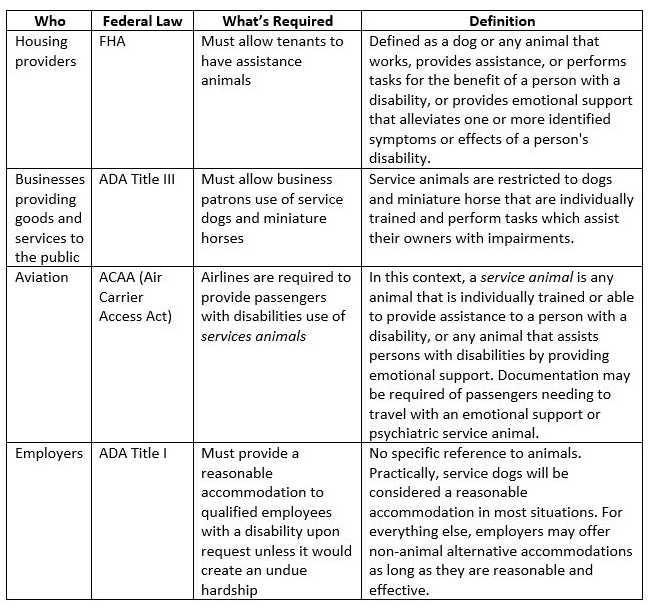
As with any regulated area, businesses subjected to the above laws should seek the assistance of counsel when drafting policies and developing staff training materials. Based on the multiple laws and definitions regarding assistive and service animals, it is no wonder that businesses, employers, and the general public are often confused about their rights and obligations. To help clarify, below is a chart that may help provide some order:
Keeping the workplace safe from violent incidents requires hospitality employers to be able to identify warning signs and risk factors. But the work starts before that; it starts with the hiring and employee monitoring processes.
Before And After You Hire: Internal Threats Of Violence
Internal threats of workplace violence require separate considerations from external threats. Preventing internal threats of violence generally requires a focus on pre-employment screening, employee monitoring, and effective employee training. Hospitality managers can think about this as occurring in two phases: before the hire and after the hire.
Before You Hire
An important time to begin taking measures to prevent and minimize workplace violence is during the hiring process. Effective pre-employment screening can help you avoid hiring employees with “red-flag” behavior. Some steps that hospitality employers can take to avoid future instances of workplace violence include:
- Criminal history and background checks. You are permitted to conduct criminal history and background checks for job applicants. While federal law prohibits the use of this information in ways that would discriminate against or disparately affect protected classes (e.g., race and national origin), you can use previous convictions, and sometimes arrests, as a screening tool, on a case-by-case basis, where such convictions may relate to an essential job requirement. With the level of daily customer contact present in the hospitality industry, properly conducted criminal history screenings, particularly where there is a history of violent crime, can work to prevent future incidents of workplace violence. Note, however, that state and local laws often govern the use of background checks by employers, so you should consult with legal counsel on best practices for implementing this screening tool.
- Social media. There are currently no federal laws that prevent you from monitoring the social media activity of prospective and current employees. Despite valid privacy concerns and the potential for bias, the social media accounts of both potential and current employees can provide a wealth of information for employers. In the hospitality industry, a large majority of the employees are millennials who are often more comfortable portraying their true thoughts through a computer screen. Through these sites, you may possibly learn of the potential violent predispositions that job applicants may have. A job applicant’s social media presence can demonstrate to you whether warning signs like fascination with violence, for instance, are present. This applies equally to current employees.
It is important to note, however, that the use of social medial as a pre-employment screening tool or a monitoring device for current workers comes with a number of potential pitfalls that you must work diligently to avoid. A potential employee’s social media can also alert employers to information such as the employee’s race, religion, gender, disability, sexual orientation, pregnancy status, etc., none of which can be taken account in the decision to hire an applicant. Moreover, a current employee’s social media feed might reveal private information you might not want to know for fear that your knowledge could be used against you in a later discrimination or retaliation claim. Therefore, you should consult with legal counsel before deciding to implement any sort of social media screening.
After You Hire
Because warning signs of future workplace violence are not always apparent before you hire, you must still take steps to monitor their current employees for potential signs. In the stressful environment of the hospitality industry, it does not take much for a simple disagreement between line cooks in the kitchen to turn into knives being pulled against a coworker. A few tips for employers:
- You should implement and maintain an effective workplace violence plan. This plan will contain outright bans on certain “trigger” behavior such as harassment, fighting, threatening, and bullying—and outline the discipline for such behavior. The plan may also contain a ban on employees carrying weapons on your premises as well. The plan should provide conflict resolution tips and strategies for employees to use to deescalate a stressful situation.
- You should train employees on how to identify and report “suspicious behavior,” some of which can include a fascination with violence, excessive verbal threats to other employees or against restaurant patrons, substance or alcohol abuse, obvious indicators of mental instability, or a history of poor impulse control or violence. In training employees on how to identify and report suspicious behavior, you should also have an effective procedure for handling employees that have been reported:
- First, management needs to take all threats seriously;
- Where the reports are of internal conflicts, harassment, or bullying, you need to work quickly to understand the root of the conflict and diffuse it; and
- You should discipline as appropriate in order to clearly demonstrate that any such violent behavior will not be tolerated.
- Employee training should also include training on conflict resolution between other employees in the workplace. Effective conflict resolution training is necessary to aid employees in immediately deescalating situations that may arise in the workplace. Importantly, these skills can also be used when dealing with the public. In training employees on how to effectively manage conflict and deescalate potential acts of violence, you should adopt the following training guidelines:
- Where tempers are running high, it is best to separate the employees and give them space to calm down;
- It is important to understand what the nature of the conflict is;
- Extreme care should be taken not to pass blame or take sides; and
- Management should be informed about the situation as soon as practicable.
The high rate of turnover in the hospitality industry presents an added layer of responsibility as it relates to dealing with internal threats of violence, because you must ensure that your new employees are constantly being trained. As such, you should consider implementing both a new-hire training schedule, as well as periodic refresher trainings.
When It Is Out Of Your Control: External Threats Of Violence
Because hospitality employers welcome the public, monitoring external threats of violence is extremely important. It only takes one angry customer or even a random criminal act to result in serious incidents of workplace violence. Some best practice tips:
- Just like you have a fire evacuation plan, you should also have plans for other emergencies like active shooters, robberies, or other violent workplace incidents. For instance, your staff should know where to go, who is responsible for contacting emergency services, and where the emergency equipment (e.g., first aid kits) are located. A comprehensive workplace plan is a useful tool in making such designations. Ideally, a workplace plan should contain a procedure for employees to follow in the event of an incident of violence and should identify a designated manager or other responsible employee who will coordinate evacuation or other employee safety efforts, and initiate or maintain contact with law enforcement.
- Many hospitality businesses operate at late hours, so it is important to structure employee shifts in order to avoid employees closing alone or working in isolated areas late into the night.
- As with internal threats of violence, it is also important to train employees on effective conflict resolution and deescalating incidents between employees and the patrons, or among patrons. While factors such as whether alcohol is served or not may play a role in how extensively employees should be trained, it is advisable to have at least some level of conflict resolution training.
- Hospitality operations, like other cash-heavy businesses, are also targets for robbers. You need to keep this in mind and train your employees to be cognizant of how they handle cash in front of customers and other members of the public. Employees also need to be trained on who to contact in case of criminal attacks, and how to behave during attempted robberies in order to deescalate the situation.
- Where financially practicable, you should consider investing in onsite, visible security. This could include visible security cameras but can go as far as security guards. Having such visible security can serve as a major deterrent for both internal and external acts of workplace violence. Even where it is not financially practicable to make such security investments, you should still consider having this kind of visible security on special occasions where the risk of violence may be heightened—e.g., Super Bowl Sunday, St. Patrick’s Day, New Year’s Eve, etc.
Conclusion
It is important to note that some instances of workplace violence cannot be reasonably foreseen or prevented, mostly due to the unpredictability of human nature. While careful background screenings, social media review, and even putting in place effective policies and procedures for times of violent incidents will go a long way to minimize the occurrence and impact of these incidents, they cannot prevent against some of the recent incidents of workplace violence covered by the media. Regardless, you have steps you can take to prevent and minimize the impact of incidents that may be within your control.
Because several legal issues may arise with an employer’s decision to both implement effective pre-employment screening tools and construct workplace violence plans, you should consult with legal counsel as you develop these procedures. If you need assistance with how to implement best practices to combat workplace violence, contact your Fisher Phillips attorney.
For more information, contact the author at CEnekwa@fisherphillips.com or 404.231.1400.
About Fisher Phillips
Employers often must take a stand: in court, with employees and unions, or with competitors. Fisher Phillips has the experience and resolve to back up management. That’s why some of the savviest employers come to the firm to handle their toughest labor and employment cases.Whether it’s a class action involving thousands of potential class members, a jury trial with exposure in the millions, or a union organizing effort or strike that could cripple a company, employers with their choice of employment lawyers choose Fisher Phillips to handle their most difficult and dangerous cases.
Is an employer liable to an employee who gets injured or injures someone else while using an electric scooter for business purposes?
Aside From Angry Pedestrians, What Could Go Wrong?
According to a recent article in The Washington Post, emergency room physicians in seven cities reported an increase in severe accidents after the devices launched to broad acclaim across the country earlier this year. Denver physicians also reported to The Denver Post that they are seeing increased visits.
Confusion may be part of the problem. As The Denver Post story suggests, the laws for operating e-scooters are not well known. They also vary from location to location. In Denver, for example, e-scooters are classified as “toy vehicles” and are not allowed in bike lanes or in general traffic. In California, e-scooters may not be ridden on sidewalks and must be ridden on the street or in bike lanes.
Some critics question the safety of the devices themselves, saying some fleets are poorly maintained by “a loose-knit flock of amateur mechanics.” Compounding the problem, e-scooters are left outside in all kinds of weather and are vulnerable to abuse by the public.
Moreover, the newness of the devices means operator error is likely. Education is up to the scooter provider and varies from company to company. Some scooter companies provide basic safety information on labels on the scooters themselves. Others provide information on their apps. Review of the app and agreement to certain safety conditions may be required before operating an e-scooter.
Despite these challenges, e-scooters may be around a while. Companies like Uber and Lyft are investing significant sums in this new form of transit. Many people are excited by this option for sustainable and economical car-free commuting. Companies like Google are providing e-scooters to their employees for business use. It is inevitable that employees in cities with the devices will use them on the job.
Legal Risks
Generally, workers’ compensation insurance doesn’t cover injuries sustained by an employee while commuting to a fixed place of employment, but can cover injuries that occur while traveling on work-related business (travel in the course and scope of employment). When employees travel between offices, to and from meetings, or run errands for their employer, it doesn’t matter if they are in a car, on an e-scooter or on foot.
Employers can also be held vicariously liable for accidents and injuries their employees cause others while traveling in the scope of their job. Injured persons may have limited recourse against the e-scooter companies — user agreements limit users to binding arbitration and/or disclaim liability – which may lead some injured persons to look elsewhere for relief.
Is Scooting While Intoxicated A Thing?
As a result of the risks, some employers have already taken steps to protect employees from injuries related to the use of e-scooters, e-bikes and bike-share systems. One approach is to adopt a policy that prohibits e-scooters and bicycles (propelled or otherwise) for business use and clearly states they are barred during working hours. Those who wish to allow their use may find that their existing vehicle-use policies can be extended to the use of such devices.
Provisions to borrow from vehicle use policies may include statements that:
- Employees must know and abide by all applicable laws and regulations;
- Employees are responsible for all citations received;
- Headphones, earphones, and cell phones may not be used during operation;
- Only devices with the required, functioning safety devices (lights, reflectors) may be used on company business;
- Users must have a valid driver’s license;
- Passengers are not allowed; and
- Users are responsible for being in control of the device at all times so as not to endanger the safety of themselves or others
Employers with large campuses may want to identify where such devices may and may not be used and parked.
In instances where local government codes fail to address safety issues (e.g. helmet use, speed limits), employers may address these issues in their policies. For example, a policy might state that the speed of devices shall be limited to a prudent rate for the conditions. A policy could require that helmets—either the employees’ own or helmets provided by the company—must be worn and must meet appropriate safety standards. A general prohibition against participating in any activity that reasonably presents a risk of injury to persons or damage to property while using a device may cover stunts, intoxication and a lot of other ground.
Any policy should be sure to distinguish the proper use of medical devices and devices used by persons with disabilities.
It won’t be long before other new transportation technology is on the scene, including self-driving cars. Employers need to be aware of what technologies their employees are using for business and set reasonable terms for use.
About Fisher Phillips
Employers often must take a stand: in court, with employees and unions, or with competitors. Fisher Phillips has the experience and resolve to back up management. That’s why some of the savviest employers come to the firm to handle their toughest labor and employment cases.Whether it’s a class action involving thousands of potential class members, a jury trial with exposure in the millions, or a union organizing effort or strike that could cripple a company, employers with their choice of employment lawyers choose Fisher Phillips to handle their most difficult and dangerous cases.
(Sesame) Seeds Of Dissension: Fast-Food Employees Want To Wear Their Buttons
After the Burgerville employees refused to remove the buttons, they were sent packing for the day. In a statement responding to the incident, the company cited to its verbal, unwritten policy against “personal buttons,” and subsequently instated a written dress code, banning the politically charged buttons and reiterating its need to protect its public image.
In response to the button incident, the “Burgerville Workers Union” (BVWU)—the first federally recognized fast food union in the United States, and an active one at that—geared up for battle, indicating that it would pursue legal options. Despite the company rescinding the policy the very next day and paying backpay to those employees who were sent home, the union solicited customers to boycott the chain and encouraged its workers to go on strike, picketing three of Burgerville’s locations—which incidentally occurred on National Cheeseburger Day, September 18.
Pinning Down What “Special Circumstances” Justify A Button Ban
Burgerville’s button issue is not the first time that burger-chain employers have faced politically motivated buttons at work. In April 2015, In-N-Out employees in Austin, Texas sported “Fight for Fifteen” buttons on their uniforms, in solidarity with the push for a $15 minimum wage. There, like Burgerville, the employer asked employees to remove the buttons, as they violated In-N-Out’s policy against non-company related pins, buttons, and stickers.
In-N-Out’s button-as-political-protest issue had so much traction that, in May 2017, the National Labor Relations Board (NLRB) weighed in on the issue.
When the agency analyzed In-N-Out’s policy, it rejected the “special circumstances” which authorizes companies to ban union apparel and insignia in order to maintain restaurant consistent image. The NLRB was unconvinced, ruling that any uniform policy forbidding employees from wearing buttons, pins, or stickers on one’s uniform violated Section 8(a)(1) of the National Labor Relations Act (NLRA), which makes it an “unlawful labor practice” to interfere with employees’ exercise of their Section 7 rights (to unionize or collectively bargain) under the NLRA.
The issue of whether an employer can regulate politically charged apparel and insignia has been festering for years, in and out of the fast-food arena, and a sampling of several recent cases reveals that the issue remains a challenge for employers to resolve:
- Pacific Bell employees were allowed to wear union insignia and buttons that read “WTF Where’s The Fairness,” “Cut the Crap! Not My Healthcare,” because the employer had not demonstrated any justifiable prohibition on the insignia, in spite of their vulgar content.
- However, employees at the W Hotel in San Diego were not allowed to wear buttons that read “Justice NOW! JUSTICIA AHORA! H.E.R.E. LOCAL 30,” as the hotel demonstrated special circumstances that the buttons would not jibe with its “trendy, chic, and alternative” hotel experience.
- Daily Grill employees could not be prohibited from wearing union buttons, as Daily Grill presented no evidence that the small buttons and pins would impede its restaurant’s “ambience” of traditional and classic style.
- Starbucks was able to limit its employees to one union button after successfully arguing that multiple buttons would be disruptive to its image.
What Can Employers Do?
In determining how you should respond should this issue arise in your workplace, the first thing to know is that, regardless of whether an employer is unionized or not, the NLRA applies to almost all private employers. And given the current divisive political climate, displays of political speech in the workplace are not uncommon and could make an appearance at your worksites. So it’s more important than ever for you to understand the rules governing these kinds of situations.
The NLRB has articulated three limited circumstances under which employers may place limits and prohibitions on the clothing choices of their employees while at work. These circumstances are:
- when its display may jeopardize employee safety or damage machinery or products;
- when its display might exacerbate employee dissension; or
- where it unreasonably interferes with a public image which the employer has established as part of its business plan, through nondiscriminatory appearance rules for its employees.
The burden is on the employer to show the special circumstances exist, and that the prohibitions are narrowly tailored to the circumstances at issue. As the aforementioned cases make clear, this is a highly fact-intensive inquiry, and employers must set forth evidence in support of its “special circumstances.”
While you can still regulate what goes on in your workplace, the policies you enforce cannot run afoul of Section 7 of the NLRA. Therefore, best practices would include having a uniformly enforced, well-documented dress code or other policy that articulates your image or particular safety concerns, if relevant. Given the presumption of at-will employment in most states, you can terminate your at-will employees for any lawful reason.
You should be mindful that, while political affiliation is not a federally protected class, states like California provide protections for employees against discrimination based on political activity and affiliation. If an employee is wearing a button, it is also critical that you avoid a harsh rebuke, whether suspending employees, sending them home, or terminating them, as such an overreaction could be evidence of illegal bias. If buttons are unavoidable, it may also be helpful to cap insignia at one pin/button a person, a la Starbucks.
Wrapping Up
While it remains to be seen what will become of the Burgerville button incident, you would be best served to approach any type of insignia with a cautious, pragmatic attitude, and to consult with your labor attorney before proceeding with a new policy or response to a button in the workplace.
For more information, contact the authors:
Setareh Ebrahimian | SEbrahimian@fisherphillips.com (703.682.7096)
Setareh Ebrahimian is an associate in the firm’s Washington D.C. office. She represents employers in a wide range of employment matters in state and federal courts. Setareh defends employers facing claims of race, gender, national origin, age, religion, pregnancy and disability discrimination, harassment and retaliation, purported violations of leave, wage and hour laws, enforcement of non-competes, as well as claims arising under local and state law. She also represents companies facing investigations by the Equal Employment Opportunity Commission and related local and state agencies.
In addition to litigating, Setareh advises and counsels employers on matters involving personnel policies, hiring, training, employee handbooks, discipline, termination, reasonable accommodations, protected leave, reductions in force, employee complaints and internal investigations, as well as regulatory compliance.
Danielle Krauthamer | DKrauthamer@fisherphillips.com (213.330.4472)
Danielle Krauthamer is an associate in the Los Angeles office. In her practice, Danielle advises companies of all sizes in an array of labor and employment matters, including claims of wage and hour violations, retaliation, wrongful termination, and discrimination.
Prior to joining Fisher Phillips, Danielle gained valuable experience as a judicial law clerk for the Honorable Ronald S.W. Lew at the United States District Court for the Central District of California, managing the judge’s docket in one of the busiest districts in the nation. While there, she had significant exposure to civil litigation cases across a wide range of subject matter.
]]>This article will focus on four risks that this season may bring: how to properly compensate your workers during weather-related absences, the dangers of this year’s flu season, how to limit risks associated with cold-weather exposure, and making sure your company holiday party doesn’t lead to a lawsuit.
You Know Nothing (About) Snow: Paying Employees During Snowstorms
First and foremost, you should plan ahead and develop policies addressing inclement weather, including how employees can find out if the business is open, how their schedule may be changed, what they should do if they are unable to make it to work or continue working due to the weather, and any reporting time rules for compensation that may apply under state law. If you already have such policies on the books, now is the time to review them to make sure they are up-to-date, compliant with applicable wage and hour laws, and reflect the current company philosophy on these issues.
The Legal Standards Involved
In addition to dealing with scheduling and commuting or travel time issues, you must also ensure that employees are paid properly. Your company must comply with the federal Fair Labor Standards Act (FLSA) and any associated state or local wage and hour laws.
Employees are treated differently under the FLSA depending on whether they are classified as non-exempt or exempt. Non-exempt employees are those who are entitled to overtime pay. Exempt employees are those who are paid on a salaried basis and also meet specific legal requirements so as to be exempt from the overtime pay requirements. In addition, conditional exemptions from overtime may be available for eligible outside or inside salespersons provided all requirements are satisfied under local, state, and federal laws.
Pay Non-Exempt Employees For Time Spent Working
Compliance with the FLSA for non-exempt employees is fairly straightforward: you only have to pay non-exempt employees for hours they work. Absent some contractual obligation (such as an individual employment agreement or a union contract) or obligations arising under public policy (e.g., reporting time regulations), you do not have to pay non-exempt employees if they miss work, in whole or in part, due to snow or other inclement weather. Also, non-exempt employees may be required to use vacation time for an absence due to inclement weather (even for a half-day).
Of course, before implementing such a policy, you should consider how disgruntled your employees might be if they are forced to use vacation time when missing work. Your employees are more likely to favor a policy that allows them to choose whether to use a vacation day to cover their winter-related absence, or to simply not be paid if they are saving vacation for special plans.
Exempt Employees Must Often Be Paid When Operations Are Suspended
Exempt employees are different. You must pay them their full salary for any week in which they perform work. So, for example, if your company is shut down for three out of five days during the workweek, you must still pay the exempt employees their normal weekly salary. To do otherwise signifies that an employee is not exempt and might lead to costly litigation.
The FLSA does not require you to provide paid vacation or time off for any employees, exempt or non-exempt. But if you have a vacation or PTO policy that covers exempt employees, unless otherwise prohibited by local or state law, you may substitute or reduce the accrued leave for the time an employee is absent from work. Even if the substitution is for less than a full day, it will not affect the classification of the employee as exempt. Either way, if the exempt employees work for a small portion of the workweek, they must be paid for the entire week, even if your operations are closed for a portion of the week.
What If Exempt Employees Are Snowbound?
The above discussion assumes that your company is shut down due to inclement weather. What should you do when you stay open but the employee is unable to come to work? The U.S. Department of Labor says that if you are open for business and an exempt employee chooses not to (or is unable to) report to work, you may count this as time off for personal reasons.
Under the FLSA, you can take deductions from an exempt employee’s salary or leave time for absences due to personal reasons other than sick leave. The sole caveat is that you may deduct from an exempt employee taking personal leave in full-day increments only, not for half-days missed. Thus, a salaried exempt employee who misses a full day of work due to personal reasons generally may receive a deduction of the day’s salary, although some restrictions may apply (for example, if an employee works remotely by checking emails or performing work at home). Thus, if your exempt employee shows up for work at noon and works until 6 pm, you will not be able to deduct from their pay (although you may be able to reduce the vacation leave bank).
What Do We Say To The Flu? Not Today.
Although flu activity typically peaks in January, it is not uncommon for your workforce to start displaying signs of the sickness well before the holidays. The time to prepare for an outbreak is now. You can start by educating yourself about preventive steps you can take and planning for what you will do if an outbreak hits your workplace this winter.
Under the FLSA, if you have a bona fide sick leave policy (and some states or localities may require it), you can take deductions from an exempt employee’s salary if the sick leave bank is empty, but only in full-day increments only, not for half-days missed. If there is no bona fide sick pay policy, no deductions for illness may occur in any week during which a salaried exempt employee has worked.
Use Common Sense
Several common sense actions can be utilized to help keep a flu epidemic from breaking out at your company. Some of these measures are very easily implemented and cost-effective. For example, you should urge your workers to thoroughly wash their hands and to use proper cough and sneeze etiquette. Keep a supply of antibacterial or waterless soap readily available. You should provide cleaning supplies for telephones, keyboards, and desks to help limit the spread of germs.
In the coming weeks, you should introduce these measures and train your workforce to take advantage of them. And of course, encourage those workers under the weather to stay at home in order to reduce the contagion.
Take A More Proactive Approach
Depending on your business operations and the potential effect of a widespread flu outbreak among your workers, you may want to take a more aggressive approach to help limit flu cases. For example, you may want to consider suspending or changing some of your workplace policies in order to encourage workers to avoid spreading the flu. You may want to temporarily alter your paid-time-off or attendance policy to lessen the chance that sick employees will rush back to work.
Or perhaps you could permit workers to telecommute or otherwise work from home during an outbreak so that an entire department doesn’t get wiped out for days or even weeks. At the first sign of symptoms, consider sending sick workers home or providing them with protective gear, such as face masks, to help prevent the spread of germs.
Another smart idea is educating employees about the benefits of the flu vaccine. The CDC and medical professionals urge the general public to get the flu vaccine to lessen the effects of an outbreak. You should consider suggesting and even encouraging your employees to get a flu shot this season, preferably before Thanksgiving. You can even consider bringing in a qualified medical professional to administer shots at your workplace.
The Pushback To Mandatory Vaccination
Requiring employees to get mandatory flu vaccinations is a controversial issue. Many workers will refuse to comply, although in some industries such as healthcare, mandatory flu shots are common.
The Occupational Safety and Health Administration (OSHA) and the Equal Employment Opportunity Commission (EEOC) have largely deferred to the CDC policies to determine the proper way to view and handle mandatory flu shots in the workplace. A risk assessment is the first step in making such a determination, and the nature of the workplace and the responsibilities of the employees will be major factors to be considered. In fact, OSHA requires you to assess each task performed by employees to determine what personal protective equipment, including hats, gloves, and other clothing, is required to perform a job safely.
Certainly some jobs and some businesses will face far more serious problems with the flu than others, and you must be prepared to take into consideration many elements when an employee objects to the vaccination. For example, is the worker objecting to the vaccine on religious grounds? Would the vaccine aggravate another health condition or set off an allergic reaction? Does the employee simply fear needles?
According to the EEOC, an employer must interact with any employee who objects to vaccines, whether based on religious or health reasons. You need to consider possible issues under the Americans with Disabilities Act (ADA) and whether reasonable accommodations are necessary.
You should consider creating forms for employees to fill out if they want to request exemptions from any required inoculations based on religious, disability, or medically-related reasons. Make sure you have a team available to review and resolve any such requests in a professional and expeditious manner.
Collective Bargaining Concerns
If your employees are represented by a union, remember that you may have a duty to bargain about flu-prevention policies. Before you make any policy changes or implement any mandatory actions, make sure that you can do so under the collective bargaining agreement.
The Winds Of Winter Are Blowing: Handling Weather Exposure Issues
With winter bearing down upon us, it is a good time to familiarize yourself with the dangers of weather-related health threats, and gain some important tips to help protect your workers from the cold weather. While the cold-weather months are obviously dangerous to employees spending long hours outside such as construction workers, other workers may be exposed as well. Remember, your employees may be conscripted to help out with shoveling out or other weather-related cleanup activities they do not normally handle.
What Does The Law Say?
Although there are no regulations specifically addressing work in cold temperatures, OSHA’s general duty clause requires you to provide a safe and healthy workplace for your employees. Besides protecting your workers from expected threats like winter-weather exposure, you also have an obligation to rid your workplace of winter-related hazards like icy walkways and parking lots to avoid a citation under the general duty clause
The Science Of Cold Weather
First, some science to help understand the dangers your workers will face. An individual gains body heat from food and activity, and loses it through convection, conduction, radiation, and sweating to maintain a constant body temperature. If the body temperature drops slightly below its normal temperature of 98.6°F, the blood vessels will constrict. This decreases blood flow to reduce heat loss from the surface of the skin. The body shivers to generate heat by increasing the body’s metabolic rate.
The environmental conditions that cause cold-related stress are low temperatures, high/cool winds, dampness, and contact with cold water. Wind chill, a combination of air temperature and speed, is a critical factor to evaluate when working outside. For example, when the actual temperature is 40°F but the wind is at 35 mph, it feels like 11°F to exposed skin. A dangerous situation of rapid heat loss may occur for someone exposed to high winds and cold temperatures even if it is not technically “freezing” outside.
The Dangers Of Cold Weather
Prolonged exposure to freezing or cold temperatures can result in serious health problems like trench foot, frostbite, hypothermia, and, in extreme cases, death.
Trench foot is caused by long, continuous exposure to a wet, cold environment, including actual immersion in water. Work involving small bodies of water or working in trenches with water pose particular threats. Symptoms include a tingling or itching sensation, burning, pain, and swelling, sometimes forming blisters in more extreme cases.
Frostbite occurs when the skin tissue actually freezes, causing ice crystals to form between cells and draw water from them. This typically occurs at temperatures below 30°F, but wind chill can cause frostbite at above-freezing temperatures. Initially, frostbite symptoms include uncomfortable sensations of coldness; a tingling, stinging, or aching feeling of the exposed area is then followed by numbness.
Hypothermia occurs when body temperatures fall to a level where normal muscular and cerebral functions are impaired. While hypothermia is generally associated with freezing temperatures, it may occur in any climate where a person’s body temperature falls below normal. The first symptoms, which begin when the individual’s temperature drops more than one degree, include shivering, an inability to perform complex motor functions, lethargy, and mild confusion.
How To Protect Employees
Obviously, employees should watch for the symptoms described above, including uncontrolled shivering, slurred speech, clumsy movements, fatigue, and confused behavior. If the employee observes the danger signs, emergency help should be called.
There are many methods to protect your employees from the cold, including protective clothing (e.g., gloves and hats), engineering controls, and common safe work practices. OSHA distributes a free “Cold Stress Card” with tips on handling cold weather. Some tips include:
- train workers about cold-induced illnesses and injuries;
- encourage workers to wear proper clothing for cold, wet, and windy conditions including layers so they can adjust to changing conditions;
- be sure that workers take frequent short breaks in warm dry shelters to allow the body to warm up;
- try to schedule work for the warmest part of the day;
- avoid exhaustion or fatigue (because energy is needed to keep muscles warm);
- use the buddy system – work in pairs so that one worker can recognize danger signs;
- drink warm, sweet beverages (sugar water, sports-type drinks) and avoid drinks with caffeine (coffee, tea, sodas, or hot chocolate) or alcohol; and
- eat warm, high-calorie foods such as hot pasta dishes.
Free copies of OSHA’s Cold Stress Card may be obtained through OSHA’s website or by calling 1-800-321-0SHA. The card is available in both English and Spanish.
Remember that workers may face increased risk because of factors including age, medications, if they are in poor physical condition, or suffer from illnesses such as diabetes, hypertension, or cardiovascular disease. Other more obvious risk factors include wearing inadequate or wet clothing, or having a cold.
Throw A Holiday Party, Not A Red Wedding
If your employees aren’t planning your company holiday party right now, they soon will be. It’s time for you to get involved to make sure things don’t go off the rails.
There is always a human resources risk involved in holding any company-sponsored function. Serving alcohol only compounds the problems. According to one study, 36% of employers reported behavioral problems at their most recent company party. These problems involved everything from excessive drinking to off-color jokes to sexual advances to fist fights (but hopefully no bloody massacres).
Since most employers still want to hold holiday parties despite the risks, you can reduce your legal liability by observing as many of the following recommendations as possible:
- If you’ve had troubles in the past or want to organize the most conservative holiday party possible, have a catered lunch at your offices without alcohol present.
- But if, like most, you serve alcohol, you should invite spouses and significant others so that there will be someone there to help keep an eye on your employees and, if necessary, get them home safely.
- Always serve food and always have plenty of non-alcoholic beverages available.
- If your party is a dinner, consider serving only wine or beer (plus non-alcoholic alternatives) with the meal, not hard liquor.
- If you do serve alcohol, don’t have an “open bar” where employees can drink as much as they want. Instead have a cash bar or use a ticket system to limit the number of drinks. Close the bar at least an hour before you plan to end the party. Switch to coffee and soft drinks from there on.
- Let your managers know that they will be considered to be “on duty” at the party. They should be instructed to keep an eye on their subordinates to ensure they do not drink too much. Instruct managers that they are not to attend any “post-party” parties.
- Consumption of alcohol lowers inhibitions, and impairs judgment. This can result in employees saying and doing things that they would not ordinarily do. Remind employees that, while you encourage everyone to have a good time, your company’s normal workplace standards of conduct will be in force at the party, and misconduct at or after the party can result in disciplinary action.
- Hire professional bartenders (don’t use supervisors!) and instruct them to report anyone who they think has had too much. Ensure that bartenders require positive identification from guests who do not appear to be substantially over 21.
- Arrange for no-cost taxi or other driving service for any employee who feels that he or she should not drive home. At management’s discretion, be prepared to provide hotel rooms for intoxicated employees.
- Finally: never, ever, hang mistletoe! Just as R plus L probably equals J, you can be sure that mistletoe + alcohol = lawsuit.
For more information, contact the authors:
Courtney Leyes | CLeyes@fisherphillips.com (901.526.0431)
Courtney Leyes is an associate in the firm’s Memphis and Gulfport offices. She represents employers throughout Mississippi and the greater Memphis-metropolitan area, with particular focus on the burgeoning industrial areas in the northern part of the state. Courtney has experience representing employers in litigation related to discrimination and harassment in the workplace, in particular, federal jury trial experience. She also has experience representing employers on wage and hour issues in both the court system and before the Department of Labor’s Wage & Hour Division (WHD). Specifically, Courtney has represented employers in several Fair Labor Standards Act (FLSA) collective actions over the past couple of years.
Richard Meneghello | RMeneghello@fisherphillips.com (503.205.8044)
Rich Meneghello is probably writing something as you’re reading this. As the firm’s Publications Partner, Rich focuses much of his time developing legal alerts, web articles, newsletter features, and blog posts for the Fisher Phillips website – in fact, he has published more than 225 such pieces in the last two years alone, and has edited hundreds of others written by the firm’s wide collection of talented writers. Rich is also an accomplished litigator. So far, the highlight of his 22-year career is winning a unanimous decision before the U.S. Supreme Court in the case of Albertsons v. Kirkingburg, an Americans with Disabilities Act (ADA) case. He’s won cases for clients at the Ninth Circuit Court of Appeals, the Oregon Supreme Court, and the Oregon Court of Appeals; he’s also won trial victories in both state and federal courts.
John Skousen | JSkousen@fisherphillips.com (949.798.2164)
John Skousen is a partner in the firm’s Irvine office. His practice is concentrated on wage and hour law and employment litigation. John has a unique blend of managerial experience in business and personnel management prior to law school, coupled with transactional and trial experience as a lawyer.John not only represents employers in class actions and other employment litigation, he creates and presents webinars and conducts management training on a variety of topics, including management practices impacting on state and federal equal employment opportunity laws, harassment prevention, and compliance with state and federal wage & hour laws.
Travis Vance | TVance@fisherphillips.com (704.778.4164).
Travis Vance is a partner in the firm’s Charlotte office. He has tried matters across several industries and various subject matters, including employment litigation, business disputes and matters prosecuted by the Mine Safety and Health Administration (MSHA) and Occupational Safety and Health Administration (OSHA). He uses unique or outside-the-box approaches to counsel employers and owners on all aspects of employment law and the development of preventive policies and procedures to avoid employment and workplace safety-related claims. Travis handles litigation in both federal and state courts as well as claims pending with state and federal agencies including the Equal Employment Opportunity Commission (EEOC), MSHA, OSHA, and the U.S. Department of Labor (USDOL).