A former server filed an action under the California Labor Code Private Attorneys General Act of 2004 (PAGA), seeking civil penalties on behalf of herself and other “aggrieved employees” for California Labor Code violations, including the failure to reimburse the cost of slip-resistant shoes. Plaintiff alleged a violation of Labor Code section 2802, which requires an employer to reimburse employees for all necessary expenditures incurred by the employee in direct consequence of the discharge of their duties.
Plaintiff argued that, because the restaurant required employees to wear slip-resistant, black, closed-toes shoes for safety reasons, such shoes should be provided free of cost or employees should be reimbursed for their cost.
The Court of Appeal, persuaded by the reasoning in an unpublished Ninth Circuit Court of Appeals decision, Lemus v. Denny’s, Inc., and guidance from the California’s Division of Labor Standards Enforcement (DLSE), held that section 2802 did not require the restaurant employer to reimburse its employees for the cost of slip-resistant shoes. Specifically, the Court held that the cost of shoes does not qualify as a “necessary expenditure” under section 2802.
In reaching its decision, the Court followed the reasoning in Lemus, citing a DLSE opinion letter, “The definition and [DLSE] enforcement policy is sufficiently flexible to allow the employer to specify basic wardrobe items which are usual and generally usable in the occupation, such as white shirts, dark pants and black shoes and belts, all of unspecified design, without requiring the employer to furnish such items. If a required black or white uniform or accessory does not meet the test of being generally usable in the occupation the [employee] may not be required to pay for it.”
Here, the plaintiff did not argue that the slip-resistant shoes were part of a “uniform” or were not usual and generally usable in the restaurant occupation. The restaurant did not require employees to purchase a specific brand, style, or design of shoes and did not prohibit employees from wearing their shoes outside of work.
Under California law, a restaurant employer must pay for its employees’ work clothing if the clothing is a “uniform” or if the clothing qualifies as certain protective apparel regulated by OSHA or California’s Division of Occupational Safety and Health (Cal/OSHA). Labor Code and Industrial Welfare Commission Wage Order No. 5-2001, governs the public housekeeping industry, including restaurants. Under Wage Order No. 5, uniforms must be provided and maintained by the employer when the uniforms are required by the employer to be worn by the employee as a condition of employment. “Uniform” includes “wearing apparel and accessories of distinctive design or color.” This section of the wage order specifically does not apply to protective equipment and safety devices regulated by the Occupational Safety and Health Standards Board.
On appeal, the plaintiff abandoned her alternative theory of liability that reimbursement was owed under provisions of Cal/OSHA, Labor Code sections 6401 and 6403, which require employers to furnish and provide safety equipment to employees.
The trial court had held that OSHA and Cal/OSHA provide than an employer is not required to reimburse employees for the cost of non-specialty shoes that offer slip-resistant characteristics, but are otherwise ordinary clothing in nature. However, the Court of Appeal ultimately did not decide the applicability of OSHA or Cal/OSHA. Likewise, the Ninth Circuit in Lemus v. Denny’s, Inc. did not address whether Cal/OSHA requires reimbursement of slip-resistant footwear.
After the decision in Townley, there remains a question of whether reimbursement for the cost of slip-resistant shoes could be required under Cal/OSHA for safety reasons. Under Federal OSHA regulations, employers must generally provide personal protective equipment at no cost to the employee. The regulation specifically includes an exemption for non-specialty safety-toe protective footwear, which the employer permits to be worn off the job-site. Employers are also not required to pay for everyday clothing, including street shoes and normal work boots. Under California law, if protective equipment is required by Cal/OSHA, the employer is responsible for paying for the safety equipment. There is no Cal/OSHA regulation equivalent to the Federal exemption for generic non-specialty shoes. While California employers have argued (and the trial court in Townley concluded) that the Federal exemption should control in California, the California Court of Appeal and Ninth Circuit have so far left that question unanswered.
Takeaways
Although we now have clarity that California Labor Code section 2802 does not require reimbursement of the cost of slip-resistant footwear, there remains the question of whether such footwear could constitute reimbursable protective equipment under Cal/OSHA safety standards. Although Townley and the Federal OSHA exemption provide some guidance for California employers, they are reminded that neither are necessarily binding or precedential. As such, it will be important for employers to track California caselaw in this area, as well as look out for Cal/OSHA guidance. In the meantime, employers are encouraged to periodically review their policies and practices for reimbursing employee business expenses to ensure compliance with California law, including Cal/OSHA regulations.
]]>Under the D.C. Human Rights Act (DCHRA), personal appearance is one of 20 protected traits for people that live, visit or work in D.C. Personal appearance is defined as the outward appearance of any person, irrespective of sex, with regard to bodily condition or characteristics, manner or style of dress, and manner or style of personal grooming, including, but not limited to, hair style and beards. To flesh this out, the D.C. Office of Human Rights, which administers the DCHRA, issued enforcement guidance in September 2017 to provide an explanation of this less understood protected category. It clarified that a person may not be discriminated against based on the individual’s actual or perceived “personal appearance,” which means employers may not refuse to hire someone, for example, because the individual wears a head scarf or has dreadlocks. The guidance document even provides an illustrative example of this. It states that, if Michael has a beard and applies for a job as a receptionist of a business office, where the job announcement requires applicants to have 3-5 years of experience and Michael possesses 5-6 years of experience as a front desk receptionist, the business employer cannot refuse to hire or consider Michael, a qualified applicant, because of his beard.
But, there are some limits to this rule. As the enforcement guidance makes clear, an employer can establish requirements for cleanliness, uniforms or other standards as long as the established standard is for a reasonable business purpose (e.g., for maintaining the health and safety of all individuals) and applied uniformly to everyone. This is often referred to as the “prescribed standards” exception, and is successfully argued by showing the following three elements: (1) the existence of prescribed standards; (2) uniform application of the standards to a class of employees; and (3) a reasonable business purpose for the prescribed standards. So, in our example, if Michael is hired, in most cases, the business employer may require that Michael adhere to the company’s established grooming standards along with all other employees, unless Michael has a religious reason for his beard. Unfortunately, however, the enforcement guidance, while certainly helpful, may have oversimplified this exception.
In the real-life context, employers have asked some tricky questions. What qualifies as a “reasonable business purpose”? How specific or broad should prescribed dress and grooming standards be? And what if we do not enforce the standards all the time because we have a lax enforcement policy or inadvertently miss a case or two? While advice from legal counsel can provide tailored answers to the first two questions, what is nearly certain about the last is that, if an employer does not enforce its dress and grooming standards, it is opening itself up to major legal risk. This is because, as described above, uniform application is a required element for employers to claim the “prescribed standards” exception. Furthermore, personal appearance discrimination claims are subject to the McDonnell Douglas burden-shifting framework that we described in a prior post. That is, if a plaintiff alleges employment discrimination through the use of indirect evidence, the plaintiff must show that: (1) she is a member of a protected class; (2) she suffered an adverse employment action; and (3) the unfavorable action gave rise to an inference of discrimination. One way for a plaintiff to demonstrate that an unfavorable action gives rise to an inference of discrimination is to present evidence of disparate treatment. This is often done by showing that she was treated differently than similarly situated employees outside of her protected class. Accordingly, if an employer does not enforce its dress and grooming standards consistently, it makes plaintiff’s case stronger, which is at least one reason why strict enforcement of such standards is so crucial.
Furthermore, although only a small number of jurisdictions extend anti-discrimination protections to personal appearance, this area of law is growing and is often intrinsically connected to other protected classes. For example, the New York City Commission on Human Rights (NYCCHR) issued new guidelines in February 2019 stating that employer policies on grooming and appearance that target, limit, or otherwise restrict natural hair or hairstyles may be unlawful and could result in a penalty of up to $250,000 per violation. This is because NYCCHR determined that black hairstyles are an inherent part of black identity, and therefore, should be protected racial characteristics. The guidance notes that protections extend to the right to maintain “natural hair or hairstyles that are closely associated with their racial, ethnic or cultural identities.” While the guidelines specifically focus on black communities, the protections extend to other groups, including those who identify as Latin-x/a/o, Indo-Caribbean, Native American, Sikhs, Muslims, Jews, Nazirites, and/or Rastafarians.
So what can employers do to minimize their legal risk and ensure they do not run afoul of any anti-discrimination personal appearance laws? As noted above, advice from legal counsel will assist in determining whether an employer’s business purpose is reasonable under the law, and whether its prescribed dress and grooming standards are written in a way that best shield the employer from potential claims. This is often done through a review of the employer’s dress and grooming standards in its employee handbook. Typically, a broader set of standards with legally protected carve outs (e.g., for religious and disability accommodations, health and safety concerns, etc.) is advisable. It is also prudent to enforce the standards uniformly and consistently. Other concerns, such as keeping the standards gender-neutral, should also be considered.
]]>Although there are no statutory limitations on the length of time that a prior citation was issued as a basis for a repeated violation, the following policy shall generally be followed.
Extending the look back period policy was just one of several actions OSHA took early during the Obama Administration to deliberately seek and cite more Repeat violations. David Michaels, Obama’s Assistant Sec’y of Labor for OSHA, complained frequently that OSHA’s enforcement teeth were not sharp enough. Without being able to change OSHA’s civil penalty authority, OSHA changed numerous policies and practices with the specific intent to find and cite more Repeat violations, because Repeat violations carried 10 times higher penalties than Serious and Other-than-Serious violations. In other words, finding ways to characterize more violations as Repeat was a way to raise OSHA penalties without being granted any new authority from Congress—so that is precisely what OSHA did.
In addition to expanding the look-back period to 5 years, the Obama Administration’s OSHA also broke down barriers between individual establishments, so that a violation at one location of a multi-establishment company could be used as the basis for a Repeat violation at any other location in fed OSHA state within that organization. OSHA also became more proactive in how it selected targets for inspections, which made it more likely for an employer to be visited multiple times during the look-back period.
Those policies were “successful,” in that the percentage of OSHA violations characterized as Repeat doubled during the Obama Administration. Citations characterized as Repeat now make up more than 5% of all OSHA citations.
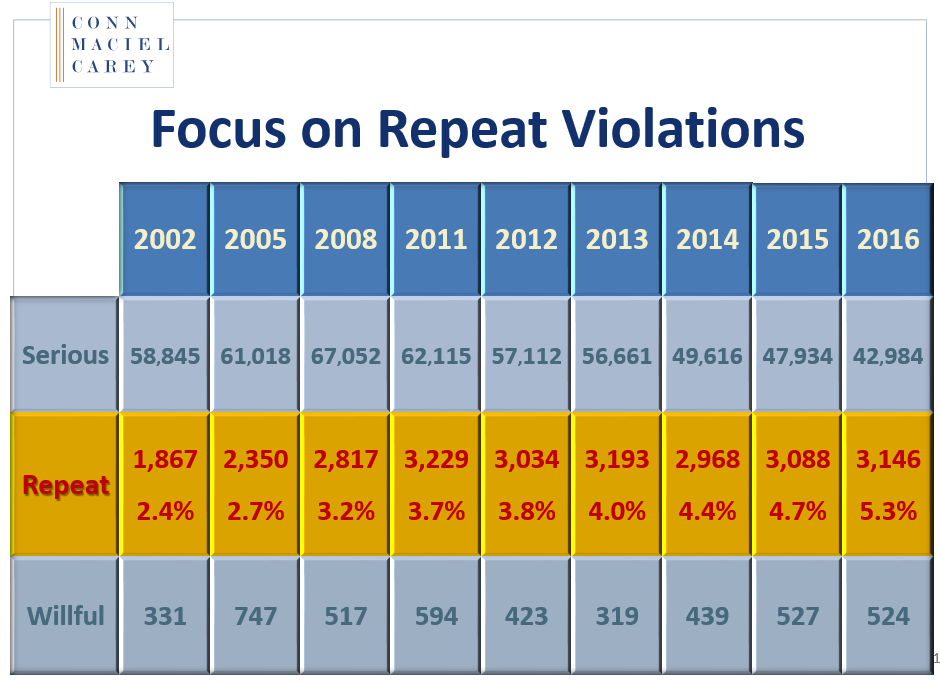
That trend continued even after Congress gave OSHA new penalty authority, increasing the max price tag for a Repeat violation from $70,000 per violation to approx. $130,000. As a result, we are seeing more $100K+ and $1M+ OSHA enforcement actions than ever before.
In light of OSHA’s Repeat violation philosophy, particularly in the context of the Second Circuit’s ruling in the Triumph case, employers need to be extra vigilant in defending against initial citations if the cited standard presents a risk of future Repeat violations, even if the initial penalty is very low. Paying the fine for a Serious or Other-than-Serious citation today may seem like no big deal if it carries a relatively small fine, but if can easily lead to a Repeat citation in three or four years (or eight years now that OSHA knows its look-back period is unlimited) could turn that initial violation into a costly burden.
Employers also need to understand the numerous other ways that Repeat violations can harm employers beyond just the 10x higher penalties. First, even under the Trump Administration, OSHA is continuing to issue inflammatory and embarrassing press releases about OSHA citations in significant cases, which includes most enforcement actions involving Repeat violations. So reputational harm can come to an employer just for being alleged to have committed a Repeat violation. Worse still is falling into the dreaded Severe Violator Enforcement Program (SVEP). The qualifying criteria for SVEP include Repeat and Willful violations in certain categories, but the data shows the vast majority of employers “sentenced” to SVEP are there because of Repeat violations.
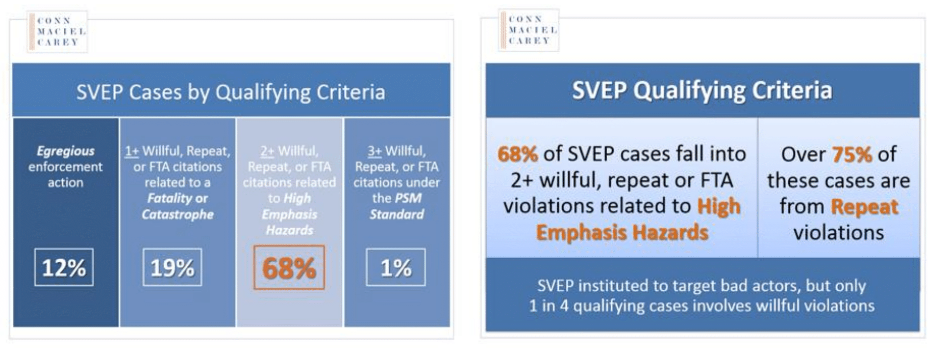
Even more reason to fight the initial violation, regardless how low that initial penalty may be.
Finally, a Repeat citation could increase insurance premiums and disqualify contractors and subcontractors from government and private contracts. There are potentially costly consequences for accepting a citation that has a high potential to become a Repeat citation. Therefore, employers should strongly consider contesting OSHA citations if a settlement cannot be reached that mitigates the risk of future Repeat violations.
Contesting a citation, however, is a post-hoc solution. The best way to avoid a Repeat citation is to understand the hazards most commonly found in your workplace, develop a program to regularly inspect for and correct them, and track your efforts to comply the applicable requirements.
In the hospitality industry, the most frequently cited OSHA standards include Hazard Communication, Electrical Safety, Wiring Methods and Components, Lockout/Tagout, Fire Extinguishers, Respiratory Protection, Walking/Working Surfaces, Bloodborne Pathogens, Protective Equipment, and Exit Routes.
OSHA Penalties
Below are the maximum penalty amounts adjusted for inflation as of Jan. 23, 2019. (See OSHA Memo, Jan 23, 2019).
| Type of Violation | Penalty |
| Serious Other-Than-Serious Posting Requirements | $13,260 per violation |
| Failure to Abate | $13,260 per day beyond the abatement date |
| Willful or Repeated | $132,598 per violation |
State Plan States
States that operate their own Occupational Safety and Health Plans are required to adopt maximum penalty levels that are at least as effective as Federal OSHA’s.
This article is part of our Conference Materials Library and has a PowerPoint counterpart that can be accessed in the Resource Libary.
HospitalityLawyer.com® provides numerous resources to all sponsors and attendees of The Hospitality Law Conference: Series 2.0 (Houston and Washington D.C.). If you have attended one of our conferences in the last 12 months you can access our Travel Risk Library, Conference Materials Library, ADA Risk Library, Electronic Journal, Rooms Chronicle and more, by creating an account. Our libraries are filled with white papers and presentations by industry leaders, hotel and restaurant experts, and hotel and restaurant lawyers. Click here to create an account or, if you already have an account, click here to login.
]]>Most employers are familiar with the basic premise that a tip is a voluntary amount a guest leaves for an employee over the amount due for the goods sold or services rendered, while a service charge is an amount agreed-upon in advance by a venue for services provided, often in connection with large pre-planned events. However, service charges are treated differently than tips for tax and other purposes, and automatic gratuities add an extra complicated layer in this analysis. A brief synopsis of the differences of these terms from a legal perspective is set forth below:
- “Tipped Employees” – customarily receive more than $30 per month in tips for services provided to customers. The FLSA allows an employer to pay less than the minimum wage to tipped-employees through the tip credit, assuming the following:
- The wage amount the employee will be receiving (at least $2.13 per hour);
- The amount the employer will claim as a tip credit (cannot exceed $5.12 per hour);
- The tip credit claimed by the employer cannot exceed the amount of tips received by the employee; and
- All tips received by the employee are retained by him, except if he participates in a valid tip pool.
- A tip pool occurs when tipped employees are required to pool a portion of their tips together, and then divide and redistribute the pooled money according to a pre-arranged system.
- Who can participate in a Tip Pool? Non-exempt employees who “regularly and customarily” receive tips.
- Who Cannot Participate in a Tip Pool? Persons who do not customarily and regularly receive tips.
- DOL Regulations state that “back of the house” staff cannot participate in tip pools – e.g., chefs, cooks, and dishwashers.
- Service Charges and Proper Disclosures
- The FLSA regulates service charges, but distinguishes them from tips in several major respects.
- No customer discretion
- Service Charge belongs to the employer
- Service Charge is not counted as tips
- Disclosures of Service Charges
- Mandatory service charges should be (i) directly paid to employees; or (ii) notice should be provided to customers that the money is not going to the employee.
- Several lawsuits have resulted in an employer’s failure to follow these requirements.
- Many states have strict laws relating to disclosure of service charges.
- Should be factored into regular rate of pay
- Banquet, catering menus, BEO’s and contracts must include language explaining who will receive (and retain) gratuity, service charge, and other fees.
- IRS Treatment of Automatic Gratuities
- Since January 2014, the IRS has enforced its treatment of automatic gratuities as service charges for purposes of taxation.
- Automatic gratuity will only be considered a tip if:
- The payment is made free from compulsion;
- The customer has an unrestricted right to determine the amount of the payment;
- The payment is not the subject of negotiation or dictated by employer policy; and
- The customer has the right to determine who receives the payment.
- If customer does not use its discretion, gratuity will be considered service charge and taxed as regular wages.
- Recommendations for Compliance
- Evaluate whether any practice in your current system would constitute an automatic gratuity;
- Treat automatic gratuities as service charges or non-tip wages for purposes of calculating regular rate of pay, overtime wages, and tax liability;
- One suggestion as a best practice: include suggested tip amounts on the bill instead – 15%, 18%, 20%.
- The FLSA regulates service charges, but distinguishes them from tips in several major respects.
The application of the laws relating to tips, service charges, and gratuities is constantly evolving. Thus, while it is imperative to be familiar and comply with the laws as set forth above, it is equally important to be on the lookout for any changes that occur to these laws, so that you don’t find yourself on the wrong end of a class action lawsuit.
About Conn Maciel Carey
Conn Maciel Carey is a boutique law firm focused on Labor & Employment, Workplace Safety, and Litigation. The clients we serve — from multi-national organizations to individuals — seek us out for strategic guidance ranging from day-to-day employment counseling to managing government regulatory investigations to leading complex litigation. What sets us apart is our special emphasis on workplace challenges, our creativity in crafting positive solutions, and our passion for serving our clients’ interests.
requirements on employers, in hopes of giving #MeToo a significant, lasting effect. So, what should employers in New York and California do now? And, given that these states are often at the forefront of labor and employment issues, how should employers outside New York and California prepare in case new laws are passed in their states?
New York’s New Anti-Sexual Harassment Laws
On April 12, 2018, New York Governor Andrew Cuomo signed into law the 2019 New York State Budget, updating the state’s sexual harassment laws. Among other changes, there are two key components under these laws. First, every employer in New York must establish a sexual harassment prevention policy. These policies should have already been adopted and provided to all employees by October 9, 2018. The New York Department of Labor and New York Division of Human Rights have established a model sexual harassment prevention policy for employers to adopt. But employers are not required to use this model, so long as their policy meets or exceeds the minimum standards of the model and set forth in the laws. Employers must distribute the policy to all employees in writing or electronically, and must ensure that all future employees receive the policy before they start work. Additionally, employers are encouraged to post a copy where employees can easily access it.
Second, every employer in New York is required to provide employees with sexual harassment prevention training. Again, the New York Department of Labor and New York Division of Human Rights have developed model training for employers to use. Though employers are not required to use the model, they must ensure that their training program meets or exceeds the minimum standards of the model, and includes the specific minimum requirements set forth in the laws. All employers are required to train current employees by October 9, 2019, and new employees should be trained as quickly as possible upon hire. In addition, all employees must complete the training at least once per year. There is no certification requirement for trainers, and employers may use third-party vendors to deliver the training.
Importantly, employers in New York should also be mindful of the mandatory arbitration and nondisclosure agreement prohibitions that went into effect this summer, on July 11, 2018. Under New York’s new anti-sexual harassment laws, a contract cannot contain any clause that requires mandatory arbitration to resolve sexual harassment claims. Unless one of the limited exceptions applies, such clauses will become null and void. Furthermore, with respect to nondisclosure agreements, the new laws have established a three-step process for memorializing the complainant’s preference for entering such an agreement. Under the new laws, a nondisclosure agreement is defined to include any resolution of any claim involving sexual harassment that would prevent the person who complained from disclosing the underlying facts and circumstances of the harassment. While the new laws generally ban such nondisclosure agreements, they are not prohibited where a complainant expresses a preference for entering into one.
Where the complainant asks for a nondisclosure agreement, the following process must be observed:
- The term or condition must be provided to all parties, and the complainant must be given 21 days to consider it.
- If, after 21 days, the term or condition is the preference of the complainant, the preference must be memorialized in an agreement signed by all parties.
- The complainant has seven days to revoke the agreement, and the agreement cannot become final until after the revocation period has ended.
Importantly, this process requires the execution of two documents: (1) the agreement memorializing the complainant’s preference; and (2) the document(s) incorporating the preferred term or condition agreed upon. Suffice it to say, through policies, training, and contract clauses, the legal landscape has changed for employers in New York, and the effect of #MeToo and increased awareness of this issue are apparent.
New Anti-Sexual Harassment Laws in California
Similarly, in California, employers are also adjusting to new sexual harassment laws. For example, by January 1, 2020, employers with at least five employees must provide: (1) at least two hours of sexual harassment prevention training to all supervisory employees; and (2) at least one hour of sexual harassment prevention training to all non-supervisory employees. Training must be conducted within six months of the employee starting the position, and must be provided once every two years thereafter. Additionally, California has enacted a law regulating provisions set forth in settlement agreements related to sexual harassment, including nondisclosure clauses. Among other things, the new law prohibits a provision that prevents the disclosure of factual information underlying the allegation of sexual harassment upon which a settlement agreement is based. Such provisions entered on or after January 1, 2019, will become void as a matter of law and as counter to public policy.
But perhaps the most significant change has had less to do directly with sexual misconduct and harassment, and more to do with empowering women in the workplace. California has become the first state to require publicly traded companies to include women on their boards of directors. Signed by California Governor Jerry Brown on September 30, 2018, California Senate Bill 826 requires there to be at least one female director on the board of each California-based public corporation by the end of 2019. Also, depending on the number of board seats, companies may be required to have up to three female directors by the end of 2021. Companies are required to report their board composition to the California Secretary of State, and may be fined $100,000 for a first violation, and $300,000 for subsequent violations. Though not as directly linked to sexual harassment as the other laws discussed above, it will be interesting to see how an increase in the number of women on boards of directors in California will change things – at the state and national levels.
Thus, a year after the #MeToo movement went viral, we are seeing the movement change from something that caused greater awareness of an issue, to something that is being acted upon by way of law. Legal obligations are changing, and employers must be extra diligent to ensure compliance. As such, employers are advised to keep a pulse on current or proposed anti-sexual harassment and related laws and the extent to which their current policies and practices may be affected. Legal changes in California and New York tend to create models for other states, some of which may already have their own anti-sexual harassment laws in the works. Furthermore, employers in New York and California should update their sexual harassment policies and training programs accordingly, and make sure to distribute the policies and implement the programs as required. They should also develop a strategy to incorporate any changes that may affect contract provisions, such as nondisclosure and mandatory arbitration clauses. And, at least in California, publicly traded companies should start thinking about who will fill those female board director seats. While there are numerous other requirements pertaining to sexual misconduct and harassment that employers must be mindful of, states like New York and California have certainly begun to give the #MeToo movement a more significant and sustained impact.
About Conn Maciel Carey
Conn Maciel Carey is a boutique law firm focused on Labor & Employment, Workplace Safety, and Litigation. The clients we serve — from multi-national organizations to individuals — seek us out for strategic guidance ranging from day-to-day employment counseling to managing government regulatory investigations to leading complex litigation. What sets us apart is our special emphasis on workplace challenges, our creativity in crafting positive solutions, and our passion for serving our clients’ interests.
In Rodriguez v. Taco Bell Corp., the United States Court of Appeals for the Ninth Circuit considered whether a restaurant violated California law by requiring employees purchasing meals from the restaurant at a discount to eat their meals on the premises.
In Rodriguez, a restaurant employee filed a class action lawsuit against Taco Bell claiming she was entitled to be paid a premium rate for the time she spent on the employer’s premises eating the discounted meal during her meal breaks. She argued that because the employer required the discounted meal to be eaten in the restaurant, that the employee was under sufficient employer control to render the time compensable.
At the time, the restaurant offered thirty-minute meal breaks that were fully compliant with California requirements, but with an offer that employees could purchase a meal from the restaurant at a discount. The catch? Employees were not required to purchase the discounted meal, but if they chose to they could only get the discount if they ate the meal in the restaurant. The policy was intended to prevent theft.
The court, applying the meal period standard set out by the California Supreme Court in Brinker Restaurant Corp. v. Superior Court, reasoned there was no violation of California law because the employer relieved employees of all duties during meal breaks and exercised no control over their activities. Employees were free to use the thirty minutes as they wanted, and the employer did not interfere with the employees’ use of the break time. Employees were not required to purchase any restaurant products.
The court in Rodriguez distinguished cases where employers exercised control over employees even though they were not performing work by, for example, requiring employees travel to work on employer provided transportation. Where employees were compelled to participate, compensation was required. On the other hand, where employers offered a benefit or service that employees could choose, compensation was not required. The court further distinguished cases where employers exercised control over employees during their breaks by, for example, subjecting them to “on-call” restrictions. In such cases employees were subject to performing duties for their employer during breaks and thus entitled to compensation for such time.
The court also rejected an additional claim by plaintiff that the discounted value of the meal should be added to her regular rate of pay for overtime purposes. Since the court held plaintiff was not entitled to be paid for her time eating the discounted meals, it likewise held she was not entitled to overtime pay for it either.
Background on Meal Periods
In general, non-exempt employees who work more than five hours in a day are entitled to an unpaid meal period of not less than 30 minutes. The meal period must begin no later than the fifth hour of work. Yet, if the total work period per day of the employee is no more than six hours, the meal period may be waived by mutual consent of both the employer and employee.
A second meal period of not less than 30 minutes is required if non-exempt employees work more than ten hours in a day. The meal period must begin no later than the end of the tenth hour of work. If the total hours worked is no more than 12 hours, the second meal period may be waived by mutual consent of the employer and employee only if the first meal period was not waived.
Wage Order 5, which governs meal periods, rest periods and overtime in the restaurant industry, requires employees be relieved of “all duty” during the meal period. The failure to provide a required meal period can be a costly mistake for employers. Employees are entitled to premium wages of one additional hour of pay at the employee’s regular rate of pay for each workday that the meal period is not provided.
Prior to the decision in Brinker, there was uncertainty over what it meant for an employer to provide a meal period. Brinker clarified that an employer is obligated to relieve the employee of all duty for the designated period. Although employers are not required to police employees to ensure no work is performed, employers must relinquish control over employee’s activities, must permit them a reasonable opportunity to take an uninterrupted 30-minute break, and must not impede or discourage them from doing so. In discussing the history of meal periods, the Brinker Court agreed with the Division of Labor Standards Enforcement’s historic interpretation of the wage order that generally employees must be free to leave the premises during their meal period.
Takeaways for Businesses
Rodriguez sanctions a common practice in the restaurant and food service industries to offer employees free or discounted meals eaten on the premises. It remains true that employees not falling within this exception must be permitted to leave the work place for a proper off-duty meal period. The key will be, as it was in Rodriguez, that the employee voluntarily chooses to purchase a discounted meal and the employer does not interfere with the employee’s activities while on break.
This case is a good reminder for businesses to ensure their meal period policy is up to date and that managers are adequately trained to ensure compliance. Care should be taken so that employees are not discouraged from taking their uninterrupted, duty-free meal periods.
]]>Employers do not need to police employee communications around the clock. However, employers can and should provide clear policies about employee conduct in the workplace and appropriate use of social media to mitigate the risk of being held responsible for an employee’s misconduct. Employer concerns about employees making potentially defamatory statements were slightly curtailed in the Fourth Circuit’s recent decision on June 11, 2018 in Sade Garnett v. Remedi Seniorcare of Virginia, LLC, No. 17-1890 (June 11, 2018). However, that holding certainly does not completely relieve employers from liability for rogue employee statements.
The Fourth Circuit’s decision provided further clarification as to when an employer can be held vicariously liable for an employee’s defamatory statements and, more specifically, when an employee is acting within the scope of their employment. The plaintiff in that case sued her employer for defamation based on crude sexual comments that her supervisor made about the reasons she was out of work for surgery. The plaintiff claimed that because the comments were made at work, the employer should be held liable.
Ultimately, the Fourth Circuit rejected this theory of liability holding that although the supervisor’s alleged defamatory statements were made at work, they were nonetheless outside the scope of employment. The Court explained that it would be impossible for an employer to police its employees’ speech and prevent such misconduct. The Court emphasized that “[l]iability will attach only if the employer (a) bears at least partial responsibility for the tortious conduct; or (b) has some ability to limit the likelihood that the employee would commit a tort.”
The Court relied on the Restatement (Third) of Agency Law which limits vicarious liability to situations in which the employee was either (a) performing work assigned by the employer; or (b) engaging in a course of conduct subject to the employer’s control. Employers are not liable when an employee acts independently or in a manner that does not serve any goal of the employer. The Court held that “[i]n other words, there must be a nexus between the employee’s workplace responsibilities and the offensive act.”
Thus, the court’s decision did not relieve employers of all liability for alleged defamatory statements made by rogue employees. Employers can still be held liable for an employee’s conduct when the employer orders or endorses that conduct or where it occurs in the execution of an employee’s professional duties. The Court provided specific examples of cases where employers were held liable because an employee facilitated a tort or crime through their position and the employer’s business, such as a bank teller using his position to facilitate a forgery scheme (i.e., Gina Chin & Assocs., Inc. v. First Union Bank, 260 Va. 533, 542 (2000)), or a psychologist engaging in sexual intercourse with a patient (i.e., Plummer v. Ctr. Psychiatrists, Ltd., 252 Va. 233, 237 (1996)).
There is no single mechanical test to determine when an employee is engaged in activities that fall within the scope of employment, but case law has yielded various formulations which are instructive. Generally, an employer can be held liable for an employee’s defamatory statements if they are made at the direction of the employer, made in the interest of the employer, made during the discharge of a duty for the employer, or if the employee acts under the express or implied authority of the employer. For example, in contrast to the facts and holding in Sade Gannet, in McLachlan v. Bell, 261 F.3d 908 (9th Cir.2001), the Ninth Circuit held that employees’ alleged defamatory statements about a co-worker concerning matters related to his work on aeronautical engineer projects for NASA were deemed within the scope of employment. Ultimately, because the statements about the plaintiff took place in the workplace and were related to business activities, the court denied the defendants’ motion for summary judgment and found that the employer could be held liable.
Workplace disputes and personal issues between co-workers often result in negative communications which – depending on the circumstances – could lead to defamation claims against the employer. The context in which a defamation claim may arise varies widely from statements made during investigations, disciplinary meetings, and reference checks to simple interoffice communications between employees. Given the rise in the number of defamation claims, employers should implement clear policies about how employees are expected to behave, including policies addressing Standards of Conduct, Business Ethics, and employee communications and statements on Social Media. Effectively communicating clear expectations about employees’ responsibilities, conduct, and the workplace will help mitigate the risk of defamation liability, though employers should also ensure these policies are conveyed and implemented in a manner that does not impact employees’ Section 7 rights under the National Labor Relations Act. If an employer knows or has reason to know that an employee is not abiding by those policies, it should take immediate action regardless of whether the employee’s statements are considered defamatory under applicable state common law principles.
]]>ADA regulations require hotels to make reasonable modifications in their policies and practices when necessary to afford goods, services, facilities, privileges, advantages, or accommodations to individuals with disabilities. Because the purpose of a hotel’s website is, in large part, to allow members of the public to review information pertaining to the goods and services available at the hotel and then reserve appropriate guest accommodations, such websites have been found to be subject to the requirements of ADA regulations. According to these regulations, a hotel must identify and describe accessible features in the facilities and guest rooms offered through its reservations service in enough detail to reasonably permit individuals with disabilities to assess independently whether a given facility or guest room meets his or her accessibility needs. Thus, rather than alleging that the website itself is inaccessible to users with disabilities, these “new” website accessibility lawsuits claim that a hotel’s website violates the ADA by failing to sufficiently identify and describe the physical “brick and mortar” accessibility features of the hotel.
The promulgation of these regulations have made it easier than ever for plaintiffs to file lawsuits against hotels. Previously, a even a “drive by” plaintiff had to physically go to a hotel, experience some sort of an ADA violation, and then allege an intent to return to the Hotel in order to establish standing necessary to bring a lawsuit. Now, however, Plaintiffs can sue multiple hotels on the same day from the comfort of their own home. They can file these types of lawsuits simply by claiming that they WANTED to visit a specific hotel (or multiple hotels), but were deterred from doing so and/or making a reservation because the hotel’s website failed to provide enough information for them to determine whether the accessibility features of the hotel meets their needs. Thus, a plaintiff can assert a claim against your hotel without ever visiting, without ever making a reservation, and without contacting you first to notify you of the alleged deficiencies on your website.
The amount of these types of lawsuits is increasing exponentially, with several plaintiffs (represented by the same few plaintiff law firms) filing dozens of these suits each and every day. Accordingly, if your hotel does not already provide a plethora of accessibility-related information regarding your property, it is imperative that you make changes to your website as soon as practicable. In particular, you should provide plenty of information about both the common areas of the hotel as well as the accessible guestrooms.
At a minimum, you should include information regarding the accessibility features of the primary features of your hotel — that is, your parking, main entrance, public restrooms, pool lift, restaurants and bars, fitness centers, and business centers. You should also provide information regarding whether there are accessible routes to get to these highly utilized common areas. It is of course equally important that these areas are actually compliant with the ADA, as providing false, inaccurate, or misleading information could result in liability as well.
Additionally, you need to provide as much accessibility-related information as possible regarding the specific room that will be booked. This includes the bed type (double double, queen, king, etc.), number of beds, type of bathroom and shower (roll-in shower, transfer shower, bathtub with accessible bench, etc.), and whether any visual alarms exist.
Based on the dearth of case law in this relatively new and complex area of the law, it is still a bit of a guessing game as to how much information is “sufficient” under the law. And, although ADA compliance is imperative, you also want to strike a balance between the amount of ADA-related information you are providing and various logistical and aesthetic issues that your website may face so that you do not overwhelm the reader. Just keep in mind that at the end of the day, providing as much accessibility related information as possible on your website will significantly increase your compliance with the ADA, and, as a result, will also decrease the chances that you will be hit with this type of “website drive by” lawsuit that so many hotels are now being forced to defend against.
]]>Background About Ergonomics
An ergonomic hazard is a physical factor within the work environment that has the potential to cause a musculoskeletal disorder (MSD). MSDs are injuries and disorders that affect the human body’s movement or musculoskeletal system; i.e., muscles, tendons, ligaments, nerves, discs, blood vessels, etc. Common ergonomic hazards include repetitive movement, manual handling, workplace design, uncomfortable workstation height, and awkward body positioning. The most frequent ergonomic injuries (or musculoskeletal disorders) include muscle/tendon strains, sprains, and back pains, Carpal Tunnel Syndrome, Tendonitis, Degenerative Disc Disease, Ruptured / Herniated Disc, etc., caused by performing the same motion over and over again (such as vacuuming), overexertion of physical force (lifting heavy objects), or working while in an awkward position (twisting your body to reach up or down to perform a work task).
MSDs are the single most common type of work related injury. According to Bureau of Labor Statistics data, MSDs alone account for nearly 30% of all worker’s compensation costs. OSHA estimates that work-related MSDs in the U.S. alone account for over 600,000 injuries and illnesses (approx. 34% of all lost workdays reported to the BLS), and employers spend as much as $20 billion a year on direct costs for MSD-related injuries and up 5x that on indirect costs (e.g., lost productivity, hiring and training replacement workers, etc.).
Federal OSHA’s Ergonomics Enforcement Policy
Nevertheless, federal OSHA has been lost in the woods for years searching for a coherent ergonomics enforcement policy. In the final days of the Clinton Administration in November 2000, federal OSHA promulgated an extremely controversial midnight Ergonomics Standard, requiring employers to take measures to curb ergonomic injuries in the workplace. Days later, utilizing the Congressional Review Act (CRA), the Republican Congress voted to overturn the ergonomics regulation and newly elected President George W. Bush signed the resolution of disapproval, repealing the ergonomics standard. Because the CRA prevents the agency from promulgating a substantially similar regulation, ergonomic injuries have since gone unregulated, other than sparing use of the general duty clause.
Although employers in states subject to federal OSHA jurisdiction have thus been able to adopt a wait-and-see approach with respect to ergonomics enforcement generally, and specifically how the Trump Administration will roll-out its overall deregulation agenda to workplace safety matters, some states with their own OSH Programs are stepping in to fill the void.
Cal/OSHA on Ergonomics
To no one’s surprise, California is one state pushing progressive new worker safety regulatory requirements, even as federal OSHA retreats in that area. One significant new move by Cal-OSHA is the recently finalized safety standard on Hotel Housekeeping Musculoskeletal Injury Prevention. The new standard, which will be enforced by Cal/OSHA, was approved on March 9th by the Office of Administrative Law, and will become effective July 1, 2018.
This standard, which focuses on ergonomic hazards associated with housekeeping positions, follows closely on the heels of a series of “panic button” ordinances enacted by several large cities across the country to protect housekeepers from sexual assault by hotel guests and/or visitors.
California adopted the new workplace safety and health regulation to prevent and reduce work-related injuries to housekeepers in the hotel and hospitality industry. This is the first ergonomic standard in the nation written specifically to protect hotel housekeepers. In a press release announcing the final standard, Cal/OSHA’s Chief Juliann Sum explained:
“Hotel housekeepers have higher rates of acute and cumulative injuries compared to workers in other industries, and data shows those injuries have steadily increased . . . This regulation requires employers to identify, evaluate and correct housekeeping-related hazards with the involvement of housekeepers and their union representative.”
The standard, applies to all lodging establishments that offer sleeping accommodations available to be rented by members of the public, from high-end hotels and resorts, to motels, inns and bed & breakfasts. The standard specifically excludes from this definition hospitals, nursing homes, residential communities, prisons, shelters, boarding schools and worker housing.
Covered establishments will be required, under the new standard, to develop, implement and maintain a written Musculoskeletal Injury Prevention Program (“MIPP”) that is tailored to hazards associated with housekeeping. Employers have the option of including the MIPP with their preexisting Injury & Illness Prevention Program (“IIPP”) or to create a standalone program specifically for housekeeping MSD risks.
Regardless of its form, the MIPP must be available to covered employees on any shift. Notably, employees must also be able to access the MIPP electronically — a requirement that may pose a challenge to smaller establishments.
The required elements of a housekeeping MIPP will be familiar to any employer that has developed an IIPP, which should already include:
- worksite hazard evaluations;
- injury investigations;
- hazard abatement efforts;
- employee training; and
- recordkeeping.
Notably, covered employers must also complete an initial worksite assessment within three months of the effective date of the standard, which assessment is intended to identify and address a variety of potential ergonomic risk factors, ranging from unpredictable trauma occurrences such as slips, trips and falls, to more traditional repetitive stress MSD concerns such as regular and frequent reaching above shoulder height, lifting, bending, kneeling, squatting, pulling and/or pushing.
Perhaps most controversial about Cal/OSHA’s new Hotel Housekeeping Ergo rule, though, is the agency’s effort to wade into operational concerns by requiring employers to assess “excessive work rates” as well as “inadequate recovery time” between tasks.
Covered employers should act promptly so they are prepared once the standard goes into effect in July of this year. Lodging establishments that wait until the last minute will be feeling the heat as they attempt to develop the required program and conduct the initial worksite assessment within three months of the standard’s effective date.
* * * * *
For more information about Cal/OSHA’s new Hotel Housekeeping Ergonomics Rule and other Cal/OSHA developments, join Conn Maciel Carey attorneys for a complimentary webinar on July 10, 2018 – “New Cal/OSHA Issues California Employers Must Track.”
Authors
Andrew Sommer – Partner, Conn Maciel Carey
Andrew J. Sommer is a partner in the Labor • Employment Group and OSHA • Workplace Safety Group. He counsels clients on a broad spectrum of employment-related matters as well as matters involving OSHA and Cal/OSHA.
Aaron Gelb – Partner, Conn Maciel Carey
Aaron R. Gelb is a partner in Conn Maciel Carey’s Chicago office. He specializes in labor and employment, and OSHA litigation.
]]>Pregnancy Accommodation Under Federal Law
Title I of the ADA prohibits discrimination against employees or applicants due to their disability or perceived disability, and requires employers to accommodate disabled employees if they can still perform the essential functions of their job. The ADA applies to employers with 15 or more employees and mandates that those employers accommodate a disabled employee’s condition as long as the accommodation would not cause undue hardship on the company. Under the ADA, pregnancy itself is not a disability; however, the ADA does cover impairments related to pregnancy and birth that would qualify as disabilities under the ADA.
For example, the Equal Employment Opportunity Commission has stated that such conditions as pregnancy-related carpal tunnel syndrome, preeclampsia, gestational diabetes and pregnancy-related sciatica would all likely be disabilities covered by the ADA, even though temporary. Thus, if a pregnant employee suffers from pregnancy-related sciatica and complains to her employer of this condition, her employer is required to provide a reasonable accommodation, such as temporarily reassigning the employee to light duty or permitting the employee to take more frequent rest breaks, as long as it would not create an undue hardship.
In addition to the ADA, the Family and Medical Leave Act (“FMLA”) and the Pregnancy Discrimination Act (“PDA”) provide further requirements related to pregnant employees. In the context of pregnancy, the FMLA requires employers to permit employees up to 12 weeks of unpaid leave for the birth or care of a newborn child, and for their own serious health condition, while the PDA mandates that pregnant employees or women affected by childbirth or related conditions be treated the same as all other non-pregnant employees or applicants. Thus, under the PDA, if non-pregnant employees that complain of back pain are routinely given light duty assignments, a pregnant employee complaining of back pain should also be given a light duty assignment even if the pain is not severe enough to constitute a disability under the ADA. Additionally, employers need to remember that Title VII of the Civil Rights Act also prohibits employers from discriminating against women affected by pregnancy or childbirth as a form of sex discrimination.
It is important to keep in mind that pregnant employees and applicants, or those affected by childbirth or related conditions, do not have to be treated better than other employees, but must be treated akin to those experiencing similar conditions.
Pregnancy Accommodation Under State Law
Where states have passed laws regarding protections for pregnant workers, those laws have generally expanded the requirement to accommodate beyond the limits of the ADA. For instance, The Massachusetts Pregnant Workers Act, which goes into effect on April 1, 2018, mandates that employers provide reasonable accommodations to pregnant workers for any pregnancy or a condition related to pregnancy. Thus, the pregnancy, or a pregnancy-related condition including, but not limited to, lactation or need to express breast milk, must be accommodated if requested, even if the worker’s condition does not meet the standard for a disability under the ADA. The Massachusetts law lays out examples of what would constitute a reasonable accommodation, including more frequent or longer breaks, time off to recover from child birth, light duty, and assistance with manual labor, although the law also notes that an accommodation is not limited to these specific options.
Like the ADA, the Massachusetts law does not require an accommodation be provided where it would cause an undue hardship on the employer and lays out the specific factors that must be considered in assessing undue hardship, such as the nature and cost of the accommodation and the overall financial resources of the employer. Additionally, under this law, an employer can require documentation of the need for a reasonable accommodation from an appropriate health care or rehabilitation professional. Significantly, however, such documentation cannot be required for certain accommodations, including more frequent restroom, food or water breaks; seating; or limits on lifting over 20 pounds. Aside from the accommodation component of the Massachusetts law, it also specifically delineates what would constitute impermissible discrimination based on pregnancy or a pregnancy-related condition such as taking an adverse action against an employee who requests or uses a reasonable accommodation.
The District of Columbia, which passed its own law regarding pregnancy accommodation called the Protecting Pregnant Workers Fairness Act of 2014, similarly requires reasonable accommodation for any employee whose ability to perform her job is limited by pregnancy, childbirth, breastfeeding or a related medical condition, unless such accommodation would cause undue hardship on the company. The District of Columbia’s law also lays out typical accommodations for a covered employee much like those provided for in other states’ laws, including relocating the employee’s work area, acquisition or modification of equipment or seating, and providing private non-bathroom space for expressing breast milk. The law also permits District of Columbia employers to require certification from a medical health care provider to show the accommodation is advisable, and does not limit the types of accommodation for which such documentation can be requested. In addition, the District of Columbia law prohibits discriminatory treatment of a pregnant worker, such as requiring an employee to take leave if another accommodation can be provided or denying an employment opportunity due to the worker’s request for an accommodation.
Beyond the requirements of these state laws, it’s important to remember that they tend to apply to a larger number of employers due to the lower employee threshold that triggers their requirements. For example, Connecticut’s law, which requires reasonable accommodations for employees and applicants based on pregnancy, childbirth, or related conditions, applies to all employers with at least 3 employees. A similar California law applies to all public employers and private employers with 5 or more employees, while the District of Columbia and New Jersey laws apply to all employers.
Many of the state laws also usually require some form of notice to employees of the rights the law protects and its relevant provisions. The applicable law may provide for a specific notice to be circulated or posted, such as the District of Columbia and Maryland, or may more broadly define the notice requirement, giving employers an option of how to provide it.
In sum, although state pregnancy laws have many similarities and some important differences, they are generally consistent in expanding protections similar to the ADA to any employee affected by pregnancy or child birth, and it is likely that any enforcement body will view the accommodations outlined in these laws as reasonable for most, if not all, employers.
What Employers Should Do to Comply
Because pregnancy accommodation laws vary from state to state, it is important for employers to be aware of the specific requirements of the law in each state in which they operate. For example, one state may permit an employer to require medical documentation no matter the type of accommodation, while another state, like Massachusetts or Washington, restricts the employer’s ability to request documentation for certain types of accommodations like seating or longer/more frequent rest breaks. Even an employer operating only in a single state should be aware of the nuances of any pregnancy accommodation law, such as whether the law is even applicable based on the size of the employer.
If an employer operates in a state with a pregnancy accommodation law, it should ensure that its handbook, as well as any relevant stand-alone policies, clearly notify employees of their rights and how to exercise those rights to obtain an accommodation. Additionally, because many state pregnancy laws require an employer to subsequently notify an employee of their rights if the employee informs the employer of a pregnancy or a pregnancy-related condition, employers in those states must be prepared to provide additional notification in that circumstance.
Finally, employers should ensure that they provide training to management about how to effectively address the need for an accommodation to ensure that pregnant workers or workers with a pregnancy-related condition are provided an appropriate accommodation, and are not treated any differently for requesting or receiving that accommodation.
]]>