The federal American with Disabilities Act (“ADA”) and many similar state laws require employers to “reasonably” accommodate an otherwise qualified disabled applicant or employee to perform the essential job functions of the position or enjoy equal benefits of employment as similarly situated employees. Similarly, other federal and state civil rights statutes prohibiting discrimination based on gender, religion, and race require an employer to accommodate an employee’s reasonable request for schedule changes, dress, and grooming practices due to religious beliefs or gender identity. The law also requires employers to reasonably accommodate pregnant employees. The issue of whether the employer must accommodate gender non-conforming or non-binary employees has not yet been fully resolved by the trend is to required such accommodations.
II. What are Your Responsibilities as an Employer?
The law does not require that you meet the specific demands of the employee, only that you make “reasonable” accommodation when called to do so. We will explore numerous examples from various courts and the EEOC of what constitutes a “reasonable” accommodation under various circumstances. However, the trend is clear that courts will require employers to at least attempt to accommodate objectively reasonable requests that do not endanger coworkers or severely impact business operations. We will also explore some of the unfortunate extremes to which some cases have ventured when requiring accommodation.
The law does not require that you meet the specific demands of the employee, only that you make a “reasonable” accommodation when called to do so. We will explore numerous examples from various courts and the EEOC of what constitutes a “reasonable” accommodation under various circumstances. However, the trend is clear that courts will require employers to at least attempt to accommodate objectively reasonable requests that do not endanger coworkers or severely impact business operations. We will also explore some of the unfortunate extremes to which some cases have ventured when requiring an accommodation.
III. What Are Your Rights as an Employer?
The courts and the EEOC have recognized various legitimate limitations on an employee’s right to demand workplace accommodations. We will explore a few well-recognized legal exceptions to the accommodation requirement including safety concerns and undue hardship to the employer. We will also provide some of the “go-to” defenses when an employee makes objectively unreasonable accommodation requests.
IV. Striking a Balance between Your Rights and Responsibilities in a Politically Correct World
Social and news media often shape the public’s view of the world—and of employers. Often, employers feel the pressure to make accommodations to demanding employees when not legally required to do so. What are the ramifications of making such accommodations? If you give the employee an inch will he take a mile? We will explore the practical and legal effects of both enforcing your rights and the failure to take a consistent stand on certain demands for accommodation.
Authors
Barry Montgomery – Partner, KPM Law
Barry, a partner with KPM LAW, began his career in litigation before he graduated law school by working as an intern at the United States Attorney’s office where he had the opportunity to prosecute federal criminal cases. In his first case, Barry successfully prosecuted a business owner for manufacturing counterfeit currency and bank checks. It was at this point that he decided that he would spend his career in commercial litigation. Barry then began representing insurance companies in fraud and coverage cases as well as personal injury defense.
While Barry still represents insurers and their insureds in commercial litigation, he now focuses his practice on labor and employment law and litigation, as well as professional liability litigation. Barry believes that labor is the force that drives our economy and that an organization’s greatest resource is its employees. Barry believes that management and professional decisions can be vigorously defended in and out of court without compromising an organization’s brand or relationship with its workforce.
Brian A. Cafritz – Partner, KPM Law
Brian has been an invaluable member of the KPM LAW team since 1994, his commitment having helped solidify and expand the foundation of KPM LAW’s regional defense network. Brian primarily focuses his practice on the defense of Fortune 500 companies that operate under large self-insured retentions. With bar licenses in four jurisdictions, he has built a dedicated team and developed an efficient system that allows him to aggressively defend all matters in a regional practice that covers the entire mid-Atlantic region.
As Brian’s practice became more focused on Retail and Restaurant litigation, it became evident to him that the Plaintiff’s bar was more organized in sharing its resources, and so in 2006 – 2007, Brian co-founded the National Retail and Restaurant Defense Association (NRRDA) to promote the education and communication channels of industry leaders and counsel. Brian was elected to serve two terms as the association’s first president. Under Brian’s leadership, NRRDA continued to grow. Today, NRRDA boasts over 600 members and is seen as a leader in the Retail and Restaurant sector.
This article is part of our Conference Materials Library and has a PowerPoint counterpart that can be accessed in the Resource Libary.
HospitalityLawyer.com® provides numerous resources to all sponsors and attendees of The Hospitality Law Conference: Series 2.0 (Houston and Washington D.C.). If you have attended one of our conferences in the last 12 months you can access our Travel Risk Library, Conference Materials Library, ADA Risk Library, Electronic Journal, Rooms Chronicle and more, by creating an account. Our libraries are filled with white papers and presentations by industry leaders, hotel and restaurant experts, and hotel and restaurant lawyers. Click here to create an account or, if you already have an account, click here to login.
]]>Under the D.C. Human Rights Act (DCHRA), personal appearance is one of 20 protected traits for people that live, visit or work in D.C. Personal appearance is defined as the outward appearance of any person, irrespective of sex, with regard to bodily condition or characteristics, manner or style of dress, and manner or style of personal grooming, including, but not limited to, hair style and beards. To flesh this out, the D.C. Office of Human Rights, which administers the DCHRA, issued enforcement guidance in September 2017 to provide an explanation of this less understood protected category. It clarified that a person may not be discriminated against based on the individual’s actual or perceived “personal appearance,” which means employers may not refuse to hire someone, for example, because the individual wears a head scarf or has dreadlocks. The guidance document even provides an illustrative example of this. It states that, if Michael has a beard and applies for a job as a receptionist of a business office, where the job announcement requires applicants to have 3-5 years of experience and Michael possesses 5-6 years of experience as a front desk receptionist, the business employer cannot refuse to hire or consider Michael, a qualified applicant, because of his beard.
But, there are some limits to this rule. As the enforcement guidance makes clear, an employer can establish requirements for cleanliness, uniforms or other standards as long as the established standard is for a reasonable business purpose (e.g., for maintaining the health and safety of all individuals) and applied uniformly to everyone. This is often referred to as the “prescribed standards” exception, and is successfully argued by showing the following three elements: (1) the existence of prescribed standards; (2) uniform application of the standards to a class of employees; and (3) a reasonable business purpose for the prescribed standards. So, in our example, if Michael is hired, in most cases, the business employer may require that Michael adhere to the company’s established grooming standards along with all other employees, unless Michael has a religious reason for his beard. Unfortunately, however, the enforcement guidance, while certainly helpful, may have oversimplified this exception.
In the real-life context, employers have asked some tricky questions. What qualifies as a “reasonable business purpose”? How specific or broad should prescribed dress and grooming standards be? And what if we do not enforce the standards all the time because we have a lax enforcement policy or inadvertently miss a case or two? While advice from legal counsel can provide tailored answers to the first two questions, what is nearly certain about the last is that, if an employer does not enforce its dress and grooming standards, it is opening itself up to major legal risk. This is because, as described above, uniform application is a required element for employers to claim the “prescribed standards” exception. Furthermore, personal appearance discrimination claims are subject to the McDonnell Douglas burden-shifting framework that we described in a prior post. That is, if a plaintiff alleges employment discrimination through the use of indirect evidence, the plaintiff must show that: (1) she is a member of a protected class; (2) she suffered an adverse employment action; and (3) the unfavorable action gave rise to an inference of discrimination. One way for a plaintiff to demonstrate that an unfavorable action gives rise to an inference of discrimination is to present evidence of disparate treatment. This is often done by showing that she was treated differently than similarly situated employees outside of her protected class. Accordingly, if an employer does not enforce its dress and grooming standards consistently, it makes plaintiff’s case stronger, which is at least one reason why strict enforcement of such standards is so crucial.
Furthermore, although only a small number of jurisdictions extend anti-discrimination protections to personal appearance, this area of law is growing and is often intrinsically connected to other protected classes. For example, the New York City Commission on Human Rights (NYCCHR) issued new guidelines in February 2019 stating that employer policies on grooming and appearance that target, limit, or otherwise restrict natural hair or hairstyles may be unlawful and could result in a penalty of up to $250,000 per violation. This is because NYCCHR determined that black hairstyles are an inherent part of black identity, and therefore, should be protected racial characteristics. The guidance notes that protections extend to the right to maintain “natural hair or hairstyles that are closely associated with their racial, ethnic or cultural identities.” While the guidelines specifically focus on black communities, the protections extend to other groups, including those who identify as Latin-x/a/o, Indo-Caribbean, Native American, Sikhs, Muslims, Jews, Nazirites, and/or Rastafarians.
So what can employers do to minimize their legal risk and ensure they do not run afoul of any anti-discrimination personal appearance laws? As noted above, advice from legal counsel will assist in determining whether an employer’s business purpose is reasonable under the law, and whether its prescribed dress and grooming standards are written in a way that best shield the employer from potential claims. This is often done through a review of the employer’s dress and grooming standards in its employee handbook. Typically, a broader set of standards with legally protected carve outs (e.g., for religious and disability accommodations, health and safety concerns, etc.) is advisable. It is also prudent to enforce the standards uniformly and consistently. Other concerns, such as keeping the standards gender-neutral, should also be considered.
]]>
The Americans with Disabilities Act (ADA) was enacted in 1990 to prevent discrimination against individuals with disabilities in all aspects of life. The Act has been applied to a variety of segments of our society, including building entrance designs, website displays, and workplace accommodations. Recently, a new twist to the Act arose when a 12-year-old boy visited a Colonial Williamsburg restaurant with his classmates on a school field trip.
The case, J.D. v. Colonial Williamsburg Foundation, was originally filed in the U.S. District Court for the Eastern District of Virginia and later appealed to the 4th Cir Ct. App. No 18-1725. In J.D., a 12-year-old boy with severe Celiac disease visited a restaurant with his classmates on a school field trip to Colonial Williamsburg. J.D.’s condition was so severe that even the slightest ingestion of gluten-based foods caused severe illness. On prior occasions, other restaurants had offered J.D. gluten-free meals that accidentally or unknowingly contained trace amounts of gluten, which caused J.D.’s symptoms to flare up. Because of this, J.D.’s parents decided that when J.D. had to eat out, they would prepare J.D.’s food for him, so that he could safely and comfortably eat without incident or fear of incident. Knowing that the field trip would require J.D. to eat at a restaurant, J.D.’s father (who also attended the field trip) brought a home-prepared meal for J.D. to eat while the rest of the class ordered its meals from the restaurant menu.
When the time came for lunch, the restaurant staff notified J.D. and his father that he was not allowed to consume outside prepared foods in the restaurant due to Virginia’s Health Code. In fact, Virginia’s Health Code prohibits food prepared in a private home from being used or offered for human consumption in a food establishment unless the home kitchen is inspected and regulated by the Virginia Department of Agriculture and Consumer Services. 12 Va. Admin Code § 5-421-270(B). However, as an accommodation, the restaurant advised J.D. that its chef would prepare J.D. a gluten-free meal of baked chicken and potatoes to meet his specific needs. The father declined the offer, stating that they did not want to risk kitchen mistakes, and he preferred J.D. eat his home-prepared meal. Left with the options of eating the chef-prepared meal, not eating, or eating outside the restaurant, J.D. and his father left the restaurant and ate the home-prepared meal separate from his classmates.
J.D. filed suit under §504 of Title III of the ADA, claiming that Colonial Williamsburg discriminated against him by excluding him from the restaurant and failing to modify its policy against the consumption of outside food. Defendants moved for summary judgment, and while the magistrate found a genuine dispute of material fact as to whether J.D. was disabled under the ADA, he recommended dismissal because J.D. failed to establish that he was discriminated against because of his disability. The District Court Judge adopted the magistrate’s recommendations and dismissed the case. Plaintiff appealed to dismissal to the 4th Cir.
An ADA claim requires a plaintiff to prove three elements: 1) that plaintiff is disabled under the meaning of the Act; 2) that the defendant operates a place of public accommodation; and 3) the defendant discriminated against him because of that disability. See Ariz. ex rel. Goddard v. Harkins Amusement Enters., Inc., 603 F.3d 666, 670 (9th Cir. 2010); Camarillo v. Carrols Corp., 518 F.3d 153, 156 (2d Cir. 2008). In this case, there was no dispute on the second element, so the Court looked only at elements 1 and 3.
Under §12102(1)(A) of the ADA, a disability is defined as any “physical or mental impairment that substantially limits one or more major life activities.” This is different from an impairment, which the Act defines as any physiological disorder or condition that affects one or more body systems, including digestive. 28 CFR §36.105(b)(1). The 4th Cir. noted that “‘[N]ot every impairment will constitute a disability within the meaning of this section,’ but it will meet the definition if ‘it substantially limits the ability of an individual to perform a major life activity as compared to most people in the general population.” Id. § 36.105(d)(1)(v). Eating is a major life activity. Id. § 36.105(c)(1)(i).” J.D. at 10. The court then explained that when deciding if the Celiac disease created a disability, it had to interpret the ADA language “broadly in favor of expansive coverage.” Id. Even though J.D. had no symptoms when he avoided gluten, this was immaterial in determining if a disability existed, because the Court was required to look at his condition when he consumed gluten. Id. With the evidence showing that J.D. had serious consequences to his health when he ingested gluten and that he had an unusually small margin for error in his diet, the Court felt that there was a material question of fact as to whether J.D. had a disability within the meaning of the ADA. Thus, consistent with the District Court ruling, the court did not decide that J.D. had proven a disability, but rather, felt it was up to the jury to decide.
The Court then looked at the third element; i.e., whether or not Colonial Williamsburg discriminated against J.D. According to 42 U.S.C. § 12182(b)(2)(A)(ii), discrimination is defined, “in part, as: a failure to make reasonable modifications in policies, practices, or procedures, when such modifications are necessary to afford such goods, services, facilities, privileges, advantages, or accommodations to individuals with disabilities, unless the entity can demonstrate that making such modifications would fundamentally alter the nature of such goods, services, [etc.].” Id. (emphasis in original)
The courts use a three-part test to determine if discrimination occurs. The three parts are: “(1) whether the requested modification is “necessary” for the disabled individual; (2) whether it is “reasonable”; and (3) whether it would “fundamentally alter the nature” of the public accommodation. Id., citing PGA Tour, Inc. v. Martin, 532 U.S. 661, 674 (2001), at 683 n.38.
The Court first looked at whether the modification [allowing him to eat his home-prepared meal] was necessary to provide J.D. with a “like experience” to non-disabled guests. This necessarily requires the court to make an individualized inquiry into the plaintiff’s specific circumstances and determine if the proposed accommodation addresses the disability, or if the accommodation creates a condition that extends beyond the person’s capacity. In this case, J.D.’s evidence showed that he repeatedly became ill when exposed to gluten from meals prepared at restaurants, even when they were purported to be gluten-fee. While the court did not make an ultimate decision on whether the modification of its rules was necessary, it did find that there was sufficient evidence presented to create a genuine dispute of fact on whether eating out is beyond J.D.’s capacity.
Second, where an accommodation is already in place, a plaintiff may still be entitled to something more if he can show that the accommodation does not account sufficiently for his disability.” J.D. at 16. In this case, the restaurant’s proposed accommodation was to prepare a gluten-free meal. Given J.D.’s history of illness from prior attempts at gluten-free restaurant meals, it became a question of fact as to whether or not the restaurant’s proposed accommodation was sufficient. “Indeed, a jury might well reject J.D.’s evidence about the severity of his gluten intolerance, and thus find that the protocols at [the restaurant] were sufficient to account for his disability. But in our view, J.D. has put forth enough evidence at this stage to raise a genuine dispute of material fact as to whether the proposed accommodation sufficiently accounts for his disability.” Id. at 17.
For the next step of its analysis, the 4th Cir. considered whether or not the restaurant’s proposed accommodation was reasonable or not. Indeed, “[f]acilities are not required to make any and all possible accommodations that would provide full and equal access to disabled patrons,” but “need only make accommodations that are reasonable.” Id. at 18. Citations omitted. Here, the court pointed out that the restaurant allowed guests to serve their own food if it is for babies or if they wanted to bring a cake in for large celebrations, provided the restaurant was given advance notice. The fact that J.D. may not have provided advance notice to the restaurant was dismissed as irrelevant to the court, because the lack of notice did not require additional staffing or create an unreasonable hardship in the restaurant’s operations. And when looking at the Health Code regulations the restaurant cited for its policy, the 4th Cir. noted that the prohibition on home-prepared foods was designed to prevent restaurants from serving food prepared in private homes. It did not prohibit customers from bringing in outside food. There was no evidence introduced that J.D.’s request would truly impose a safety concern or risk contamination of other foods. The court reasoned that if that were the case, the restaurant would not allow outside foods in other circumstances.
The Court ultimately ruled that decisions of reasonableness of accommodations are highly individualized, fact-specific for each case. As a result, they are decisions best left to a jury, who can judge the credibility of witnesses and weigh the importance of evidence.
Finally, the Court looked to the restaurant’s affirmative defense that allowing homemade meals fundamentally changes the restaurant experience. Under this defense, the defendant must prove that the Plaintiff’s request would fundamentally alter the nature of the program or services provided by the restaurant. Like the other issues, the court considered, this too was found to be a jury question. A jury “could reasonably find that accommodating the occasional request of someone with severe food sensitivities would not fundamentally alter the Tavern’s business model, especially if other family members purchase food or (as happened here) if the meals are already paid for as part of a group rate.” Id. at 23.
Impact of Ruling
Given the above, the 4th Cir. reversed the trial court’s dismissal and remanded it back to the District Court. The takeaways from the decision are striking.
First, it seems clear that the court is framing ADA cases such as this to be treated similarly to ordinary negligence cases. Those cases are almost always fact-specific and to be determined by a jury. If there is any credible evidence to support a claimant’s case, the court is likely to defer ruling to the jury.
Second, it is important to note that the Health Code Regulation relied upon by the restaurant does not expressly state that it is designed to prohibit the serving of food, rather than customers bringing in food. This ruling places restaurants in a difficult position of having to choose between enforcing written regulations and agreeing to proposed individual modifications as necessitated by the ADA. Restaurant staffers are not trained in legal analysis, and it seems untenable that a waiter or manager would have to interpret the intent of a health regulation. Forcing a restaurant to make such interpretation exposes a restaurant to more litigation because the parties cannot know if it is proper to violate the regulations based on its language. Indeed, the Dissent correctly notes that the de facto result of this ruling is that “Restaurants must either allow patrons to consume food prepared outside their premises or must justify their refusal at a costly trial.” J.D. at 32. Both the disabled parties and the restaurant industry would be better served if the Health Regulation was written clearly to prohibit serving versus bringing in outside foods, and the restaurant could rely upon the code as written.
Finally, it seems clear that the Courts are taking an expansive view of the ADA’s coverage. Rather than draw bright line tests that disabled persons and businesses can plan for, individualized assessments on a case-by-case basis must be made. This is likely to result in inconsistent applications where some modifications are allowed but possibly similar modifications are not allowed. As the dissent in J.D. notes, “[t]he majority’s rule means that a patron’s demand that he be allowed to eat outside food will sometimes be reasonable and other times not. This puts managers in the middle of a difficult line-drawing exercise: What criteria are they supposed to use in navigating the tension between the ADA’s requirements and public health law? Which privately prepared meals must they allow and which may they refuse? The majority wouldn’t even require advance notice from customers in J.D.’s position, meaning that managers will have to evaluate the disruption and the safety hazard of a customer’s outside meal on the fly, with the specter of litigation hanging overhead.” J.D. at 31.
If you have any questions about this ruling, its impact on restaurant operations, or how it may impact your business, the attorneys at KPM LAW are ready for your call.
]]>ADA/Standing
1. Brito v. Wyndham Hotels and Resorts, LLC, 2018 WL 317464 (D. Colo., 01/08/2018). Plaintiff is a paraplegic and requires the use of a wheelchair to ambulate. While at defendant hotel he encountered multiple violations of the Americans with Disabilities Act (ADA) that effected his use and enjoyment of the premises and sued. The hotel challenged plaintiff’s standing. To establish standing, a plaintiff must show, inter alia, that he suffered an injury in fact. To prove that, plaintiff must establish a likelihood that he will return to defendant’s premises. Factors a court considers are the proximity of the business to plaintiff’s residence, the plaintiff’s past patronage of the business, the definitiveness of plaintiff’s plan to return, and the plaintiff’s frequency of travel near defendant. In the complaint plaintiff stated he lives in the same county as defendant, he has frequented defendant hotel for “pleasure purposes,” he was a guest at the premises for a two day stay, and he alleges an intention to return within four months. This constitutes a personal stake in the outcome to constitute standing and avoid dismissal of the complaint.
Bankruptcy
2. In Re Lorraine Hotel 2017 LLC, 2018 WL 5288893 (N.D. Ohio, 10/22/2018). Plaintiff hotel filed a Chapter 11 petition in bankruptcy. The debtor’s sole asset was a 93-room hotel, of which 54 rooms were rentable. The debtor did not have casualty insurance covering destruction of, or damage to, the facility. The Bankruptcy Code, Section 1112(b) authorizes a judge to dismiss or convert a Chapter 11 case to Chapter 7 “for cause.” Cause exists where a debtor fails to maintain appropriate insurance resulting in risk to the estate. The court stated appropriate insurance coverage is of “paramount importance” in this case because of the single asset in the estate and the status of the business as a struggling downtown hotel. The court thus dismissed the Chapter 11 case and denied conversion to Chapter 7. Instead, creditors can pursue their state remedies.
Class Action
3. Valverde v. Xclusive Staffing, Inc., et al, 2018 WL 4178532 (D. Co., 08/31/2018). Plaintiff is an employee of Omni Hotel. Per the written employment policies of the management company that operates the hotel, a $3.00 processing fee is deducted from each paycheck plaintiff and other employees receive. Plaintiff objected and seeks certification of a nationwide class of plaintiffs. Defendant objected arguing the allegations were insufficient to show that plaintiffs from other states were subject to the same policy. The court noted that defendant management company’s policies are national and controlled centrally from its Colorado headquarters. They are contained in its written employment policies used nationwide. The court thus found the evidence sufficient to certify a nationwide class.
Contracts
4. Murphy Elevator Co., Inc., v. Coco Key Hotel & Water Resort, 2018 WL 1747924 (Ohio Appls Crt, 04/11/2018). The parties had a two-year elevator maintenance contract. After the first year and a half, the hotel failed to pay. The elevator company stopped performing and sued for breach of contract. The hotel argued that it should only be liable for the unpaid moneys up to the time plaintiff stopped performing. The court rejected this argument and granted the elevator company lost profits. Noted the court, an award of damages should put the injured party in the same position it would have been in had there been no breach.
5. Stanciel v. Ramada Lansing Hotel and Conference Center, 2018 WL 842907 (Mich. Appls, 02/13/2018). Plaintiff fell when entering a hot tub at defendant hotel. Plaintiff attributes the fall to a broken support bar leading into the tub. Plaintiff sued, and the parties purportedly agreed to a settlement. Defendant prepared a written settlement agreement and submitted it to plaintiff. The documents included a “Medicare addendum.” Defendant’s attorney told plaintiff’s counsel to advise if he had a problem with any of the wording. Plaintiff returned the signed documents to defendant but unilaterally crossed out language in the addendum. Plaintiff now seeks to enforce the settlement agreement. Defendant argued the agreement was not valid because defendant was not willing to agree to the settlement without the eliminated clause. Plaintiff argued the clause that was crossed out was not an essential term of the settlement agreement so there was still a meeting of the minds on all the essential terms. The court ruled the parties did not reach an enforceable settlement agreement. Case dismissed.
6. Claris, Ltd. v. Hotel Development Services, LLC, 2018 WL 3203053 (Crt. Appls, Ohio, 06/29/18). Per contract dated 8/2005, defendant agreed to build plaintiff a 4-floor, 122 room hotel which plaintiff planned to operate as a Candlewood Suites. The construction was completed in late summer 2006. In 2013 the hotel began experiencing water penetration when rain occurred. Plaintiff’s expert witness investigated defendant’s construction work of the hotel’s walls and identified five deficiencies. The expert excluded one of the five as the cause of the water problem but did not identify the extent to which the other four may have contributed to the damage. Therefore, plaintiff failed to establish that a breach of contract by defendant caused the leakage. Thus, the court reversed a jury verdict in favor of plaintiff and directed a verdict for defendant.
7. Couture Hotel Corporate v. US, 2018 WL 3076847 (Crt. of Fed. Clms, 06/21/2018). Plaintiff purchased a $9 million hotel near Nellis Air Force Base intending to participate in the off-base lodging business for visitors to the base utilized when on-base lodging is full. To meet the base’s requirements, plaintiff made modifications costing in excess of $1 million. When the work was completed, defendant advised plaintiff that, due to lowered demand, it was not adding any new facilities to its overflow listings at the time. Plaintiff sued, claiming that defendant’s refusal to permit plaintiff to compete for off-base services violated the Competition in Contracting Act, various associated procurement regulations, and a contract implied-in-fact. The court held for the government finding procurement rules were not violated, and a contract-in-fact did not exist. While the government representative talked to plaintiff about prerequisites to qualify for the lodging overflow business before plaintiff purchased the facility, documents provided to plaintiff clearly stated that a prerequisite to the government signing a contract were various inspections and approvals. Said the court, “[I]n negotiations where the parties contemplate that their contractual relationship would arise by means of a written agreement, no contract can be implied.” The complaint was thus dismissed for failure to state a claim.
Default Judgment
8. Travelodge Hotels, Inc. v. Durga, LLC, 2018 WL 5307809 (D. NJ, 10/26/2018). Defendant was a franchisee of plaintiff. Defendant ceased operating and plaintiff filed suit for damages for breach of contract. Plaintiff ultimately received a default judgment. Defendant now seeks relief from that judgment. He argued his failure to defend was excusable because he was traveling the world searching for experimental medical treatments for their daughter who suffers from a rare anoxic brain injury which worsened about the time of the lawsuit. Per defendant, this search “consumed” his life. The court granted the relief, noting that the defendant’s inattention to the lawsuit was excusable given the daughter’s illness.
Eminent Domain
9. North Carolina Dept. of Transportation v. Laxmi Hotels, Inc., 2018 WL 2207793 (05/15/2018). Defendant operates a Super 8 Motel. The Department of Transportation (DOT) sought to widen and improve the street on which the hotel was located. As a result of the work, the hotel lost several parking spaces. Also, due to a 15-foot tall retaining wall installed, visibility of the facility from the nearby thoroughfares was totally lost. The DOT claims it explained the extent of the work to be performed. The hotel’s president stated the DOT assured him the hotel would not lose any parking spaces and failed to explain the height of the retaining wall. As a result of the lost parking and street visibility, the hotel claims the DOT significantly underpaid for the taking since the loss of parking and visibility severely impacted the value of the hotel. The court agreed that the DOT did not adequately inform the hotel of the extent of the taking of hotel property. The court thus ordered the DOT to provide just compensation. The case was remanded for further calculation of appropriate reimbursement for the hotel.
Employment/Actual Employer
10. Frey v. Hotel Coleman, et al, 2018 WL 4327310 (7th Cir., 2018). Plaintiff worked at a Holiday Inn Express in Algonquin, Illinois. The hotel was owned by Hotel Coleman, Inc. which hired Vaughn Hospitality, Inc. to manage the facility. Vaughn Hospitality consisted of Michael Vaughn and his wife. Plaintiff’s paychecks came from Hotel Coleman; she was trained, supervised, evaluated, assigned, etc. by Vaughn Hospitality. Plaintiff claimed Michael Vaughn sexually harassed her and she filed a claim with the EEOC. She was thereafter fired and sued Hotel Coleman and Vaughn Hospitality for retaliatory discharge. The lower court determined Vaughn Hospitality was not plaintiff’s employer and dismissed the charges against it. Following trial against Hotel Coleman, plaintiff appealed Vaughn Hospitality’s dismissal. The appeals court reviewed several factors to consider when determining who is an employer, the most important being the right to control and supervise the worker. The court vacated the ruling that Vaughn Hospitality was not a joint employer and remanded the case. In doing so the court commented that the district court will “likely” conclude that Vaughn Hospitality was plaintiff’s employer.
Interested in more? Click here to continue reading.
This article is part of our Conference Materials Library and has a PowerPoint counterpart that can be accessed in the Resource Libary.
HospitalityLawyer.com® provides numerous resources to all sponsors and attendees of The Hospitality Law Conference: Series 2.0 (Houston and Washington D.C.). If you have attended one of our conferences in the last 12 months you can access our Travel Risk Library, Conference Materials Library, ADA Risk Library, Electronic Journal, Rooms Chronicle and more, by creating an account. Our libraries are filled with white papers and presentations by industry leaders, hotel and restaurant experts, and hotel and restaurant lawyers. Click here to create an account or, if you already have an account, click here to login.
Authors
KAREN MORRIS
(585) 256-0160
Judgekaren@aol.com
Karen Morris is an elected Town Justice in Brighton New York, a Professor of Law at Monroe Community College (MCC), and an author. She was elevated to the title of Distinguished Professor, awarded by the Chancellor of the State University of New York.
She has written several textbooks including numerous editions of Hotel, Restaurant and Travel Law, the latest of which was published in 2017 by Kendall Hunt and won a Textbook Excellence Award from Text and Academic Authors Association. She also wrote two editions of New York Cases in Business Law for Cengage Publishing. In 2011, she published Law Made Fun through Harry Potter’s Adventures, and in 2017, Law Made Fun through Downton Abbey. She also co-authors Criminal Law in New York, a treatise for lawyers. She writes a column for Hotel Management Magazine entitled, Legally Speaking, and a blog for Cengage Publishing Company on the law underpinning the news.
Among the courses she has taught are Hotel and Restaurant Law, Business Law I and II, Constitutional Law, Movies and the Law, “The Michael Jackson Trial” and “O.J. Simpson 101; Understanding Our Criminal Justice System.” Her course offerings include some in traditional classroom settings and others online. She won the Excellence in Teaching Award in 1994, having been selected by her peers, and the Chancellor’s Award for Teaching Excellence in 2002, conferred by the Chancellor of the State University of New York.
DIANA S. BARBER
(404) 822-0736
dsbarber@gsu.edu
Diana@LodgeLawConsulting.com
Diana S. Barber, J.D., CHE, CWP is currently an adjunct professor teaching hospitality law and hospitality human resource management at Georgia State University in Atlanta, GA. In addition, she conducts a one-day workshop on contracting and risk management for the Events and Meeting Planning Certificate Program offered by The University of Georgia in Athens, Georgia.
In 2017, Diana became a co-author of Hospitality Law, Managing Legal Issues in the Hospitality Industry (5th Edition), along with Stephen Barth.
Ms. Barber is a recipient of the J. Mack Robinson College of Business Teaching Excellence Award in 2011 and was awarded 2011 Study Abroad Program Director of the Year by Georgia State University. In addition, Ms. Barber is the recipient of the 2010 Hospitality Faculty of the Year award and in 2012, received a Certificate of Recognition from the Career Management Center for the J. Mack Robinson College of Business. Ms. Barber is a member of Phi Beta Delta, an honor society for international scholars. Diana also completed her certification as a Certified Wedding Planner through the nationally recognized [the] Bridal Society.
Ms. Barber has recently launched a consulting/speaking company called LodgeLaw Consulting using her combined academic and hospitality legal skills; specializing in providing education to hospitality companies on preventative measures to reduce legal exposure, as well as a full range of legal services to hotels, motels, restaurants, event planning companies and private clubs. She has over thirty years of legal hospitality experience. Diana began her law practice as an associate attorney at King & Spalding in Atlanta, Georgia after graduating cum laude from Walter F. George School of Law at Mercer University in Macon, Georgia. She then spent over fourteen years with The Ritz-Carlton Hotel Company, LLC serving as vice president and associate general counsel. She is a member of the State Bar of Georgia, G.A.H.A., and the Georgia Hotel & Lodging Association (“GHLA”).
]]>Per the Equal Employment Opportunity Commission’s annual report, the EEOC secured more than $505 million for victims of discrimination for the fiscal year 2018. Amongst them, the EEOC won a verdict in the Ninth Circuit against a railway, holding that it was a violation of the ADA to force an employee to obtain an MRI at his own expense before beginning employment. EEOC v. BNSF Railway Company, 902 F.3d 916 (9th Cir. 2018).
Long-Term/Indefinite Leaves of Absence Under the ADA: Courts have ruled differently with respect to whether long-term or undefined leaves of absence are reasonable accommodations under the ADA. It depends on the jurisdiction that you are in and/or the particular facts of the case. The Seventh Circuit held that a long-term or undefined leave of absence is not a reasonable accommodation under the ADA. Severson v. Heartland Woodcraft, Inc., 872 F.3d 476, 482 (7th Cir. 2017). Several courts have followed Severson and held that indefinite or long-term leaves of absence are unreasonable. See Rancourt v. OneAZ Credit Union, No. cv-17-00194-phx-jjt, 2018 U.S. Dist. LEXIS 138805 (D. Ariz. Aug. 16, 2018); Markowitz v. UPS, 711 Fed. Appx. 430 (9th Cir. 2018); Wilson v. Greenco Indus., No. 17-cv934-wmc (W.D. Wis. Mar. 7, 2019). However, at least one court has declined to follow Severson, holding that an extended unpaid leave could be a reasonable accommodation so long as it was not an undue hardship for the employer, regardless of the length of the leave. Estep v. Forever 21 Retail, Inc., (D. Or. Nov. 13, 2018) (citing Nunes v. Wal-Mart Stores, Inc., 164 F.3d 1243, 1247 (9th Cir. 1999)).
ADA and Obesity: Employers should reevaluate accommodation requests and hiring processes for employees and applicants that are obese. Any denials of accommodation or refusal to hire should be based on the limitations posed by obesity itself, not based on any “perceived” characteristic associated with obesity. Courts may determine that employers “regarded” an employee as disabled based on perceived health complications associated with obesity, amounting to a violation of the ADA. See Shell v. Burlington Northern Santa Fe Railway Company, No. 15-cv-11040 (N.D. Ill. Mar. 5, 2018).
FMLA Notice Requirements: Courts have reinforced that employers may require notice of the use of FMLA leave and an initial showing of a “serious health condition.” However, employers should not deny requests simply because an employee has not expressly stated that the employee needs or is using FMLA leave. Additionally, employees are not required to return to work when they are cleared for light-duty by a medical provider, and may still utilize unexhausted FMLA leave before returning to the workplace. Still, employers may require employees to notify the employer if and when the employee decides to return. See Stein v. Atlas. Indus., 730 Fed. Appx. 313 (6th Cir. 2018).
FMLA Interference: As demonstrated in Walker v. Pocatello, No. 4:15-cv-00498-BLW (D. Id. Jan. 31, 2018), employees maintain the right to require a second opinion from an employee’s medical provider if it has objective reason to doubt the validity of FMLA medical certification. However, if an employer takes additional actions to find evidence of an employee’s medical issues – including internet or video surveillance – these measures could amount to FMLA interference.
Takeaways for the ADA: Continue to assess accommodation requests on a case-by-case basis, and review policies regarding pre-employment medical examination requests.
Takeaways for the FMLA: Employers may still require notification and certification to evaluate whether an employee is eligible for FMLA, but employees may still be entitled to take FMLA leave even where they have not expressly stated that they are using FMLA or have a need to take FMLA leave.
This article is part of our Conference Materials Library and has a PowerPoint counterpart that can be accessed in the Resource Libary.
HospitalityLawyer.com® provides numerous resources to all sponsors and attendees of The Hospitality Law Conference: Series 2.0 (Houston and Washington D.C.). If you have attended one of our conferences in the last 12 months you can access our Travel Risk Library, Conference Materials Library, ADA Risk Library, Electronic Journal, Rooms Chronicle and more, by creating an account. Our libraries are filled with white papers and presentations by industry leaders, hotel and restaurant experts, and hotel and restaurant lawyers. Click here to create an account or, if you already have an account, click here to login.
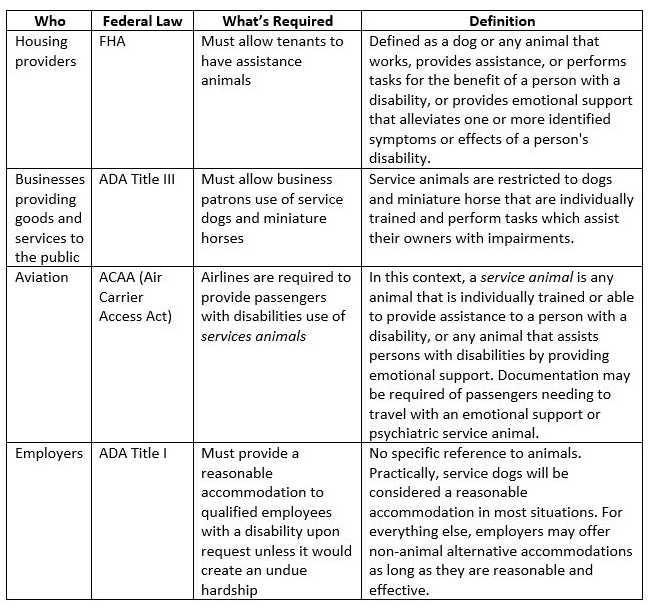
]]>In order to dispel the confusion under federal law, let’s examine a hypothetical scenario. Imagine that Acme Apartments, a business that leases apartments, has a no-pet rule for its tenants and an office policy prohibiting pets in the workplace. Acme also operates a fitness center for tenants and the general public with a no-animal policy. In this situation, Acme will need to follow the Fair Housing Act (FHA), Title I of the American Disabilities Act (ADA), and Title III of the ADA. How each of these laws apply to Acme—and your business—is described below.
Assistance Animals And The FHA
Acme’s pet restrictions are generally lawful. However, under the FHA, Acme must allow tenants and applicants with a disability to live with assistance animals that meet their disability-related needs. The only exception to this requirement is if the assistance animal would pose a direct threat to others or would cause substantial physical damage to property.
What constitutes an assistance animal is interpreted broadly. It could be a dog or any other animal that “works, provides assistance, or performs tasks for the benefit of a person with a disability, or provides emotional support that alleviates one or more identified symptoms or effects of a person’s disability.” Assistance animals will typically perform functions like providing protection or rescue assistance, fetching items, alerting persons to impending seizures, or providing emotional support to persons with disabilities who have a disability-related need for such support. In this context, assistance animals are sometimes referred to as “service animals,” “assistive animals,” “support animals,” or “therapy animals.” However, the preferred term is assistance animals to avoid confusion with other laws.
Service Animals And Public Accommodations Under The ADA
The legal requirements differ depending on whether you are considering accommodations in public places or in the workplace.
In Public Places
Title III of the ADA requires businesses that provide goods or services to the public to allow service animals to accompany people with disabilities in all areas of its facility in which the public is normally allowed access. Going back to Acme, this means that it must accommodate service animals in its leasing office and fitness center for visitors and patrons with a disability.
However, under Title III, service animals are limited to only individually trained dogs and, with some exceptions, miniature horses. Most often, service animals perform functions like guiding the blind, alerting the deaf, pulling wheelchairs, providing seizure alerts, or calming a person during an anxiety attack. Service animals do not include untrained comfort animals, which are generally animals that provide psychological comfort by their existence. In other words, no rabbit, bird, cat, monkey, or untrained dog can qualify as a service animal under the ADA in this context.
So how would Acme know if a dog or miniature horse is a service animal? Under the ADA, Acme is allowed to ask whether the animal is a service animal and what tasks the animal has been trained to perform, but nothing more. Acme cannot require proof of disability, certification, or make any other inquiry.
However, if the owner cannot maintain control of the service animal, or if the service animal proves dangerous or disruptive by its conduct, then Acme can expel it from the premises. Because of this limited inquiry, and the fact that many pet owners are apparently now attempting to pass their pets off as service animals, a growing number of states are making it a crime to misrepresent a pet as a service animal or misrepresent oneself as a person with a disability to gain access with a dog. Arizona, California, Minnesota, New Jersey, and Texas now have criminal penalties including jail time for such misrepresentations, with more states looking to follow.
In The Workplace
What about employees who request to bring animals into the workplace? Assume that one of Acme’s employees says that she has an anxiety disorder and would like to bring her pet rabbit to work. She explains that it helps mitigate the disorder and allows her to perform her duties. Must Acme allow the rabbit in the workplace? To answer this question, employers must turn to Title I of the ADA.
Title I of the ADA requires that Acme, when asked, provide reasonable accommodations to qualified employees with a disability in order to allow the employee to perform the essential functions of the job. Acme is obligated to provide reasonable accommodations unless it would create an undue hardship.
When such requests are made, the employer should engage in an interactive discussion with the employee to learn about the employee’s disability, how it is impacts the employee’s major life functions, and how it may be impeding getting the employee’s job duties done. In this process, it is important to highlight that employers must only provide a reasonable accommodation, and not the preferred accommodation requested by the employee if effective alternatives exist. In other words, if the employer can provide an alternative to the accommodation requested that is effective in allowing the employee to perform the job functions and is more in line with the needs of the employer, then the employer can provide that alternative and meet its ADA obligations.
As a practical matter, after engaging in the interactive process, most employers will discover that there are likely reasonable alternatives to permitting comfort animals in the workplace—but few to none regarding service dogs. In the rare case of a comfort animal request, some employers have offered less disruptive alternatives such as the use of a pet monitor at work or the use of a stuffed animal likeness. To date, there are no known cases in which a court has found an employer in violation of the ADA for denying the work presence of an untrained comfort animal where an alternative has been offered.
In contrast, a trained service dog accompanying an employee to their job has long been viewed as a “reasonable accommodation” under Title I of the ADA, even though not specifically listed as part of that section. There are a number of cases in which employers have been found to have violated the law by not permitting service dogs in job interviews or at work. In fact, the EEOC is currently pursuing a federal lawsuit against a trucking company for violating the ADA by not allowing a military veteran truck driver to complete his training with a trained service dog who provides “emotional support” and mitigates his post-traumatic stress and mood disorder.
However, employers may still deny these animals in the workplace if the employer can show the rare circumstance that it would create an undue hardship to operation of the employer’s business. Under the ADA, undue hardship is defined as an “action requiring significant difficulty or expense” when considered in light of a number of factors. Examples of undue hardship in this context may include safety issues caused by the presence of the dog, the presence of other employees with dog allergies, or coworker phobias. Claiming undue hardship is a very narrow exception under the law and businesses who wish to use it should seek advice from legal counsel.
Conclusion
As with any regulated area, businesses subjected to the above laws should seek the assistance of counsel when drafting policies and developing staff training materials. Based on the multiple laws and definitions regarding assistive and service animals, it is no wonder that businesses, employers, and the general public are often confused about their rights and obligations. To help clarify, below is a chart that may help provide some order:
ADA regulations require hotels to make reasonable modifications in their policies and practices when necessary to afford goods, services, facilities, privileges, advantages, or accommodations to individuals with disabilities. Because the purpose of a hotel’s website is, in large part, to allow members of the public to review information pertaining to the goods and services available at the hotel and then reserve appropriate guest accommodations, such websites have been found to be subject to the requirements of ADA regulations. According to these regulations, a hotel must identify and describe accessible features in the facilities and guest rooms offered through its reservations service in enough detail to reasonably permit individuals with disabilities to assess independently whether a given facility or guest room meets his or her accessibility needs. Thus, rather than alleging that the website itself is inaccessible to users with disabilities, these “new” website accessibility lawsuits claim that a hotel’s website violates the ADA by failing to sufficiently identify and describe the physical “brick and mortar” accessibility features of the hotel.
The promulgation of these regulations have made it easier than ever for plaintiffs to file lawsuits against hotels. Previously, a even a “drive by” plaintiff had to physically go to a hotel, experience some sort of an ADA violation, and then allege an intent to return to the Hotel in order to establish standing necessary to bring a lawsuit. Now, however, Plaintiffs can sue multiple hotels on the same day from the comfort of their own home. They can file these types of lawsuits simply by claiming that they WANTED to visit a specific hotel (or multiple hotels), but were deterred from doing so and/or making a reservation because the hotel’s website failed to provide enough information for them to determine whether the accessibility features of the hotel meets their needs. Thus, a plaintiff can assert a claim against your hotel without ever visiting, without ever making a reservation, and without contacting you first to notify you of the alleged deficiencies on your website.
The amount of these types of lawsuits is increasing exponentially, with several plaintiffs (represented by the same few plaintiff law firms) filing dozens of these suits each and every day. Accordingly, if your hotel does not already provide a plethora of accessibility-related information regarding your property, it is imperative that you make changes to your website as soon as practicable. In particular, you should provide plenty of information about both the common areas of the hotel as well as the accessible guestrooms.
At a minimum, you should include information regarding the accessibility features of the primary features of your hotel — that is, your parking, main entrance, public restrooms, pool lift, restaurants and bars, fitness centers, and business centers. You should also provide information regarding whether there are accessible routes to get to these highly utilized common areas. It is of course equally important that these areas are actually compliant with the ADA, as providing false, inaccurate, or misleading information could result in liability as well.
Additionally, you need to provide as much accessibility-related information as possible regarding the specific room that will be booked. This includes the bed type (double double, queen, king, etc.), number of beds, type of bathroom and shower (roll-in shower, transfer shower, bathtub with accessible bench, etc.), and whether any visual alarms exist.
Based on the dearth of case law in this relatively new and complex area of the law, it is still a bit of a guessing game as to how much information is “sufficient” under the law. And, although ADA compliance is imperative, you also want to strike a balance between the amount of ADA-related information you are providing and various logistical and aesthetic issues that your website may face so that you do not overwhelm the reader. Just keep in mind that at the end of the day, providing as much accessibility related information as possible on your website will significantly increase your compliance with the ADA, and, as a result, will also decrease the chances that you will be hit with this type of “website drive by” lawsuit that so many hotels are now being forced to defend against.
]]>Who does Title III apply to?
Title III of the ADA applies to private entities and covers:
(1) places of public accommodation;
(2) commercial facilities; and
(3) examinations and courses related to applications, licensing, certification or credentialing for secondary or postsecondary education, professional, or trade purposes.
A place of public accommodation is defined as a place maintained by a private entity whose operations affect commerce, and that falls within one of twelve enumerated categories (not discussed here).
There are inconsistent interpretations among courts regarding whether private websites are considered places of public accommodation subject to the accessibility requirements of Title III and if so, to what standard they are subject. While more specific criteria for accessibility of websites are expected next year, the DOJ has not yet published any clear regulations on the issue.
The court’s decision in Gil v. Winn-Dixie Stores, Inc. offers insight into the direction that the law may be heading. The plaintiff, a visually impaired individual, alleged that the defendant food store’s website was inaccessible to him. The court undertook to determine if the website was subject to the requirements of the ADA. If the website was a place of public accommodation, the court reasoned that it would be subject to the ADA. Although Winn-Dixie does not offer any products for sale directly through its website, the website does permit customers the opportunity to access digital coupons and refill prescriptions.
Many individuals with auditory, visual, or other related disabilities often use assistive technology to help them operate computers and mobile devices and easily access the same information that is available to users without disabilities. The plaintiff in the Winn-Dixie case used assistive software, but he was still unable to access 90% of the tabs on Winn-Dixie’s website, including information such as store locations and hours.
Ultimately the court determined that since the website is “heavily integrated” with Winn-Dixie’s physical store locations and operates as a gateway to them, the website constituted a place of public accommodation and is subject to the requirements of the ADA. The court determined that the online pharmacy, access to digital coupons, and ability to locate stores and hours were considered “services, privileges, advantages, and accommodations” offered by Winn-Dixie’s physical store locations, and as such, the ADA requires that disabled individuals are provided “full and equal enjoyment” of both the website and the stores.
The court’s decision confirms that websites with any public interaction will be considered a place of public accommodation and thus subject to the ADA. Essentially, if a website interacts with the public, it is likely a place of public accommodation. These interactions may be direct, such as e-commerce sales. As in the Winn-Dixie case they may also be less direct such as access to coupons, information regarding store locations and hours, and access to any other tab or page found on the website containing information about products or services that are associated with the physical store.
What is Required?
The court adopted the Web Content Accessibility Guidelines (WCAG) as the accessibility standard for websites. The WCAG is a set of accessibility guidelines created by the World Wide Web Consortium (W3C) which is the primary international standards organization for the Internet. It was compiled based on the expert opinions of the W3C staff, member organizations, and interest groups. The consortium is led by Tim Berners-Lee, the inventor of the World Wide Web, and W3C CEO, Jeffrey Jaffe. The court noted that the internet provides the public with information that is easily accessible to viewers at any time. The ADA’s purpose is to ensure disabled users are afforded an opportunity, equal to that of users without disabilities, to access the goods, services, facilities, privileges, advantages, or accommodations provided on websites.
So How Does a Business with a Website Comply?
There are several steps a business can take to protect itself. The first is to make sure its website is accessible. Acknowledge the potential use of assistive technology by disabled viewers and create websites that are compatible by doing things such as:
- Adding text equivalents to all non-text content. A mere description of the image is not sufficient, the text must be equivalent to the image by including the same meaningful information that users without disabilities obtain by looking at it;
- Posting documents in a text-based format such as HTML or RTF in addition to PDF;
- Allowing viewers to adjust color and font settings in their web browsers;
- Including text captions describing any videos and other multimedia graphics;
- Minimizing blinking and flashing. If such features are necessary, allow them to be paused or stopped;
- Providing an alternative way for disabled viewers to access the information and resources such as a staffed telephone information line;
- Designing a plan to make content more accessible, posting the plan on an accessible webpage, and providing a phone number or email address encouraging viewers to provide feedback or request further accommodations regarding accessibility;
- Organizing mandatory web accessibility training to all employees who develop programs, code for, or publish final content to the website on how to conform with the Web Content Accessibility Guidelines;
- Conducting automated accessibility tests of websites;
- Requiring third-parties who interface with the website to also conform to the WCAG; and
- Consulting with legal counsel to ensure the website meets the relevant standards.
Businesses should be aware that these suggestions may be referred to for guidance, but do not encompass the entirety of the accommodations Title III of the ADA may require. It is strongly recommended that businesses operating websites conform with the WCAG in an effort to ensure that disabled individuals receive the full and equal enjoyment of the goods, services, facilities, privileges, advantages, or accommodations of a website.
What Happens if a Website Does Not Comply?
Businesses should be proactive in bringing their website into compliance despite the current lack of formal regulations. Disabled persons encountering an inaccessible website may retain counsel to send out threatening demand letters to a website operator or file a lawsuit. As one of few decisions on the issue, Gil v. Winn-Dixie Stores, Inc. will serve as persuasive precedent to courts confronted with the issue in the near future.
Websites that fail to comply may find themselves:
- Receiving a demand letter from an attorney addressing the website’s noncompliance;
- Defending a lawsuit alleging violations of the ADA; and/or
- Paying damages, settlements, significant attorney fees and costs.
In addition to protecting against the risk of liability, modifying websites to increase accessibility to disabled viewers potentially expands a business’ market to promote its products or services to new customers who previously could not adequately access information about the business.
For any questions, feel free to contact Hillary Hughes at hhughes@gsblaw.com or at 212.965.4527, Nancy Cooper at ncooper@gsblaw.com or at 503.553.3174, or your attorney for more information on the applicability and requirements of these new guidelines.
This alert was prepared with the assistance of Meghan O’Brien, a legal extern and law student at New York Law School.
Author Pages
Hillary Hughes – Owner, Garvey Schubert Barer
Nancy Cooper – Owner, Garvey Schubert Barer
For the past nine years, the Mid-Atlantic ADA Center (one of 10 regional ADA information centers of the ADA National Network) has spearheaded the ADA National Network’s “Hospitality Initiative” – to create its critically-acclaimed portfolio of valuable resources for hoteliers, restaurateurs, customer-facing businesses, along with state and local governments.
Both resources are free of charge and can be found at www.ADAhospitality.org. They are ideal to strengthen marketing outreach to guests with disabilities and to plan accessible events. Compiled from nine years of feedback from trainings, guest columns, articles and/or Webinars with the American Hotel & Lodging Association (AH&LA), National Restaurant Association (NRA) and Asian American Hotel Owners Association (AAHOA), the two new resources anticipate the needs of front-line staff and are great disability-savvy tools to support staff that interface with guests with a wide variety of disabilities. For HR staff, the film can be used as a training tool for existing staff and to on-board new staff, coupled with the ADA National Network’s ADA – Title I Employment on-line course that offers continuing education credits from the HR Certification Institute: http://www.adainfo.org/training/ada-title-i-employment-requirements
The disability market segment boasts $220 billion in purchasing power – that’s more than the coveted teen market. For more information, additional free resources, and to access the Accessible Meetings, Events and Conferences Guide, “at your service” 20-minute film and two-minute Preview in English, Spanish , open captions and audio descriptions, visit www.ADAhospitality.org.
For additional information on the ADA and other resources, visit www.ADAinfo.org or call 800-949-4232.
]]>The EEOC finally issued a proposed rule on April 20. The following is what employers need to know in a “Q&A” format.
What problem is the EEOC trying to resolve?
The quick answer is an apparent conflict between the ADA rules on employer “medical inquiries,” on the one hand, and the “wellness program” provisions of the HIPAA/ACA, on the other.
Title I of the ADA (the part of the ADA that applies to private sector employers) generally prohibits employers from making “medical inquiries” of current employees unless the inquiries are “job-related and consistent with business necessity” (for example, to verify the need for a reasonable accommodation). The general rule is that employers are not supposed to be asking for medical information from current employees.
There are some limited exceptions to this rule, including an exception for medical inquiries made in connection with a “voluntary wellness program.”
As employer wellness programs have become more popular, many employers began offering specific rewards or penalties to employees based on whether they participated in the programs and even on whether they achieved certain “results.” As will be discussed in more detail below, the HIPAA and the ACA specifically authorize wellness programs to offer incentives for “participation” and “outcomes” under certain circumstances. However, the question arose whether the use of such incentives would render the wellness program not “voluntary” for ADA purposes. If the wellness program was not voluntary because of the incentives, then any requests for employee medical information made in connection with the wellness program would violate the ADA.
(Title I of the ADA would not have an impact on medical inquiries made, say, to the family member of an employee who might also be eligible to participate in the employer’s wellness program.)
Thus, it was possible that an employer could offer a wellness program that was authorized and lawful under the HIPAA/ACA but still be vulnerable to charges and lawsuits under the ADA. The EEOC’s proposed rule seeks to address this problem, and for the most part, it should be welcomed by employers who offer wellness programs.
What does the proposed rule say, in a nutshell?
The proposed rule says that a wellness program can still be “voluntary” for ADA purposes if the program provides “incentives” for employees (both rewards and penalties), as long as the employer complies with the wellness incentive requirements of the HIPAA/Affordable Care Act.
There are two caveats: The wellness program would have to be associated with a group health plan (either insured or self-insured), and the EEOC proposals do not exactly match the HIPAA/ACA rules, although they are reasonably close.
Can you give us a recap of the HIPAA/ACA requirements?
Under the HIPAA/ACA scheme, there are two types of wellness programs. A “participatory” program is one that rewards employees just for participating and does not require a specific goal to be met. (An example would be an employer who reimburses employees for fitness club memberships.) Under the HIPAA/ACA, participatory programs can be offered without limitation, as long as they’re available to all similarly situated individuals.
The other type of wellness program is a “health-contingent” program. There are two types of “health-contingent” programs: (1) activity-only programs, in which the employee is rewarded for completing an activity but doesn’t have to achieve or maintain an outcome (for example, “we’ll pay you $100 if you walk a mile three days a week for a year”); and (2) outcome-based programs, in which employees are rewarded for achieving or maintaining results (for example, “we’ll pay you $100 if you keep your BMI at or below 25 for a year, or if you quit smoking”).
If the program is health-contingent, employers are allowed to offer incentives (carrots or sticks) if –
- Employees are allowed to try to qualify at least once a year,
- The total reward offered doesn’t exceed 30 percent of the total cost of employee-only coverage under the plan or the total cost of family coverage if dependents are also allowed to participate in the program (“total” means the employee’s and the employer’s share). The percentage is up to 50 percent for tobacco prevention or cessation,
- The program is reasonably designed to promote health or prevent disease,
- The full reward must be available for all similarly situated individuals, and reasonable alternatives must be offered to those who can’t qualify, and
- The availability of reasonable alternatives must be disclosed in plan materials and in any disclosure telling an individual that he or she did not meet an initial outcome-based standard.
Under the HIPAA/ACA, the 30 percent/50 percent incentive limit applies only to “health-contingent” programs. HIPAA and the ACA have no limit on rewards that apply to “participatory” programs (if the programs are available to all similarly situated individuals).
The EEOC’s proposed rule is slightly different.
How does the EEOC proposed rule contrast with the HIPAA/ACA rule?
The EEOC would allow employers to offer incentives for employee participation in wellness programs associated with group health plans if the total reward does not exceed 30 percent of the total cost of employee-only coverage under the plan for both participatory and health-contingent wellness programs. The EEOC proposed rule does not allow a 50 percent reward level for tobacco cessation programs (unless there are no associated disability-related questions or medical exams), and the total cost used in the reward calculations does not take into account family-level coverage, even where dependents can participate in the program.
In addition, the wellness program must be completely voluntary. The EEOC would define “voluntary” as follows:
- Employees aren’t required to participate in the wellness program,
- Health insurance coverage is not denied or made more difficult to get if the employee chooses not to participate (with the exception of the permitted “incentives”), and
- The employer does not take adverse action against an employee for refusing to participate . . . as this employer allegedly did.
The EEOC invites the public to comment on the proposed rulethrough June 19. The agency is particularly interested in comments pertaining to how much medical information an employee should be required to disclose to be eligible for an incentive, whether the rule should require that the incentives not render health insurance “unaffordable” within the meaning of the ACA, issues related to the “notice” requirement, how to treat wellness programs that are not associated with group health insurance, as well as other topics.
The employer would also be required to provide a notice “that clearly explains what medical information will be obtained, who will receive the medical information, how the medical information will be used, the restrictions on its disclosure, and the methods the covered entity will employ to prevent improper disclosure of the medical information.”
The wellness program would be required to disclose medical information to the employer only in aggregated, non-individually-identifiable form, “except as needed to administer the health plan.”
Are there any other issues to consider under the HIPAA/ACA?
Although the EEOC rule is currently in proposed form, we expect any final version to still be somewhat different from the HIPAA/ACA requirements for wellness programs. For example, one of the primary requirements of a outcome-based program under HIPAA is the ability of an employee to meet a “reasonable alternative standard” to receive the reward. Participants in the program must be clearly informed of that option, and it remains to be seen how that notification will be coordinated with the notice proposed by the EEOC. A related issue is the intersection of the “reasonable alternative standard” under HIPAA with the reasonable accommodation and interactive process obligations under the ADA. The EEOC’s Interpretive Guidance to the proposed rule says that provision of a “reasonable alternative standard” along with the required notification will generally satisfy the employer’s reasonable accommodation obligations under the ADA, but no specifics are given. Moreover, the Interpretive Guidance notes that under the ADA an employer would have to make reasonable accommodations for an employee who could not be in a “participatory” program because of a disability, even though the HIPAA/ACA rules do not require a “reasonable alternative standard” for participatory programs.
Also, details about wellness programs commonly appear in ERISA-governed summary plan descriptions, so will the EEOC rules also have to appear there as well?
There are similarities between the employee benefits issues affecting wellness programs, on the one hand, and the ADA and employee-relations issues, on the other, but the differences are equally important and will hopefully be addressed by the EEOC in the final rules expected to be issued later this year.
What should employers do?
The proposed rule describes certain employer “best practices,” as follows:
- Employers should ensure that employees who handle medical information know their obligations under the laws.
- Employers should adopt privacy policies for collection and handling of employee medical information, assuming that they have not already done so.
- If medical information is stored electronically, it should be encrypted and other security measures implemented such as password protection and firewalls.
- If possible, employees who handle medical information should not be “making decisions related to employment, such as hiring, termination, or discipline.” If this is not possible, then the employer should ensure that there is no discrimination based on an employee’s disability.
- Breaches of confidentiality should be promptly and effectively addressed, and the affected employees should be informed immediately.
- Employers should take appropriate action against an employee who breaches confidentiality, and should “consider discontinuing” their relationships with vendors who breach confidentiality.
Why doesn’t the EEOC proposed rule have a 50-percent incentive for tobacco-related programs, since the HIPAA/ACA does?
The EEOC explained that it did not include the 50 percent incentive for tobacco programs because, it said, most of those programs do not seek employee medical information at all. If not, there would be no ADA issue. But if a tobacco program does seek such information (for example, through testing for nicotine, or monitoring blood pressure), then the tobacco program would have to be included in computing the 30-percent limit for incentives.
Did the proposed rule address the employer’s right to get medical information from an employee’s family members, who may be covered under the employee’s health insurance and might be eligible for participation in the wellness program?
No, because Title I of the ADA applies only to employers and employees. Medical inquiries about an employee’s family member would, of course, be covered under the Genetic Information Nondiscrimination Act, which is also enforced by the EEOC. The EEOC says it will issue guidance on wellness and the GINA “in future EEOC rulemaking.”
Did the proposed rule contain anything else of interest?
Yes. The EEOC has explicitly disagreed with a wellness/ADA decision from the U.S. Court of Appeals for the Eleventh Circuit, Seff v. Broward County. At issue in theSeff case was a $20-per-paycheck penalty that employees had to pay if they chose not to participate in the county’s wellness program. The court found that the county’s program fell within a “safe harbor” in the ADA, which provides that a covered entity is not prohibited “from establishing, sponsoring, observing or administering the terms of a bona fide benefit plan that are based on underwriting risks, classifying risks, or administering such risks that are based on or not inconsistent with State law.” Because the program fell within the safe harbor, the court said, it was irrelevant whether the program was “voluntary” or whether medical inquiries made in connection with the program violated the ADA.
The EEOC’s position is that this “safe harbor” provision in the ADA does not apply to wellness programs.
Employers who operate in the Eleventh Circuit states of Alabama, Florida, or Georgia can continue to follow Seff for the time being. However, employers who operate in other states may choose to follow the EEOC’s position once its proposal becomes final. The conflict between the EEOC and the Eleventh Circuit will probably be resolved eventually by the courts.
___________________________________________________________________
Authors:M. Brian Magargle | Of Counsel : Since 1993, Brian Magargle has practiced employment law, and he began practicing in the area of employee benefits and ERISA in 1995. Robin E. Shea | Partner : Robin Shea has more than 20 years’ experience in employment litigation, including Title VII and the Age Discrimination in Employment Act, the Americans with Disabilities Act.
]]>