There were 7,621 cases of human trafficking reported in the U.S. in 2016, the last year for which yearly totals are available. In the United States, human trafficking tends to occur around international travel-hubs with large immigrant populations, notably California, Texas, Florida, and Georgia. Illinois ranked 9th out of the 50 States with 296 reported cases of human trafficking during 2016.
The issue of human trafficking has gained national attention due to cases involving high profile individuals such as prominent investor Jeffrey Epstein and New England Patriots owner Robert Kraft.
Human trafficking is prevalent in the hospitality industry, particularly at hotels. Businesses in the hospitality industry are prime territory for sex traffickers, because they can take advantage of the privacy and anonymity offered to guests, according to the U.S. Department of Homeland Security. Hotels and motels are obvious examples, but sex trafficking also can occur at theme parks, cruise ships, resorts, and nightclubs. The Polaris Project has recorded 3,300 cases of sex trafficking in hotels over a ten-year period. For this reason, federal and state specific laws are law are being implemented, which are taking aim at curtailing sex trafficking in the hospitality industry.
Under the Trafficking Victims Protection Act (TVPA), hospitality business owners can be held civilly and criminally liable for allowing sex trafficking to occur on their property. The law allows the federal government or a survivor to bring a case against the trafficker, but also against any entity that financially benefited from his or her victimization and knew or should have known that the activity was a violation of human trafficking law. Notably, under federal law, buyers of sex are considered traffickers. Therefore, a hotel can be held liable to the victim if an employee rents a room to a trafficker or a buyer and the employee knew or should have known that the room would be used for a commercial sex act State laws, such as a newly passed law in Florida, also directly impact the hospitality industry. This new Florida law requires hotels and other lodging establishments to provide annual training on human trafficking awareness to housekeeping employees and those who work at a front desk or reception area where guests ordinarily check in or out.
A concerted effort must be made at your place of business to eliminate sexual trafficking and mitigate your company’s liability. The first step is to train your employee on identifying general indicators of sex trafficking which include:
- Individuals show signs of fear, anxiety, tension, submission, and/or nervousness.
- Individuals show signs of physical abuse, restraint, and/or confinement.
- Individuals exhibit evidence of verbal threats, emotional abuse, and/or being treated in a demeaning way.
- Individuals show signs of malnourishment, poor hygiene, fatigue, sleep deprivation, untreated illness, injuries, and/or unusual behavior.
- Individuals lack freedom of movement or are constantly monitored.
- Individuals avoid eye contact and interaction with others.
- Individuals have no control over or possession of money or ID.
- Individuals dress inappropriately for their age or have lower quality clothing compared to others in their party.
- Individuals have few or no personal items—such as no luggage or other bags.
- Individuals appear to be with a significantly older “boyfriend” or in the company of older males.
- A group of girls appears to be traveling with an older female or male.
- A group of males or females with identical tattoos in similar locations. This may indicate “branding” by a trafficker.
Your employee must also be trained on how to act when they suspect a situation of human trafficking. Employees are recommended to: 1) Do not at any time attempt to confront a suspected trafficker directly or alert a victim to your suspicions, (2) Call 9-1-1 for emergency situations—threats of violence, physical assault, emergency medical needs, etc. (3) Follow your corporate protocol, such as by notifying management and security. (4) Call 1-866-DHS-2-ICE (1-866-347-2423) to report suspicious criminal activity to federal law enforcement. Highly trained specialists take reports from both the public and law enforcement agencies. (5) Submit a tip at www.ice.gov/tips or get help from the National Human Trafficking Resource Center (NHTRC), call 1-888-373-7888 or text HELP or INFO to BeFree (233733).
This article is part of our Conference Materials Library and has a PowerPoint counterpart that can be accessed in the Resource Libary.
HospitalityLawyer.com® provides numerous resources to all sponsors and attendees of The Hospitality Law Conference: Series 2.0 (Houston and Washington D.C.). If you have attended one of our conferences in the last 12 months you can access our Travel Risk Library, Conference Materials Library, ADA Risk Library, Electronic Journal, Rooms Chronicle and more, by creating an account. Our libraries are filled with white papers and presentations by industry leaders, hotel and restaurant experts, and hotel and restaurant lawyers. Click here to create an account or, if you already have an account, click here to login.
]]>Scenario: Jane Doe, a guest, checks into the hotel and is sexually assaulted by John Thug, a fellow guest. Through discovery, it is revealed that, due to a series of mishaps and internal breakdowns, staff inadvertently allowed J. Thug to discover the room number of Doe and gain access while Doe was asleep.
During check-in and while preparing Ms. Doe’s electronic key, the front desk clerk loudly announced the room number.Shortly after Ms. Doe checked in, and after hearing the clerk reveal her room number, J. Thug approached the same front desk clerk, and having no reservation, requested the room adjoining Doe’s room.
After checking into his room, Thug waited until he heard Doe leave her room. As he exited his room, he noticed a housekeeping cart was located at the end of the hall. He approached the housekeeper who was cleaning a room, indicated he just departed his room and forgot to take his key. The second mistake occurred when the housekeeper improperly granted Thug access to Doe’s room where he proceeded to disengage the lock on the door adjoining his room.
Before leaving Ms. Doe’s room, J. Thug noticed an open water bottle and spiked it with Rohypnol. After exiting Doe’s room, J. Thug patiently waited until she returned and believed her to be incapacitated. He then spent the next several hours repeatedly sexually assaulting her.
Jane Doe filed a negligence action against the hotel and has made a demand for $25,000,000 in compensatory damages and $100,000,000 in punitive damages.
Witnesses who were deposed:
- Front desk clerk: utilizing the Reptile Theory, Doe’s attorney had this witness admit she had received no safety training, was not familiar with the hotel’s policies and procedures, and as a result, failed to avoid needlessly endangering Doe.
- General Manager /named Defendant: Doe’s attorney skillfully utilized the Reptile Theory to have the Manager admit she failed to provide a safe premises for her guests.
- Franchisee: his deposition was taken for the purpose of establishing the duty owed to the public in general and Doe in particular.
- Disgruntled former employer/housekeeper: Her testimony, along with four other disgruntled former employees, was taken for the purpose of showing corporate was on notice of the safety issues and lack of appropriate training of key staff.
What is the Reptile Theory?
We like to believe we are run by logic and emotion. Sometimes we are. But when something we do or don’t do can affect – even a little – our safety or the propagation and safety of our genes, the Reptile takes over. If your cognitive or emotional brain resists, the Reptile turns it to her will. The greater the perceived danger to you or your offspring, the more firmly the Reptile controls you. From Reptile, Chapter 1, The Science.
Major axiom: When the Reptile sees a survival danger, she protects her genes by impelling the juror to protect himself and the community.
Manipulation at its best: as demonstrated in the deposition clips, witnesses who are unprepared, disinterested, or both, can be utilized by the Plaintiff’s attorneys to make all sorts of inflammatory admissions:
- Yes we needlessly endangered our guests;
- Yes our conduct was egregious;
- Yes our behavior shocks the conscience;
- Yes we violated our safety rules;
- Yes corporate was recklessly indifferent to the safety of our guest.
Faced with the above admissions, the Reptile asks jurors the following:
- How likely was it that the act or omission would hurt someone? Highly likely according to the Defendant’s own employees.
- How much harm could it have caused? See Doe’s medical and psychiatric records.
- How much harm could it cause in other kinds of situations? This question appeals to the community (i.e. send a message that this type of behavior is unacceptable).
In a nutshell, the Reptile Theory is a way to inject punitive type testimony into the compensatory phase of the trial.
This article is part of our Conference Materials Library and has a PowerPoint counterpart that can be accessed in the Resource Libary.
HospitalityLawyer.com® provides numerous resources to all sponsors and attendees of The Hospitality Law Conference: Series 2.0 (Houston and Washington D.C.). If you have attended one of our conferences in the last 12 months you can access our Travel Risk Library, Conference Materials Library, ADA Risk Library, Electronic Journal, Rooms Chronicle and more, by creating an account. Our libraries are filled with white papers and presentations by industry leaders, hotel and restaurant experts, and hotel and restaurant lawyers. Click here to create an account or, if you already have an account, click here to login.
]]>Reporting Channels
According to the Association of Certified Fraud Examiners 2018 Report to the Nation on Occupational Fraud and Abuse, less than half of organizations in the foodservice and hospitality industries had any sort of hotline established. Most of those businesses that currently provide a hotline are public companies which, by law, must offer an anonymous reporting channel to comply with Sarbanes Oxley regulations. Considering 90% of restaurants and 61% of hotels are small businesses, there is a significant lack of internal misconduct reporting options in the industry. However, reports made directly to state and federal agencies by hospitality workers are increasing and have placed the hospitality industry front and center of the media focus on workers rights and movements such as #MeToo.
2019 Benchmarks
Recent benchmarking statistics and a study from George Washington University1 demonstrate that “more active use of internal whistleblower systems is associated with fewer and smaller amounts of government fines and material lawsuits filed against the organization.”
Summary
In 2018 and 2019, there has been an increase in the number of reports alleging unethical or illegal conduct submitted by employees. This increase has been seen not through telephone hotlines, but other channels such as web, email, and open-door discussions.
Human Resources-related topics continue to be the majority of issues reported. Substantiation rates have increased, regardless of whether the reporter is named or anonymous. Retaliation claims continue to rise, with reports made primarily outside of the organization, rather than internally.
This article is part of our Conference Materials Library and has a PowerPoint counterpart that can be accessed in the Resource Libary.
HospitalityLawyer.com® provides numerous resources to all sponsors and attendees of The Hospitality Law Conference: Series 2.0 (Houston and Washington D.C.). If you have attended one of our conferences in the last 12 months you can access our Travel Risk Library, Conference Materials Library, ADA Risk Library, Electronic Journal, Rooms Chronicle and more, by creating an account. Our libraries are filled with white papers and presentations by industry leaders, hotel and restaurant experts, and hotel and restaurant lawyers. Click here to create an account or, if you already have an account, click here to login.
]]>The federal American with Disabilities Act (“ADA”) and many similar state laws require employers to “reasonably” accommodate an otherwise qualified disabled applicant or employee to perform the essential job functions of the position or enjoy equal benefits of employment as similarly situated employees. Similarly, other federal and state civil rights statutes prohibiting discrimination based on gender, religion, and race require an employer to accommodate an employee’s reasonable request for schedule changes, dress, and grooming practices due to religious beliefs or gender identity. The law also requires employers to reasonably accommodate pregnant employees. The issue of whether the employer must accommodate gender non-conforming or non-binary employees has not yet been fully resolved by the trend is to required such accommodations.
II. What are Your Responsibilities as an Employer?
The law does not require that you meet the specific demands of the employee, only that you make “reasonable” accommodation when called to do so. We will explore numerous examples from various courts and the EEOC of what constitutes a “reasonable” accommodation under various circumstances. However, the trend is clear that courts will require employers to at least attempt to accommodate objectively reasonable requests that do not endanger coworkers or severely impact business operations. We will also explore some of the unfortunate extremes to which some cases have ventured when requiring accommodation.
The law does not require that you meet the specific demands of the employee, only that you make a “reasonable” accommodation when called to do so. We will explore numerous examples from various courts and the EEOC of what constitutes a “reasonable” accommodation under various circumstances. However, the trend is clear that courts will require employers to at least attempt to accommodate objectively reasonable requests that do not endanger coworkers or severely impact business operations. We will also explore some of the unfortunate extremes to which some cases have ventured when requiring an accommodation.
III. What Are Your Rights as an Employer?
The courts and the EEOC have recognized various legitimate limitations on an employee’s right to demand workplace accommodations. We will explore a few well-recognized legal exceptions to the accommodation requirement including safety concerns and undue hardship to the employer. We will also provide some of the “go-to” defenses when an employee makes objectively unreasonable accommodation requests.
IV. Striking a Balance between Your Rights and Responsibilities in a Politically Correct World
Social and news media often shape the public’s view of the world—and of employers. Often, employers feel the pressure to make accommodations to demanding employees when not legally required to do so. What are the ramifications of making such accommodations? If you give the employee an inch will he take a mile? We will explore the practical and legal effects of both enforcing your rights and the failure to take a consistent stand on certain demands for accommodation.
Authors
Barry Montgomery – Partner, KPM Law
Barry, a partner with KPM LAW, began his career in litigation before he graduated law school by working as an intern at the United States Attorney’s office where he had the opportunity to prosecute federal criminal cases. In his first case, Barry successfully prosecuted a business owner for manufacturing counterfeit currency and bank checks. It was at this point that he decided that he would spend his career in commercial litigation. Barry then began representing insurance companies in fraud and coverage cases as well as personal injury defense.
While Barry still represents insurers and their insureds in commercial litigation, he now focuses his practice on labor and employment law and litigation, as well as professional liability litigation. Barry believes that labor is the force that drives our economy and that an organization’s greatest resource is its employees. Barry believes that management and professional decisions can be vigorously defended in and out of court without compromising an organization’s brand or relationship with its workforce.
Brian A. Cafritz – Partner, KPM Law
Brian has been an invaluable member of the KPM LAW team since 1994, his commitment having helped solidify and expand the foundation of KPM LAW’s regional defense network. Brian primarily focuses his practice on the defense of Fortune 500 companies that operate under large self-insured retentions. With bar licenses in four jurisdictions, he has built a dedicated team and developed an efficient system that allows him to aggressively defend all matters in a regional practice that covers the entire mid-Atlantic region.
As Brian’s practice became more focused on Retail and Restaurant litigation, it became evident to him that the Plaintiff’s bar was more organized in sharing its resources, and so in 2006 – 2007, Brian co-founded the National Retail and Restaurant Defense Association (NRRDA) to promote the education and communication channels of industry leaders and counsel. Brian was elected to serve two terms as the association’s first president. Under Brian’s leadership, NRRDA continued to grow. Today, NRRDA boasts over 600 members and is seen as a leader in the Retail and Restaurant sector.
This article is part of our Conference Materials Library and has a PowerPoint counterpart that can be accessed in the Resource Libary.
HospitalityLawyer.com® provides numerous resources to all sponsors and attendees of The Hospitality Law Conference: Series 2.0 (Houston and Washington D.C.). If you have attended one of our conferences in the last 12 months you can access our Travel Risk Library, Conference Materials Library, ADA Risk Library, Electronic Journal, Rooms Chronicle and more, by creating an account. Our libraries are filled with white papers and presentations by industry leaders, hotel and restaurant experts, and hotel and restaurant lawyers. Click here to create an account or, if you already have an account, click here to login.
]]>This summer we completed our first annual survey of typical overnight parking rates nationwide. Not surprisingly, the highest rates for parking are generally found in New York City, including the $95 parking rate currently charged by The Plaza. Nightly rates at luxury and upper-upscale properties in New York City, San Francisco, and Chicago tend to trend near the $70 to $75 mark. By comparison, most other city centers offer overnight parking at a bargain or do not charge for overnight parking. Also note the following findings:
- The following data reflect valet parking charges; if self-parking is an option, we have found these hotels discount the valet parking rate by $10 to $15 dollars on average.
- Hotels that reported free parking (when the range in the table begins with $0) are generally located on the fringe of central business districts, and not directly in the center of downtown.
- Luxury and upper-upscale hotels fall at the upper end of the range, whereas midscale hotels fall at the lower end of the range.
- Bold green reflects the cities with the highest overnight parking charges, whereas light green still reflects high parking rates, but not at the nation’s peak level.
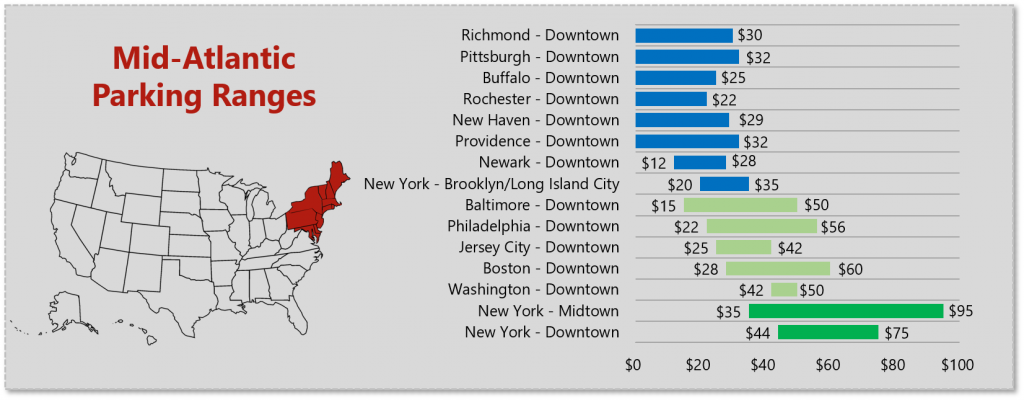
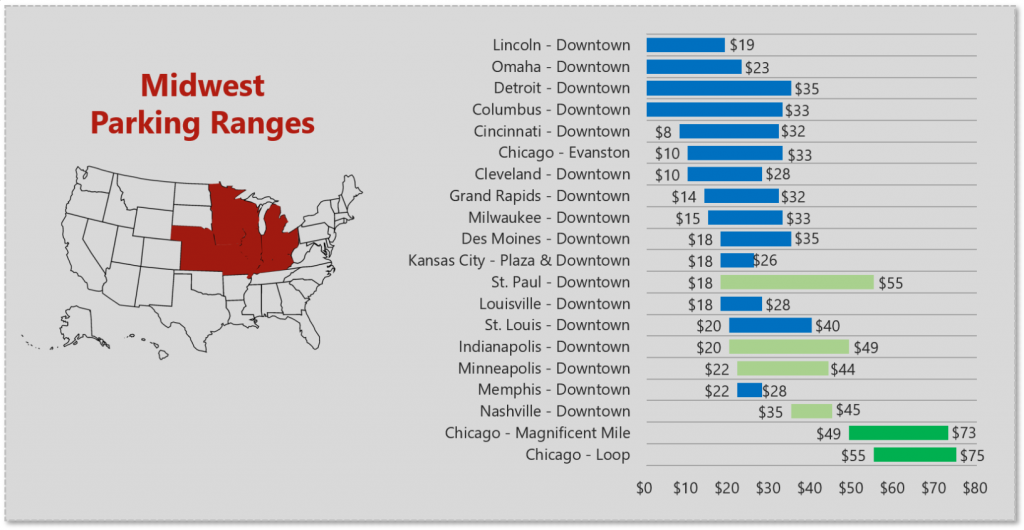
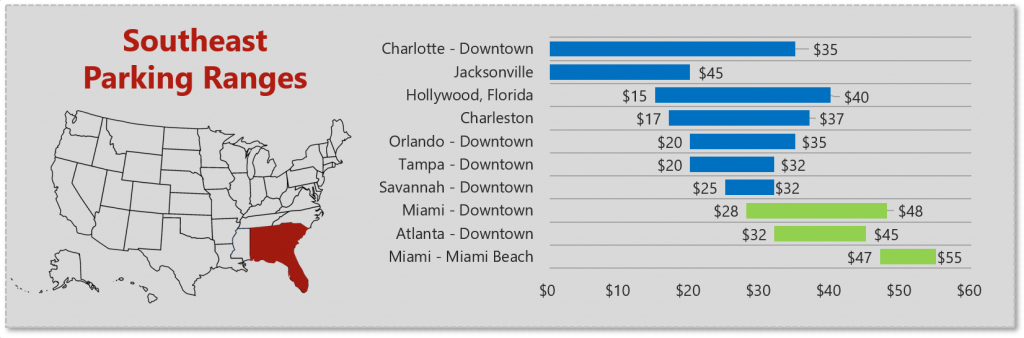
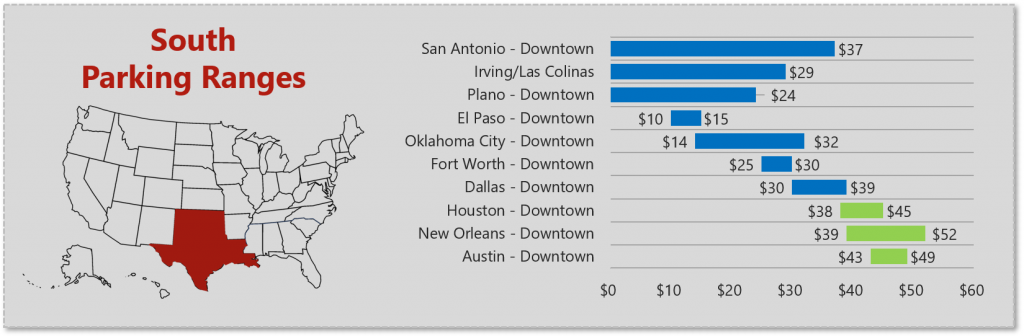
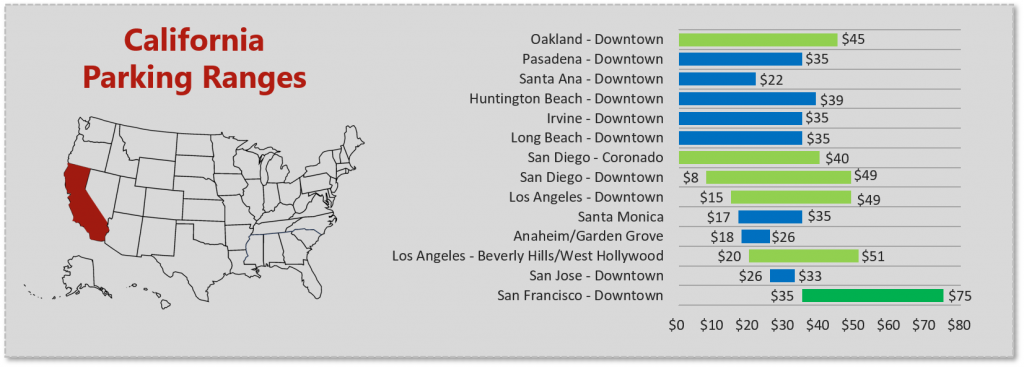
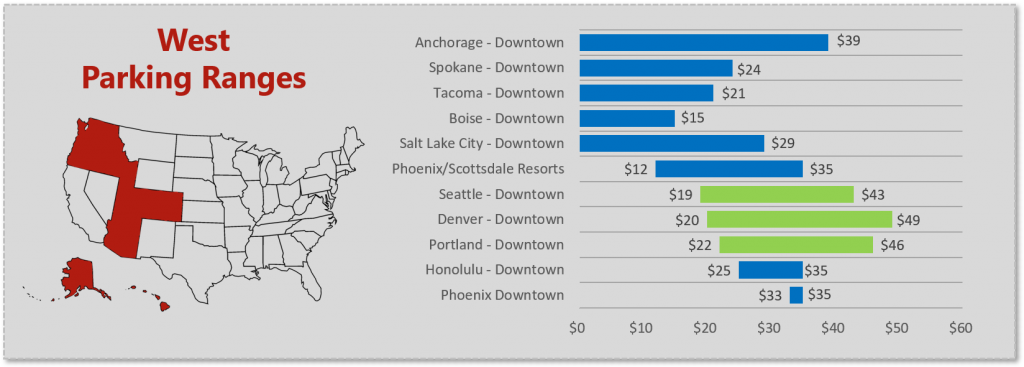
From a valuation perspective, be careful when comparing properties in city centers. A few may have major parking components (abnormal for a market) that skew a value high on a per- key basis, compared to another similarly-sized property on solely a room-count basis. It is important to inquire about garage utilization by daily and monthly users, daily parking rates, monthly contract rates, and the trends in all of the above over the last several years.
Data collection assistance provided by HVS team members Yi Ann Pan, Ziggy Hallgarten, and Bryanna Andersen.
]]>Before you travel to a destination with unhealthy air pollution:
- Familiarize yourself with your company’s virtual meeting capabilities. Maybe you can avoid a trip to a city with poor air quality.
- Get to know your company’s travel policy on health and emergency plans.
- Monitor the Air Quality Index, weather websites and local media to understand if the risk is particularly high during your stay.
- Travelers with a medical history of lung or heart issues should be extra vigilant.
- Discuss your planned trip with your doctor.
- Carry appropriate medications, such as inhalers for asthma, as well as documentation. You may need a doctor’s letter to get the medicines through customs.
- Research whether the air quality in your destination improves certain times of the year, and consider postponing your trip until pollution decreases.
During your business trip to a city with poor air quality
- Exercise outdoors early in the morning to lower potential exposure to pollution.
- Avoid high-traffic areas where pollution will be worst.
- Use mass transportation and ride in enclosed cars.
- Consider wearing a personal air quality monitor to assess risks in real time.
- Opt for glasses, rather than contact lenses, to minimize eye irritation. Or pack plenty of saline solution.
- Consider wearing a pollutant-filtering mask, such as an N95 respirator.
- Watch out for repeated coughing, pain when taking a deep breath, tightness in your chest or wheezing. All can be signs that you’re overexposed to polluted air. If you have these symptoms, go indoors immediately.
Get your Travel Risk Survival Kit
Close the gaps between the safety support your business travelers want and what your corporate program provides. Our Travel Risk Survival Kit describes the hazards ahead and offers solutions for overcoming them.
Breathing easier on business trips
BCD Travel’s Inform report, Air Quality and Business Travel, educates corporate travel managers and travelers about bad air hot spots and offers practical tips for protection.
]]>Research fees and document requirements before traveling.
Corruption remains a problem among customs and security personnel at some airports. Officials may insist that travelers pay fees or fines for fictitious violations. Some countries have strict requirements for certain documents, including vaccination records, and impose hefty (but legal) fines on travelers who do not have the required documents. If you are familiar with the published duties and fees, you can challenge the request for a fine. Bribes are illegal in every country- always use the term “fine” or “fee” when challenging the request for payment. If officials still insist on an additional fare, comply and pay the fine if the situation isn’t mitigated.
Stay vigilant entering the airport.
In places under constant threat, like Baghdad and Kabul, Afghanistan, security checkpoints begin miles from the terminal and include a myriad of scans, checks, and bomb-sniffing dogs. Following the Brussels airport bombing event, the airport added vehicle screening which occurs about a mile before the airport on the access road. US-based airports currently do not have street-side airport security; travelers can drive up to the terminal and use a convenient curbside bag-check. In this respect, it’s important to be aware of suspicious activity or baggage and report to airport security.
Be flexible.
While the aviation industry has made significant progress towards harmonizing aviation security screening standards across the world, some countries still have different procedures and standards. Travelers should not be alarmed if security procedures differ from those in their home country.
Be aware during bag check.
Have your ID at the ready and know the bag weight limit of the airline you’re flying. If prepared, you’re less likely to feel rushed or lose any belongings. Burglars have been known to hang around airports checking addresses to locate empty homes. It’s a good idea to make sure to hide your luggage tag so that passersby cannot view your home address.
Pack essentials in your carry-on.
To ensure the safekeeping of your electronics, medicine, and any other items that you will need access to during your flight, pack them in your carry-on. Keeping an eye on your carry-on is also important in wait lines. Bring a carry-on or purse that has a zipper to avoid a quick reach-and-grab. It may go without saying, but also never leave luggage unattended- even if someone next to you offers to watch it while you use the restroom.
Prepare for security checkpoints.
Once checked-in and in line for security, a standard rule of thumb is to take out electronics, cameras, and mobile devices and be ready to place them in a separate bin. Some checkpoint requirements are country-specific laws. For example, flights from some countries do not allow people to carry laptops in a carry-on. Other airports instruct the removal of shoes, belts, and anything metal. Know the security requirements of the places you are traveling to and from; you will be able to focus more on what is happening around you.
Move from landside to airside as quickly as possible.
Airside (post-security) areas of airports are less exposed to terrorism and crime than the landside, so travelers should try to get through from the landside to the airside as quickly as possible. Max Leitschuh, Sr. Intelligence Transportation Manager, says that passengers can take several steps to reduce their exposure to the possible threat of terrorist attacks in landside areas of airports. These include:
- Only bring carry-on luggage if possible
- Check in online before arriving at the airport
- Print boarding passes at home or send to a mobile device
- Proceed directly to security checkpoints after arriving at the airport instead of loitering in the landside areas
- Sign up for trusted traveler programs that are available (such as TSA Pre Check)
Passengers can sometimes use security checkpoints at terminals or concourses different from the scheduled flight concourse if they connect to the airside portion of the airport and the lines are shorter.
Be cognizant when you reach your destination.
Long flights, time differences, and travel itself can leave travelers tired. Be sure to take necessary steps to re-energize prior to arriving at your destination. This will allow you to stay alert as you transition from the airplane to the airport. Use peripheral vision to stay aware of your surroundings as you migrate through the airport. Make sure you only use official taxis or transportation that has been booked ahead of time. If staying at a hotel, pre-arrange an airport transfer using the hotel transportation service.
It’s important that travelers purchase insurance before embarking on a trip. Travel insurance covers emergency help if needed.
]]>The tied house and commercial bribery provisions are those most frequently cited by regulators reviewing an advertisement or marketing campaign.
It shall be unlawful for any person engaged in business as a distiller, brewer, rectifier, blender, or other producer, or as an importer or wholesaler, of distilled spirits, wine, or malt beverages, or as a bottler, or warehouseman and bottler, of distilled spirits, directly or indirectly or through an affiliate…
(b) “Tied house”
To induce through any of the following means, any retailer, engaged in the sale of distilled spirits, wine, or malt beverages, to purchase any such products from such person to the exclusion in whole or in part of distilled spirits, wine, or malt beverages sold or offered for sale by other persons in interstate or foreign commerce, if such inducement is made in the course of interstate or foreign commerce, or if such person engages in the practice of using such means, or any of them, to such an extent as substantially to restrain or prevent transactions in interstate or foreign commerce in any such products, or if the direct effect of such inducement is to prevent, deter, hinder, or restrict other persons from selling or offering for sale any such products to such retailer in interstate or foreign commerce: (1) By acquiring or holding (after the expiration of any existing license) any interest in any license with respect to the premises of the retailer; or (2) by acquiring any interest in real or personal property owned, occupied, or used by the retailer in the conduct of his business; or (3) by furnishing, giving, renting, lending, or selling to the retailer, any equipment, fixtures, signs, supplies, money, services, or other thing of value, subject to such exceptions as the Secretary of the Treasury shall by regulation prescribe, having due regard for public health, the quantity and value of articles involved, established trade customs not contrary to the public interest and the purposes of this subsection; or (4) by paying or crediting the retailer for any advertising, display, or distribution service; or (5) by guaranteeing any loan or the repayment of any financial obligation of the retailer; or (6) by extending to the retailer credit for a period in excess of the credit period usual and customary to the industry for the particular class of transactions, as ascertained by the Secretary of the Treasury and prescribed by regulations by him; or (7) by requiring the retailer to take and dispose of a certain quota of any of such products; or
(c) Commercial bribery
To induce through any of the following means, any trade buyer engaged in the sale of distilled spirits, wine, or malt beverages, to purchase any such products from such person to the exclusion in whole or in part of distilled spirits, wine, or malt beverages sold or offered for sale by other persons in interstate or foreign commerce, if such inducement is made in the course of interstate or foreign commerce, or if such person engages in the practice of using such means, or any of them, to such an extent as substantially to restrain or prevent transactions in interstate or foreign commerce in any such products, or if the direct effect of such inducement is to prevent, deter, hinder, or restrict other persons from selling or offering for sale any products to such trade buyer in interstate or foreign commerce: (1) By commercial bribery; or (2) by offering or giving any bonus, premium, or compensation to any officer, or employee, or representative of the trade buyer; …
TTB, with the cooperation in some states of state alcohol agencies, is conducting a widespread investigation of supplier and retailer activities involving one or more of the following activities: “pay to play” tied house violations, exclusive outlet, commercial bribery consignment sales, slotting fees, illegal sponsorship arrangements, and improper use of third parties, to name a few. TTB is conducting widespread industry interviews and is serving both formal and informal document requests directed at identifying these activities. TTB may prosecute a violation of the Act if the agency can prove an illegal inducement or requirement which resulted in exclusion; put another way, in order to meet its burden of proof, TTB needs to show that the inducement or requirement of the retailer resulted in the retailer purchasing the offending supplier’s products to the exclusion of other brands.
This article is part of our Conference Materials Library and has a PowerPoint counterpart that can be accessed in the Resource Libary.
HospitalityLawyer.com® provides numerous resources to all sponsors and attendees of The Hospitality Law Conference: Series 2.0 (Houston and Washington D.C.). If you have attended one of our conferences in the last 12 months you can access our Travel Risk Library, Conference Materials Library, ADA Risk Library, Electronic Journal, Rooms Chronicle and more, by creating an account. Our libraries are filled with white papers and presentations by industry leaders, hotel and restaurant experts, and hotel and restaurant lawyers. Click here to create an account or, if you already have an account, click here to login.
]]>FRANCHISE LAW
Similarly to the United States, Canada has pre-sale franchise disclosure laws in six of the 10 provinces in the country, each of which require that a “franchise disclosure document” or “FDD” be provided to a prospective franchisee at least 14 days before a franchise agreement is signed or any consideration is paid in respect of the franchise. Due to the broad application of franchise laws, certain relationships, including licensed or managed hotel arrangements, may be considered “franchises” under Canadian law, even if not so intended as such or characterised under American law. Consequences for failures or errors of disclosure include statutory misrepresentation and rescission, including the right to sue for losses. Canadian franchise laws are historically strictly construed against franchisors, with case law supporting large damage awards against hotel franchisors because of technical errors in disclosure. While the substance of disclosure is relatively similar in both countries, Canadian disclosure obligations include an overriding “materiality” concept which can require a FDD to be modified on a deal-by-deal basis to account for deal-specific facts, including, in some instances, the content of a PIP, as well as an ongoing disclosure obligations in respect of “material changes” between the provision of the FDD and the execution of a franchise agreement. Certain exemptions exist from the obligation to make disclosure, including in Ontario and British Columbia, where the acquisition of the franchise exceeds $5M
Similarly to the United States, Canada has pre-sale franchise disclosure laws in six of the 10 provinces in the country, each of which require that a “franchise disclosure document” or “FDD” be provided to a prospective franchisee at least 14 days before a franchise agreement is signed or any consideration is paid in respect of the franchise. Due to the broad application of franchise laws, certain relationships, including licensed or managed hotel arrangements, may be considered “franchises” under Canadian law, even if not so intended as such or characterised under American law. Consequences for failures or errors of disclosure include statutory misrepresentation and rescission, including the right to sue for losses. Canadian franchise laws are historically strictly construed against franchisors, with case law supporting large damage awards against hotel franchisors because of technical errors in disclosure. While the substance of disclosure is relatively similar in both countries, Canadian disclosure obligations include an overriding “materiality” concept which can require a FDD to be modified on a deal-by-deal basis to account for deal-specific facts, including, in some instances, the content of a PIP, as well as an ongoing disclosure obligations in respect of “material changes” between the provision of the FDD and the execution of a franchise agreement. Certain exemptions exist from the obligation to make disclosure, including in Ontario and British Columbia, where the acquisition of the franchise exceeds $5M.
NO “AT-WILL” EMPLOYMENT IN CANADA
There is no “at-will” employment in Canada. No Canadian employer has the ability to terminate a Canadian employee’s employment at any time without cause and without notice, except within the first three months of an employee’s employment (provided the employer has reserved that right, in writing, when it offers employment to be able to exercise it).
Employers have an implied duty of good faith and fair dealing with their employees. Consistent with this is the implied obligation to provide an employee with “reasonable notice” of termination of employment where there exists no “cause”. This entitlement can trigger substantial severance payments and is one of the key reasons that Canadian employers typically enter into formal written employment agreements with their employees.
While employers are permitted to terminate employees’ employment without notice for cause, cause has a very high threshold under a Canadian law. Under employment standards legislation in every Canadian jurisdiction, written notice of termination or pay in lieu of notice is required for the termination without cause of any employee with three months’ service or more. The statutory requirements vary across the country, but generally equal roughly a week of notice or pay in lieu for each year of service to a maximum of eight weeks.
Employment standards legislation cannot be contracted out of; attempts to do so are deemed void. The Supreme Court of Canada has set aside an employment agreement where the employee agreed no notice of termination was required. In that case, the Court required the employer to pay an amount consistent with the common law obligation to provide reasonable notice (which is typically much greater than the minimum imposed by employment standards legislation).
The common law obligation to provide reasonable notice is based on a number of factors such as age, length of service, position performed, and prospects for securing alternate, comparable employment. While there is no “rule of thumb”, awards of one month per year of service, and more, are commonplace in Canada.
Reasonable notice generally includes not just pay, but benefits, commissions, most incentives or bonus, pension, deferred payments, car allowances, continued stock option vesting, etc. The employer is required to keep the employee “whole” for the period of reasonable notice and, if paying in lieu, is required to maintain all of the compensation and benefits associated with the employment relationship, unless there is very careful drafting in the applicable plan to prevent this.
CANNABIS LAW
As of October 17, 2018, it has been legal to cultivate, posses, acquire and consume cannabis and cannabis products across Canada. Permitted products include cannabis and cannabis accessories, but excluded, until October 17, 2019, “edibles” and other cannabis-infused products, such beverages and vaporizers. The legal framework which regulates cannabis consists of federal, provincial and municipal laws and regulations. Federal legislation focuses on public health and safety, with jurisdiction over such things as production licensing, packaging, labelling and promotion and taxation. Provincial legislation focuses on distribution, retail, as well as setting rules regarding where individuals may smoke cannabis. The decentralization of jurisdiction to the provinces has created a lack of uniformity across the country. For instance, consumption in public areas is prohibited in some provinces, while others, like Ontario, permit consumption anywhere tobacco smoking is permitted, with certain exemptions (such as vehicles or where children frequent). Certain provinces, like Alberta, have created rules to permit (at a later date) the regulation of consumption spaces (such as lounges or cafes), while others have not. In Ontario, British Columbia, and other provinces, cannabis can be smoked in designated guest rooms in hotels, motels and inns. Local or municipal governments may impose further restrictions which could limit provincial rules.
DESTINATION MARKETING FEE LITIGATION – KNUTH V. BEST WESTERN ET AL…
In Canada, destination marketing programs have been established by local tourism authorities, hotel associations or other bodies, for the purpose of promoting tourism in a particular city or region. These programs raise money for their promotional activities by soliciting hotels and other tourist service providers to remit a percentage or fixed amount of their revenues to the marketing program. These contributions may be funded by the hotels in whatever manner they see fit, but usually take the form of a percentage surcharge on the quoted room rate; surcharges, referred to as Destination Marketing Fees (“DMF”), are collected voluntarily by the hotels, and have no statutory basis.
DMFs are distinguished from lodging or accommodation taxes which are also levied in some provinces over and above applicable sales taxes. These are collected and remitted to provincial authorities. Generally, municipalities in Canada lack the authority to levy local taxes on hotel rooms.
In Canada, a consumer must be provided with clear, unambiguous notice of the DMF prior to the consumer entering into the agreement, particularly as the consumer will use the pricing information to determine if he or she will enter into the agreement. The DMF must be disclosed as a separate item/charge and must not be combined with applicable taxes or any other amounts payable by the consumer.
In the ongoing case of Knuth v. Best Western et al, the plaintiff made claims based on, among other things, the following:
- the characterization (during the booking process on the hotel website) of a DMF as a tax, and
- misleading or incorrect disclosure (during the booking process on the hotel website) of the DMF or the applicable tax.
In many instances the website/software platforms being used by certain hotels could not easily set out the DMF on a separate line at the point of booking. In some instances, it is claimed that the DMF was included with the tax giving the appearance of taxes being charged in excess of the applicable rate. Further many systems could not charge the correct tax on the full room rate such that the tax was on top of the DMF.
By way of update, certain of the franchisors in the action brought a motion for summary judgement to have the action dismissed against them on the basis that they are not liable for the actions of their franchisees. In August 2019, the Court dismissed the summary judgement motion. It is expected that the next major step will be certification as a class action.
LOYALTY PROGRAM LAW UPDATE
There are recently-enacted laws in Ontario (January 2018) and Quebec (August 2019) regulating loyalty programs. Subject to prescribed exceptions, the new laws prohibit the expiry of reward points due to the passage of time alone.
The key exceptions include:
- if the customer has not earned or redeemed any points within a specified period, and such expiration is provided for in the agreement (note that in Quebec, the inactivity must last at least one year)
- rewards for a specific good or service identified at the outset (e.g. coffee stamp card)
- gratuitous points
It is anticipated that other Canadian jurisdictions will adopt similar loyalty specific legislation in the coming years.
CANADA’S ANTI-SPAM LEGISLATION (“CASL”)
In Canada, there are disclosure and consent requirements for the sending of a commercial electronic message (“CEM”). The sender must obtain explicit opt-in consent unless implied consent or an exception applies. This differs from the US “opt-out” model. The key exception is where there is an existing business relationship within a 2-year period immediately preceding sending of the CEM.
There are requirements for every CEM delivered, including:
- the contact information of the sender must be included in the CEM
- the CEM must provide an unsubscribe mechanism that is capable of being readily performed and is clear and prominent
- the sender must retain a clear and comprehensive record of opt-in/opt-out
MERGERS & ACQUISITIONS
Acquisitions of US hotels are almost always completed as asset deals unless there is a specific reason that an entity deal must be utilized. While asset deals are common in Canada, entity deals are sometimes utilized to take advantage of the lifetimes capital gains exemption. The exemption allows a Canadian individual who holds shares of a qualified small business corporation to a lifetime capital gains exemption equal to approximately CAD $850,000. There are a number of requirements in order to take advantage of this exemption including that the shares were held for a minimum of 2 years, the corporation was a Canadian-controlled private corporation, and that the corporation had during such time “active” business income. Further, land transfer tax is not payable in connection with a transfer of shares of a corporation but is payable on a transfer of assets which is further incentive to structure as a share deal.
AUTHORS
Jason Arbuck
Partner and Co-chair, Hospitality Group Cassels Brock & Blackwell LLP
jarbuck@casselsbrock.com
Frank Robinson
Partner and Co-chair, Hospitality Group Cassels Brock & Blackwell LLP
frobinson@casselsbrock.com
This article is part of our Conference Materials Library and has a PowerPoint counterpart that can be accessed in the Resource Libary.
HospitalityLawyer.com® provides numerous resources to all sponsors and attendees of The Hospitality Law Conference: Series 2.0 (Houston and Washington D.C.). If you have attended one of our conferences in the last 12 months you can access our Travel Risk Library, Conference Materials Library, ADA Risk Library, Electronic Journal, Rooms Chronicle and more, by creating an account. Our libraries are filled with white papers and presentations by industry leaders, hotel and restaurant experts, and hotel and restaurant lawyers. Click here to create an account or, if you already have an account, click here to login.
]]>A former server filed an action under the California Labor Code Private Attorneys General Act of 2004 (PAGA), seeking civil penalties on behalf of herself and other “aggrieved employees” for California Labor Code violations, including the failure to reimburse the cost of slip-resistant shoes. Plaintiff alleged a violation of Labor Code section 2802, which requires an employer to reimburse employees for all necessary expenditures incurred by the employee in direct consequence of the discharge of their duties.
Plaintiff argued that, because the restaurant required employees to wear slip-resistant, black, closed-toes shoes for safety reasons, such shoes should be provided free of cost or employees should be reimbursed for their cost.
The Court of Appeal, persuaded by the reasoning in an unpublished Ninth Circuit Court of Appeals decision, Lemus v. Denny’s, Inc., and guidance from the California’s Division of Labor Standards Enforcement (DLSE), held that section 2802 did not require the restaurant employer to reimburse its employees for the cost of slip-resistant shoes. Specifically, the Court held that the cost of shoes does not qualify as a “necessary expenditure” under section 2802.
In reaching its decision, the Court followed the reasoning in Lemus, citing a DLSE opinion letter, “The definition and [DLSE] enforcement policy is sufficiently flexible to allow the employer to specify basic wardrobe items which are usual and generally usable in the occupation, such as white shirts, dark pants and black shoes and belts, all of unspecified design, without requiring the employer to furnish such items. If a required black or white uniform or accessory does not meet the test of being generally usable in the occupation the [employee] may not be required to pay for it.”
Here, the plaintiff did not argue that the slip-resistant shoes were part of a “uniform” or were not usual and generally usable in the restaurant occupation. The restaurant did not require employees to purchase a specific brand, style, or design of shoes and did not prohibit employees from wearing their shoes outside of work.
Under California law, a restaurant employer must pay for its employees’ work clothing if the clothing is a “uniform” or if the clothing qualifies as certain protective apparel regulated by OSHA or California’s Division of Occupational Safety and Health (Cal/OSHA). Labor Code and Industrial Welfare Commission Wage Order No. 5-2001, governs the public housekeeping industry, including restaurants. Under Wage Order No. 5, uniforms must be provided and maintained by the employer when the uniforms are required by the employer to be worn by the employee as a condition of employment. “Uniform” includes “wearing apparel and accessories of distinctive design or color.” This section of the wage order specifically does not apply to protective equipment and safety devices regulated by the Occupational Safety and Health Standards Board.
On appeal, the plaintiff abandoned her alternative theory of liability that reimbursement was owed under provisions of Cal/OSHA, Labor Code sections 6401 and 6403, which require employers to furnish and provide safety equipment to employees.
The trial court had held that OSHA and Cal/OSHA provide than an employer is not required to reimburse employees for the cost of non-specialty shoes that offer slip-resistant characteristics, but are otherwise ordinary clothing in nature. However, the Court of Appeal ultimately did not decide the applicability of OSHA or Cal/OSHA. Likewise, the Ninth Circuit in Lemus v. Denny’s, Inc. did not address whether Cal/OSHA requires reimbursement of slip-resistant footwear.
After the decision in Townley, there remains a question of whether reimbursement for the cost of slip-resistant shoes could be required under Cal/OSHA for safety reasons. Under Federal OSHA regulations, employers must generally provide personal protective equipment at no cost to the employee. The regulation specifically includes an exemption for non-specialty safety-toe protective footwear, which the employer permits to be worn off the job-site. Employers are also not required to pay for everyday clothing, including street shoes and normal work boots. Under California law, if protective equipment is required by Cal/OSHA, the employer is responsible for paying for the safety equipment. There is no Cal/OSHA regulation equivalent to the Federal exemption for generic non-specialty shoes. While California employers have argued (and the trial court in Townley concluded) that the Federal exemption should control in California, the California Court of Appeal and Ninth Circuit have so far left that question unanswered.
Takeaways
Although we now have clarity that California Labor Code section 2802 does not require reimbursement of the cost of slip-resistant footwear, there remains the question of whether such footwear could constitute reimbursable protective equipment under Cal/OSHA safety standards. Although Townley and the Federal OSHA exemption provide some guidance for California employers, they are reminded that neither are necessarily binding or precedential. As such, it will be important for employers to track California caselaw in this area, as well as look out for Cal/OSHA guidance. In the meantime, employers are encouraged to periodically review their policies and practices for reimbursing employee business expenses to ensure compliance with California law, including Cal/OSHA regulations.
]]>