Reporting Channels
According to the Association of Certified Fraud Examiners 2018 Report to the Nation on Occupational Fraud and Abuse, less than half of organizations in the foodservice and hospitality industries had any sort of hotline established. Most of those businesses that currently provide a hotline are public companies which, by law, must offer an anonymous reporting channel to comply with Sarbanes Oxley regulations. Considering 90% of restaurants and 61% of hotels are small businesses, there is a significant lack of internal misconduct reporting options in the industry. However, reports made directly to state and federal agencies by hospitality workers are increasing and have placed the hospitality industry front and center of the media focus on workers rights and movements such as #MeToo.
2019 Benchmarks
Recent benchmarking statistics and a study from George Washington University1 demonstrate that “more active use of internal whistleblower systems is associated with fewer and smaller amounts of government fines and material lawsuits filed against the organization.”
Summary
In 2018 and 2019, there has been an increase in the number of reports alleging unethical or illegal conduct submitted by employees. This increase has been seen not through telephone hotlines, but other channels such as web, email, and open-door discussions.
Human Resources-related topics continue to be the majority of issues reported. Substantiation rates have increased, regardless of whether the reporter is named or anonymous. Retaliation claims continue to rise, with reports made primarily outside of the organization, rather than internally.
This article is part of our Conference Materials Library and has a PowerPoint counterpart that can be accessed in the Resource Libary.
HospitalityLawyer.com® provides numerous resources to all sponsors and attendees of The Hospitality Law Conference: Series 2.0 (Houston and Washington D.C.). If you have attended one of our conferences in the last 12 months you can access our Travel Risk Library, Conference Materials Library, ADA Risk Library, Electronic Journal, Rooms Chronicle and more, by creating an account. Our libraries are filled with white papers and presentations by industry leaders, hotel and restaurant experts, and hotel and restaurant lawyers. Click here to create an account or, if you already have an account, click here to login.
]]>What Are Predictive Scheduling Laws?
Predictive scheduling laws are generally straightforward. In short, they require employers to post employee work schedules a set number of days in advance of when the work is to be performed. Once posted, however, employers are penalized for making any scheduling changes.
In theory, these laws seek to balance respective interests between employers and employees—a balance that was recently addressed in the landmark California decision, Ward v. Tilly’s. In that case, the court assumed the role of the employee’s champion and explained that schedule predictability was an absolute necessity that allowed employees to plan around second jobs, make child-care arrangements, coordinate school schedules, or commit to social plans, among other things. Glaringly absent from this analysis, however, was the employer’s perspective and concurrent recognition that scheduling changes and fluctuating staffing needs are often caused by unforeseeable market realities such as inclement weather, employee call-outs, and unposted community events.
In practice, unfortunately, legislators have expressed wide disagreement over how to address this problem, causing many jurisdictions to take wildly different approaches. For example, in New York City, certain employers are only required to post schedules 72 hours in advance, with changes thereafter being completely prohibited. In contrast, San Francisco requires employers to post schedules not less than two weeks in advance. Once posted, however, any changes require the employer to pay the affected employee anywhere between one and four hours of additional “Predictability Pay,” depending on how last-minute the change actually was. As these examples demonstrate, legislators have yet to agree on any centralized model for predictive scheduling laws, creating a potential minefield for those employers that attempt to apply consistent scheduling practices throughout multiple jurisdictions.
What Industries And Jurisdictions Have Been Most Affected?
Since the first predictive scheduling law arose in San Francisco several years ago, other states and major U.S. cities have contributed to a precipitous rise in these laws. Places like Oregon, New York City, Chicago, Seattle, and Philadelphia have all since participated in this rising regulatory experiment by respectively proposing and implementing their own unique frameworks.
Simultaneously, other states have actively sought to combat the rise of these practices. In the wake of San Francisco’s law, states like Georgia and Tennessee quickly implemented legislation that prohibited their own major cities from enacting similar predictive scheduling laws at the local level, seeking to stifle an already-emerging trend.
To date, however, the retail and hospitality industries have taken the brunt of the regulatory force, with the vast majority of predictive scheduling laws targeting these industries exclusively. As justification for this disparate treatment, legislators have pointed to the disproportionate number of low-wage workers present in these industries who they believe warrant greater protection. For these employees, securing a reliable schedule through traditional means, such as direct negotiation, is far less likely. Accordingly, in these industries, the employer-employee tension between scheduling flexibility and predictably is at its zenith.
So What Should You Do Now?
Unfortunately, compliance with predictive scheduling laws is far from easy. Larger employers with locations throughout multiple jurisdictions tend to be the most affected, although even smaller employers can find themselves in a position that requires a full overhaul of their current staffing model. Accordingly, it’s important to keep a few points in mind.
First, you should audit your locations. The piecemeal framework of predictive scheduling laws means that you may have multiple locations subject to different predictive scheduling requirements. As a result, a centralized staffing model can quickly become outdated, or even worse, a liability. Location-specific policy changes may need to be made, and managers may require retraining on how to handle staffing shortages.
Second, avoid the related pitfalls. No employment law exists in a vacuum, and predictive scheduling laws are no exception. Implementing predictive scheduling models will often impact other aspects of your business and, in some cases, could create unforeseen liability traps. For example, in San Francisco, forgetting to tell your payroll company to separately delineate the “Predictability Pay” scheduling change penalty on your employees’ wage statements could saddle you with a host of unexpected labor code violations and class action demand letters—all for a simple oversight.
Third, consider novel and creative approaches. To address the rise of these laws, some large companies have implemented the use of scheduling apps. In addition to viewing pre-posted schedules, employees can use the apps to swap shifts with coworkers or sign up for unfilled shifts in upcoming weeks. Although, even without apps, voluntary schedule swapping and sign-up policies are both phenomenal ways to reduce, and even eliminate, the need for last-minute scheduling changes—all while boosting employee morale.
Conclusion
Ultimately, when it comes to employment policies, there is rarely a “one size fits all” approach. What’s right for one company may not be right for another. As a result, it’s important to keep up to date on the newest changes in both law and compliance strategies. In the modern day, employment laws are changing at an ever-increasing pace; if the recent rise in predictive scheduling laws hasn’t hit your state or city just yet, it soon may.
For more information, contact the authors at CCook@fisherphillips.com (415.490.9032) or AGuzman@fisherphillips.com (415.490.9028).
]]>Under the D.C. Human Rights Act (DCHRA), personal appearance is one of 20 protected traits for people that live, visit or work in D.C. Personal appearance is defined as the outward appearance of any person, irrespective of sex, with regard to bodily condition or characteristics, manner or style of dress, and manner or style of personal grooming, including, but not limited to, hair style and beards. To flesh this out, the D.C. Office of Human Rights, which administers the DCHRA, issued enforcement guidance in September 2017 to provide an explanation of this less understood protected category. It clarified that a person may not be discriminated against based on the individual’s actual or perceived “personal appearance,” which means employers may not refuse to hire someone, for example, because the individual wears a head scarf or has dreadlocks. The guidance document even provides an illustrative example of this. It states that, if Michael has a beard and applies for a job as a receptionist of a business office, where the job announcement requires applicants to have 3-5 years of experience and Michael possesses 5-6 years of experience as a front desk receptionist, the business employer cannot refuse to hire or consider Michael, a qualified applicant, because of his beard.
But, there are some limits to this rule. As the enforcement guidance makes clear, an employer can establish requirements for cleanliness, uniforms or other standards as long as the established standard is for a reasonable business purpose (e.g., for maintaining the health and safety of all individuals) and applied uniformly to everyone. This is often referred to as the “prescribed standards” exception, and is successfully argued by showing the following three elements: (1) the existence of prescribed standards; (2) uniform application of the standards to a class of employees; and (3) a reasonable business purpose for the prescribed standards. So, in our example, if Michael is hired, in most cases, the business employer may require that Michael adhere to the company’s established grooming standards along with all other employees, unless Michael has a religious reason for his beard. Unfortunately, however, the enforcement guidance, while certainly helpful, may have oversimplified this exception.
In the real-life context, employers have asked some tricky questions. What qualifies as a “reasonable business purpose”? How specific or broad should prescribed dress and grooming standards be? And what if we do not enforce the standards all the time because we have a lax enforcement policy or inadvertently miss a case or two? While advice from legal counsel can provide tailored answers to the first two questions, what is nearly certain about the last is that, if an employer does not enforce its dress and grooming standards, it is opening itself up to major legal risk. This is because, as described above, uniform application is a required element for employers to claim the “prescribed standards” exception. Furthermore, personal appearance discrimination claims are subject to the McDonnell Douglas burden-shifting framework that we described in a prior post. That is, if a plaintiff alleges employment discrimination through the use of indirect evidence, the plaintiff must show that: (1) she is a member of a protected class; (2) she suffered an adverse employment action; and (3) the unfavorable action gave rise to an inference of discrimination. One way for a plaintiff to demonstrate that an unfavorable action gives rise to an inference of discrimination is to present evidence of disparate treatment. This is often done by showing that she was treated differently than similarly situated employees outside of her protected class. Accordingly, if an employer does not enforce its dress and grooming standards consistently, it makes plaintiff’s case stronger, which is at least one reason why strict enforcement of such standards is so crucial.
Furthermore, although only a small number of jurisdictions extend anti-discrimination protections to personal appearance, this area of law is growing and is often intrinsically connected to other protected classes. For example, the New York City Commission on Human Rights (NYCCHR) issued new guidelines in February 2019 stating that employer policies on grooming and appearance that target, limit, or otherwise restrict natural hair or hairstyles may be unlawful and could result in a penalty of up to $250,000 per violation. This is because NYCCHR determined that black hairstyles are an inherent part of black identity, and therefore, should be protected racial characteristics. The guidance notes that protections extend to the right to maintain “natural hair or hairstyles that are closely associated with their racial, ethnic or cultural identities.” While the guidelines specifically focus on black communities, the protections extend to other groups, including those who identify as Latin-x/a/o, Indo-Caribbean, Native American, Sikhs, Muslims, Jews, Nazirites, and/or Rastafarians.
So what can employers do to minimize their legal risk and ensure they do not run afoul of any anti-discrimination personal appearance laws? As noted above, advice from legal counsel will assist in determining whether an employer’s business purpose is reasonable under the law, and whether its prescribed dress and grooming standards are written in a way that best shield the employer from potential claims. This is often done through a review of the employer’s dress and grooming standards in its employee handbook. Typically, a broader set of standards with legally protected carve outs (e.g., for religious and disability accommodations, health and safety concerns, etc.) is advisable. It is also prudent to enforce the standards uniformly and consistently. Other concerns, such as keeping the standards gender-neutral, should also be considered.
]]>- in the last 10 years, Title VII filings involving harassment have increased by nearly 700%;
- nearly 50% of women report experiencing some form of harassment at work at least once;
- according to a recent NY Times poll, nearly 1/3 of men reported doing something at work within the past year that would qualify as objectionable behavior or harassment; and
- on October 15, 2017, Alyssa Milano tweeted a request to reply if you have been sexually harassed or assaulted, and she received over one million mentions – by the next day.
And one can hardly forget the steady stream of business executives, entertainment moguls, and political leaders scandalized their organizations with outrageous details of men behaving badly. So where have employers, and those who work with them to get it right, gone wrong? Why are the herculean efforts of HR departments calming the rising tide of harassing behavior?
The answer is that we are focusing too much on what not to do under the law (and what we have to do to have a potential defense to liability), rather than providing employees and their managers with tools on how to create positive work relationships and foster psychological safety in their work groups. To be sure, harassing behavior is more than the product of a bad employee; it is symptomatic of a toxic work environment. In such environs we often find:
- An obsession with making the numbers, where outcomes are uncritically adopted;
- Recruitment, promotion, and reward systems focus on individuals’ “strength of personality” or interpersonal aggressiveness while ignoring emotional intelligence;
- Short-term planning governs operations;
- Executives give higher priority to personal friendships than to legitimate business interests; and
- Fear is a dominant, desired workplace emotion, whether deliberately engineered or inadvertently created.
Although there can be much discussion on the cultural causes of sexual harassment, what is clear is that workplace harassment allowed to ferment is the source of serious liability to business. It can be a sales dropping, share price lowering, brand tarnishing business killer. The #Metoo movement is a paradigm shift and call for a new approach to tackle this problem.
The good news is that we have a number of innovators who are solving parts of the problem, and their work can be brought together to form a new training regime that works to prevent harassment. I commend to you Professors Christine Pearson and Christine Porath and their work, “How incivility is damaging your business and what to do about it.” Leonardo Inghilleri’s work on training empathic skills to hospitality employees, and of course Google’s Project Aristotle and its steps for developing effective teams.
So, what is working? Training that includes protocols which teach employees and more importantly managers on how to foster good working relationship in their workgroups. We recommend revamping sexual harassment avoidance training to include 6 protocols.
- Developing an employee “how can I help you” culture;
- Techniques to project empathy or at least the appearance;
- Routine steps to handling any employee concern;
- Managing the unexpected;
- Using the most respectful language possible with random acts of kindness; and
- Bystander training.
A prevention program built around these principles will help employers to do more than just comply with the law – it will reinforce the notion that everyone plays a critical role in preventing workplace harassment (or any other kind of misconduct for that matter) and creating a successful workplace culture. It will also empower employees with the tools to step in and stop it. These, in turn, will help employers to achieve their business goals – from decreasing harassment occurrences to improving performance and morale. It is hard to argue against such benefits. It is clear, change is rapidly occurring and this next generation workforce is not silent.
]]>Yes, indeed—the labor market is tight. And with the nationwide unemployment rate below 4 percent, 263,000 new jobs created in April 2019, and a sizzling economy, the labor market is likely to get even tighter. This is especially true for the hospitality industry, which has traditionally relied upon a steady stream of lower-skilled and younger applicants eager to enter into the job market. In fact, the National Restaurant Association predicts that jobs in the food service industry will top 15 million in 2019, and lists recruiting and retaining employees among the top challenges for operators.
Yet, just 19 percent of 15- to 17-year-olds had jobs in 2018, and 58 percent of 18- to 21-year-olds had jobs, according to a Pew Research Center study published in November 2018. This is significantly down from years past. The cause of this trend is difficult to predict. Whether parents are not pushing their kids to enter the workforce, or there are too many other extracurricular activities to occupy their time, one thing is certain: younger workers are not as eager to pick up a part-time job, even at the local eatery that is begging for help.
Legal Roadblocks Also Complicate Hiring
Federal and state laws can also deter hiring anyone who is under 18 years of age. Under the federal Fair Labor Standards Act (FLSA), there are regulations that preclude employees who are 16 and 17 from performing certain job duties, such as operating power-driven machines like mixers and meat processors, and delivering food via automobile. Another layer of federal regulations applies to 14 and 15-year-olds, which significantly restricts the number of hours that can be worked during a day and workweek, particularly during the school year. If you are skeptical, check out “Fact Sheet #2A: Child Labor Rules for Employing Youth in Restaurants and Quick Service Establishments Under the Fair Labor Standards Act (FLSA)” on the U.S. Department of Labor’s website.
State laws also serve as a bugaboo to employing minors, and these laws can vary greatly from state to state. One example is in Louisiana, where additional rules and regulations for employing require that all minors (defined as under 18 years of age) to have a 30-minute uninterrupted work break within every five hours of employment. A failure to comply with this requirement will subject the employer to a significant fine.
Time To Get Creative
So, what can Mr. Joe at Big Eats do to increase applicant flow and hire more employees at his stores? We told Mr. Joe that one idea is to increase his starting wage and increase benefits, which he did not want to hear. The fact is, however, many competitors for this part of the workforce (such as big-box retailers) have increased their starting wages well above minimum wage in order to attract applicants.
A quick Google search offers other examples of how employers are creatively trying to solve this workforce problem. From utilizing mobile apps that allow employees to swap shifts at the last minute when conflicts arise, to allowing employees to express their opinions on branding of the products being sold, to handing out recruiting cards to customers who visit the establishment, to offering bonuses to employees who recruit other employees to join the company, to teaming up with AARP to recruit and hire older workers—it is clear that creative thinking gives employers a distinct advantage.
Need another example? Look no further than the Louisiana Restaurant Association’s Education Foundation (LRAEF), which is tackling the workforce issue head on. The LRAEF is a major supporter of the nationwide ProStart program, a two-year program for high school students teaching culinary techniques and management skills that are specifically tailored to the food service industry. Today, there are 56 Louisiana high schools and almost 2,000 Louisiana high school juniors and seniors participating in the program.
According to Wendy Waren, the Vice President of Communications for the LRA, “The LRAEF provides school support grants to purchase ingredients for labs, testing materials, and for field trips. The high school students also participate in the Raising Cane’s ProStart Invitational, held yearly at the New Orleans Convention Center, and that event provides the students with a chance to show their skills and compete for $1.2 million in scholarships. ProStart is a comprehensive program and it is a great way to get our young people interested in the food service industry. We hope they will discover that there are exciting and fulfilling career opportunities in the industry. While employing teens may present challenges, hiring ProStart students will make the challenge worth it given their advanced training.”
Conclusion
So, our advice to Mr. Joe at Big Eats? In addition to suggesting that he may want to look at raising his starting wage and offering additional benefits, he will have to get creative in his search for more applicants and good employees.
Yes, the labor market is tight. But, by partnering with a local restaurant association, using technology and social media, and just generally letting the creative juices flow, even Mr. Joe will be able to find and retain the elusive employees that he so desperately needs.
For more information, contact the authors:
Steven Cupp – Partner, Gulfport office | New Orleans office
SCupp@fisherphillips.com
(228.822.1440)
Steve Cupp is a partner in the firm’s Gulfport office. He has experience across a range of industries, including manufacturing, financial services, construction, and retail.
He has devoted his practice to representing management interests in various areas of labor and employment law, including traditional labor litigation before the National Labor Relations Board (NLRB), handling Department of Labor (DOL) wage and hour audits, and litigation of Fair Labor Standards Act (FLSA) cases.
Steve is certified as a Senior Professional in Human Resources from the Human Resource Certification Institute and he is an active member of the Society for Human Resource Management.
Jaklyn Wrigley – Of Counsel Gulfport Office
JWrigley@fisherphillips.com
(228.822.1440).
Jaklyn Wrigley is a high-energy labor and employment law litigator who exclusively represents the interests of management. Over the years, she has achieved countless employer-friendly results, recently in the form of a full defense verdict in a complicated he-said/she-said sexual harassment lawsuit. Jaklyn is committed to providing the highest level of service, and in this “24/7” client service business, she recognizes that near-fanatical responsiveness is often as critical as innovative and quality legal representation. She prides herself in offering both. These efforts have been recognized, and Jaklyn has been selected for inclusion in Mississippi Super Lawyers – Rising Starsevery year since 2013.
Practicing in both Mississippi and Florida state and federal courts, as well as before administrative agencies, Jaklyn has extensive experience with the alphabet soup of federal labor and employment laws: ADA, ADEA, FLSA, FMLA, NLRA OSH Act, and Title VII; and litigation involving immigration issues, wrongful termination, and breached employment agreements. In her practice, Jaklyn applies a laser focus on the healthcare industry, and understands the interplay between and among healthcare compliance issues, the medical staff, and employment law. She also actively represents clients in the retail, gaming and hospitality, agriculture, and auto dealer industries (among others). Jaklyn has made a point to learn the business environments in which her clients operate so that she can offer advice that is specifically tailored to their needs.
When she is not litigating on behalf of her clients, Jaklyn is working diligently to help her clients avoid legal problems. This is particularly true as it concerns sexual harassment, gender identity, sexual orientation and gender equity issues in the workplace. From internal audits, management training and employee contracts, to handbook reviews and practical day-to-day advices, Jaklyn believes the easiest problem to solve is one that never arises in the first place.
]]>But not every article of clothing constitutes a “uniform” under the FLSA. The U.S. Department of Labor (USDOL) has long maintained that certain clothing, although required by the employer, is of such a character that it may be reasonably worn outside the context of work and therefore is not a uniform. Shoes are an interesting case-study.
Does The Shoe Fit?
Many hospitality employers often require employees, such as culinary department workers, to wear a certain type of shoe during work hours. Perhaps the most popular variety is the dark-colored, non-slip shoe—widely used both for their appearance and for safety reasons.
Some employers may be surprised to learn that the USDOL takes the position that these shoes do not constitute a uniform under the FLSA. As a result, employers can impose the cost of such shoes even if the cost results in the employee receiving less than the minimum wage after such deduction.
Before The Other Shoe Drops…
A word of caution before hospitality employers rush out to take advantage of this cost transfer. Experience in USDOL investigations teaches us that the agency does not give employers complete freedom regarding shoe deductions, even when it comes to dark-colored, non-slip shoes. For example, if you require employees to order a specific brand of shoe from a certain vendor when a comparable, less-expensive alternative is available, the USDOL may conclude that the shoe is no longer “basic street clothing.” The agency may reach the same conclusion if the employee already owns a pair of shoes but is told that they must order a new pair. Finally, the USDOL will be on the lookout for any ordering mechanism whereby the employer receives a fee or profit anytime an employee orders shoes through a designated vendor.
Many hospitality employers are familiar with Shoes for Crews, a manufacturer of non-slip shoes and other accessories. Shoes for Crews offers a corporate program to businesses which includes a “warranty” in the form of a $5,000 payment if an employee wearing Shoes for Crews slips at work. The USDOL finds this warranty problematic. The agency has been known to take the position in investigations that this warranty constitutes a benefit to the employer that changes the legal characteristic of the shoe such that it becomes a uniform. Thus, according to USDOL, an employer participating in this Shoes for Crews corporate program may not impose the cost of the shoe on an employee if doing so cuts into the minimum wage or overtime wages. The agency has taken this position even when an employer has never asserted a claim for the Shoes for Crews warranty payment.
Conclusion: Putting Yourself In Your Employees’ Shoes
The cost of purchasing (or cleaning) a uniform can be problematic for employers, when the cost (or part of the cost) is borne by the employee. Setting aside whether there is a legal basis for the USDOL’s position on the shoe warranty program, hospitality employers should carefully review their policies as they relate to the cost of required clothing worn by employees.
For non-slip shoes, if you have decided to pass on the cost of these shoes to employees, consider giving the employee the option of purchasing shoes at a retailer of their choice or wearing already-owned shoes which are compliant with safety requirements. This is particularly true for employers that participate in the Shoes for Crews corporate program.
For more information, contact the authors:
Andria Ryan – Partner, Atlanta office
ALureryan@fisherphillips.com
(404.240.4219)
Ted Boehm – Partner, Atlanta office
TBoehm@fisherphillips.com
(404.240.4286)
Per the Equal Employment Opportunity Commission’s annual report, the EEOC secured more than $505 million for victims of discrimination for the fiscal year 2018. Amongst them, the EEOC won a verdict in the Ninth Circuit against a railway, holding that it was a violation of the ADA to force an employee to obtain an MRI at his own expense before beginning employment. EEOC v. BNSF Railway Company, 902 F.3d 916 (9th Cir. 2018).
Long-Term/Indefinite Leaves of Absence Under the ADA: Courts have ruled differently with respect to whether long-term or undefined leaves of absence are reasonable accommodations under the ADA. It depends on the jurisdiction that you are in and/or the particular facts of the case. The Seventh Circuit held that a long-term or undefined leave of absence is not a reasonable accommodation under the ADA. Severson v. Heartland Woodcraft, Inc., 872 F.3d 476, 482 (7th Cir. 2017). Several courts have followed Severson and held that indefinite or long-term leaves of absence are unreasonable. See Rancourt v. OneAZ Credit Union, No. cv-17-00194-phx-jjt, 2018 U.S. Dist. LEXIS 138805 (D. Ariz. Aug. 16, 2018); Markowitz v. UPS, 711 Fed. Appx. 430 (9th Cir. 2018); Wilson v. Greenco Indus., No. 17-cv934-wmc (W.D. Wis. Mar. 7, 2019). However, at least one court has declined to follow Severson, holding that an extended unpaid leave could be a reasonable accommodation so long as it was not an undue hardship for the employer, regardless of the length of the leave. Estep v. Forever 21 Retail, Inc., (D. Or. Nov. 13, 2018) (citing Nunes v. Wal-Mart Stores, Inc., 164 F.3d 1243, 1247 (9th Cir. 1999)).
ADA and Obesity: Employers should reevaluate accommodation requests and hiring processes for employees and applicants that are obese. Any denials of accommodation or refusal to hire should be based on the limitations posed by obesity itself, not based on any “perceived” characteristic associated with obesity. Courts may determine that employers “regarded” an employee as disabled based on perceived health complications associated with obesity, amounting to a violation of the ADA. See Shell v. Burlington Northern Santa Fe Railway Company, No. 15-cv-11040 (N.D. Ill. Mar. 5, 2018).
FMLA Notice Requirements: Courts have reinforced that employers may require notice of the use of FMLA leave and an initial showing of a “serious health condition.” However, employers should not deny requests simply because an employee has not expressly stated that the employee needs or is using FMLA leave. Additionally, employees are not required to return to work when they are cleared for light-duty by a medical provider, and may still utilize unexhausted FMLA leave before returning to the workplace. Still, employers may require employees to notify the employer if and when the employee decides to return. See Stein v. Atlas. Indus., 730 Fed. Appx. 313 (6th Cir. 2018).
FMLA Interference: As demonstrated in Walker v. Pocatello, No. 4:15-cv-00498-BLW (D. Id. Jan. 31, 2018), employees maintain the right to require a second opinion from an employee’s medical provider if it has objective reason to doubt the validity of FMLA medical certification. However, if an employer takes additional actions to find evidence of an employee’s medical issues – including internet or video surveillance – these measures could amount to FMLA interference.
Takeaways for the ADA: Continue to assess accommodation requests on a case-by-case basis, and review policies regarding pre-employment medical examination requests.
Takeaways for the FMLA: Employers may still require notification and certification to evaluate whether an employee is eligible for FMLA, but employees may still be entitled to take FMLA leave even where they have not expressly stated that they are using FMLA or have a need to take FMLA leave.
This article is part of our Conference Materials Library and has a PowerPoint counterpart that can be accessed in the Resource Libary.
HospitalityLawyer.com® provides numerous resources to all sponsors and attendees of The Hospitality Law Conference: Series 2.0 (Houston and Washington D.C.). If you have attended one of our conferences in the last 12 months you can access our Travel Risk Library, Conference Materials Library, ADA Risk Library, Electronic Journal, Rooms Chronicle and more, by creating an account. Our libraries are filled with white papers and presentations by industry leaders, hotel and restaurant experts, and hotel and restaurant lawyers. Click here to create an account or, if you already have an account, click here to login.
]]>No “Employment at Will”
The U.S. concept of employment at will does not exist in Canada. In Canada, both employment standards legislation and the common law require an employer that terminates an employee’s employment without just cause to provide certain entitlements.
Under the employment standards legislation in each province, an employer must provide an employee notice of termination of employment in lieu of notice (usually one week per year of service to a maximum of eight weeks: more for group terminations), unless the employee is terminated for willful misconduct or willful neglect of duty. Some jurisdictions also require an employer to pay severance pay in addition to providing notice. For example, in Ontario, an employee with five or more years of service with an employer that has an annual payroll of at least $2.5 million is entitled to one week’s pay per year of service up to a maximum of 26 weeks.
The common law requires that an employer provide an employee “reasonable” notice of termination or pay in lieu of notice unless just cause exists, there is a clear agreement otherwise, or a union represents the employee. Reasonable notice for each employee is determined on a case-by-case basis and depends on a number of factors, such as the employee’s position, age, and length of service, and the availability of similar employment elsewhere. Reasonable notice at common law almost always exceeds the notice required by applicable legislation.
Pregnancy and Parental Leave
Whereas the U.S. Family and Medical Leave Act (FMLA) requires an employer to provide an employee up to 12 weeks of unpaid leave, employment standards legislation in all Canadian jurisdictions require an employer to provide up to at least 52 weeks of pregnancy and parental leave. In addition, the right to pregnancy and parental leave applies to all employees in Canada, not just to those employed by employers with 50 or more employees (as provided by the FMLA).
Discrimination and Harassment
Prohibitions against discrimination and harassment in employment under various U.S. statutes, such as Title VII of the Civil Rights Act of 1964, the Americans with Disabilities Act, and the Age Discrimination in Employment Act of 1967, may be found in each province’s or territory’s human rights legislation (e.g., in Ontario, the Human Rights Code). Canadian human rights legislation in all jurisdictions prohibit discrimination and harassment on the basis of sex, disability, age, race, national or ethnic origin, color, religion or creed, marital status, and sexual orientation.
An employee in Canada may not file a civil action for discrimination, as is permitted in the United States. An employee may complain only to an administrative tribunal in the province he or she works, which adjudicates complaints. Administrative tribunals across Canada have wide powers to order reinstatement of employees, to require an employer to take steps to prevent discrimination and harassment, and to award monetary compensation. Monetary awards, however, are generally much lower than U.S. jury awards.
There are other significant differences between Canadian and U.S. employment laws. Local legal counsel can help to ensure that you are in compliance with all applicable laws. Other Canadian employment-related laws with which you should comply include:
- Employment standards legislation, which regulates minimum wages, hours of work, breaks, overtime pay, vacation and holidays with pay, entitlements on termination, and leaves of absence.
- Labor relations legislation, which governs certification/decertification of unions and collective bargaining.
- Occupation health and safety legislation, which governs an employer’s obligation to provide a safe workplace.
- Statutory workers’ compensation/workplace safety and insurance legislation, which governs an employer’s obligations respecting workplace injuries and accidents.
- Pay equity and employment equity legislation, which require equal pay for equal work and equal employment opportunities for employees.
For more information on Canadian employment law issues, contact James R. Hassell or Patricia S.W. Ross of the Employment and Labor Law Department of Osler, Hoskin & Harcourt LLP Barristers & Solicitors:
(416) 362-2111
P.O. Box 50
1 First Canadian Place
Toronto, Ontario, M5X 1B8
Or log on to www.osler.com, Osler, Hoskin & Harcourt’s website, which contains numerous articles on Canadian labor and employment law: canadaonline.about.com/od/labourstandards/Canada_Employment_and_Labour_Standards.htm for links to Ministry of Labour websites across Canada that provide information on employment standards, health, and safety, and labor relations, and to www.ohrc.on.ca, for Ontario’s Human Rights Commission, and links to other human rights agencies across Canada.
Provided by James R. Hassell and Patricia S.W. Ross of Osler, Hoskin & Harcourt LLP, Toronto, Ontario. www.osler.com.
]]>In order to dispel the confusion under federal law, let’s examine a hypothetical scenario. Imagine that Acme Apartments, a business that leases apartments, has a no-pet rule for its tenants and an office policy prohibiting pets in the workplace. Acme also operates a fitness center for tenants and the general public with a no-animal policy. In this situation, Acme will need to follow the Fair Housing Act (FHA), Title I of the American Disabilities Act (ADA), and Title III of the ADA. How each of these laws apply to Acme—and your business—is described below.
Assistance Animals And The FHA
Acme’s pet restrictions are generally lawful. However, under the FHA, Acme must allow tenants and applicants with a disability to live with assistance animals that meet their disability-related needs. The only exception to this requirement is if the assistance animal would pose a direct threat to others or would cause substantial physical damage to property.
What constitutes an assistance animal is interpreted broadly. It could be a dog or any other animal that “works, provides assistance, or performs tasks for the benefit of a person with a disability, or provides emotional support that alleviates one or more identified symptoms or effects of a person’s disability.” Assistance animals will typically perform functions like providing protection or rescue assistance, fetching items, alerting persons to impending seizures, or providing emotional support to persons with disabilities who have a disability-related need for such support. In this context, assistance animals are sometimes referred to as “service animals,” “assistive animals,” “support animals,” or “therapy animals.” However, the preferred term is assistance animals to avoid confusion with other laws.
Service Animals And Public Accommodations Under The ADA
The legal requirements differ depending on whether you are considering accommodations in public places or in the workplace.
In Public Places
Title III of the ADA requires businesses that provide goods or services to the public to allow service animals to accompany people with disabilities in all areas of its facility in which the public is normally allowed access. Going back to Acme, this means that it must accommodate service animals in its leasing office and fitness center for visitors and patrons with a disability.
However, under Title III, service animals are limited to only individually trained dogs and, with some exceptions, miniature horses. Most often, service animals perform functions like guiding the blind, alerting the deaf, pulling wheelchairs, providing seizure alerts, or calming a person during an anxiety attack. Service animals do not include untrained comfort animals, which are generally animals that provide psychological comfort by their existence. In other words, no rabbit, bird, cat, monkey, or untrained dog can qualify as a service animal under the ADA in this context.
So how would Acme know if a dog or miniature horse is a service animal? Under the ADA, Acme is allowed to ask whether the animal is a service animal and what tasks the animal has been trained to perform, but nothing more. Acme cannot require proof of disability, certification, or make any other inquiry.
However, if the owner cannot maintain control of the service animal, or if the service animal proves dangerous or disruptive by its conduct, then Acme can expel it from the premises. Because of this limited inquiry, and the fact that many pet owners are apparently now attempting to pass their pets off as service animals, a growing number of states are making it a crime to misrepresent a pet as a service animal or misrepresent oneself as a person with a disability to gain access with a dog. Arizona, California, Minnesota, New Jersey, and Texas now have criminal penalties including jail time for such misrepresentations, with more states looking to follow.
In The Workplace
What about employees who request to bring animals into the workplace? Assume that one of Acme’s employees says that she has an anxiety disorder and would like to bring her pet rabbit to work. She explains that it helps mitigate the disorder and allows her to perform her duties. Must Acme allow the rabbit in the workplace? To answer this question, employers must turn to Title I of the ADA.
Title I of the ADA requires that Acme, when asked, provide reasonable accommodations to qualified employees with a disability in order to allow the employee to perform the essential functions of the job. Acme is obligated to provide reasonable accommodations unless it would create an undue hardship.
When such requests are made, the employer should engage in an interactive discussion with the employee to learn about the employee’s disability, how it is impacts the employee’s major life functions, and how it may be impeding getting the employee’s job duties done. In this process, it is important to highlight that employers must only provide a reasonable accommodation, and not the preferred accommodation requested by the employee if effective alternatives exist. In other words, if the employer can provide an alternative to the accommodation requested that is effective in allowing the employee to perform the job functions and is more in line with the needs of the employer, then the employer can provide that alternative and meet its ADA obligations.
As a practical matter, after engaging in the interactive process, most employers will discover that there are likely reasonable alternatives to permitting comfort animals in the workplace—but few to none regarding service dogs. In the rare case of a comfort animal request, some employers have offered less disruptive alternatives such as the use of a pet monitor at work or the use of a stuffed animal likeness. To date, there are no known cases in which a court has found an employer in violation of the ADA for denying the work presence of an untrained comfort animal where an alternative has been offered.
In contrast, a trained service dog accompanying an employee to their job has long been viewed as a “reasonable accommodation” under Title I of the ADA, even though not specifically listed as part of that section. There are a number of cases in which employers have been found to have violated the law by not permitting service dogs in job interviews or at work. In fact, the EEOC is currently pursuing a federal lawsuit against a trucking company for violating the ADA by not allowing a military veteran truck driver to complete his training with a trained service dog who provides “emotional support” and mitigates his post-traumatic stress and mood disorder.
However, employers may still deny these animals in the workplace if the employer can show the rare circumstance that it would create an undue hardship to operation of the employer’s business. Under the ADA, undue hardship is defined as an “action requiring significant difficulty or expense” when considered in light of a number of factors. Examples of undue hardship in this context may include safety issues caused by the presence of the dog, the presence of other employees with dog allergies, or coworker phobias. Claiming undue hardship is a very narrow exception under the law and businesses who wish to use it should seek advice from legal counsel.
Conclusion
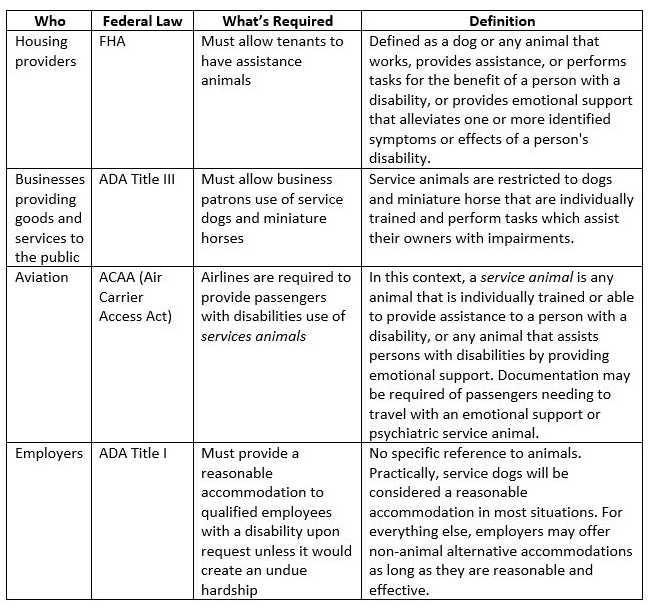
As with any regulated area, businesses subjected to the above laws should seek the assistance of counsel when drafting policies and developing staff training materials. Based on the multiple laws and definitions regarding assistive and service animals, it is no wonder that businesses, employers, and the general public are often confused about their rights and obligations. To help clarify, below is a chart that may help provide some order:
Keeping the workplace safe from violent incidents requires hospitality employers to be able to identify warning signs and risk factors. But the work starts before that; it starts with the hiring and employee monitoring processes.
Before And After You Hire: Internal Threats Of Violence
Internal threats of workplace violence require separate considerations from external threats. Preventing internal threats of violence generally requires a focus on pre-employment screening, employee monitoring, and effective employee training. Hospitality managers can think about this as occurring in two phases: before the hire and after the hire.
Before You Hire
An important time to begin taking measures to prevent and minimize workplace violence is during the hiring process. Effective pre-employment screening can help you avoid hiring employees with “red-flag” behavior. Some steps that hospitality employers can take to avoid future instances of workplace violence include:
- Criminal history and background checks. You are permitted to conduct criminal history and background checks for job applicants. While federal law prohibits the use of this information in ways that would discriminate against or disparately affect protected classes (e.g., race and national origin), you can use previous convictions, and sometimes arrests, as a screening tool, on a case-by-case basis, where such convictions may relate to an essential job requirement. With the level of daily customer contact present in the hospitality industry, properly conducted criminal history screenings, particularly where there is a history of violent crime, can work to prevent future incidents of workplace violence. Note, however, that state and local laws often govern the use of background checks by employers, so you should consult with legal counsel on best practices for implementing this screening tool.
- Social media. There are currently no federal laws that prevent you from monitoring the social media activity of prospective and current employees. Despite valid privacy concerns and the potential for bias, the social media accounts of both potential and current employees can provide a wealth of information for employers. In the hospitality industry, a large majority of the employees are millennials who are often more comfortable portraying their true thoughts through a computer screen. Through these sites, you may possibly learn of the potential violent predispositions that job applicants may have. A job applicant’s social media presence can demonstrate to you whether warning signs like fascination with violence, for instance, are present. This applies equally to current employees.
It is important to note, however, that the use of social medial as a pre-employment screening tool or a monitoring device for current workers comes with a number of potential pitfalls that you must work diligently to avoid. A potential employee’s social media can also alert employers to information such as the employee’s race, religion, gender, disability, sexual orientation, pregnancy status, etc., none of which can be taken account in the decision to hire an applicant. Moreover, a current employee’s social media feed might reveal private information you might not want to know for fear that your knowledge could be used against you in a later discrimination or retaliation claim. Therefore, you should consult with legal counsel before deciding to implement any sort of social media screening.
After You Hire
Because warning signs of future workplace violence are not always apparent before you hire, you must still take steps to monitor their current employees for potential signs. In the stressful environment of the hospitality industry, it does not take much for a simple disagreement between line cooks in the kitchen to turn into knives being pulled against a coworker. A few tips for employers:
- You should implement and maintain an effective workplace violence plan. This plan will contain outright bans on certain “trigger” behavior such as harassment, fighting, threatening, and bullying—and outline the discipline for such behavior. The plan may also contain a ban on employees carrying weapons on your premises as well. The plan should provide conflict resolution tips and strategies for employees to use to deescalate a stressful situation.
- You should train employees on how to identify and report “suspicious behavior,” some of which can include a fascination with violence, excessive verbal threats to other employees or against restaurant patrons, substance or alcohol abuse, obvious indicators of mental instability, or a history of poor impulse control or violence. In training employees on how to identify and report suspicious behavior, you should also have an effective procedure for handling employees that have been reported:
- First, management needs to take all threats seriously;
- Where the reports are of internal conflicts, harassment, or bullying, you need to work quickly to understand the root of the conflict and diffuse it; and
- You should discipline as appropriate in order to clearly demonstrate that any such violent behavior will not be tolerated.
- Employee training should also include training on conflict resolution between other employees in the workplace. Effective conflict resolution training is necessary to aid employees in immediately deescalating situations that may arise in the workplace. Importantly, these skills can also be used when dealing with the public. In training employees on how to effectively manage conflict and deescalate potential acts of violence, you should adopt the following training guidelines:
- Where tempers are running high, it is best to separate the employees and give them space to calm down;
- It is important to understand what the nature of the conflict is;
- Extreme care should be taken not to pass blame or take sides; and
- Management should be informed about the situation as soon as practicable.
The high rate of turnover in the hospitality industry presents an added layer of responsibility as it relates to dealing with internal threats of violence, because you must ensure that your new employees are constantly being trained. As such, you should consider implementing both a new-hire training schedule, as well as periodic refresher trainings.
When It Is Out Of Your Control: External Threats Of Violence
Because hospitality employers welcome the public, monitoring external threats of violence is extremely important. It only takes one angry customer or even a random criminal act to result in serious incidents of workplace violence. Some best practice tips:
- Just like you have a fire evacuation plan, you should also have plans for other emergencies like active shooters, robberies, or other violent workplace incidents. For instance, your staff should know where to go, who is responsible for contacting emergency services, and where the emergency equipment (e.g., first aid kits) are located. A comprehensive workplace plan is a useful tool in making such designations. Ideally, a workplace plan should contain a procedure for employees to follow in the event of an incident of violence and should identify a designated manager or other responsible employee who will coordinate evacuation or other employee safety efforts, and initiate or maintain contact with law enforcement.
- Many hospitality businesses operate at late hours, so it is important to structure employee shifts in order to avoid employees closing alone or working in isolated areas late into the night.
- As with internal threats of violence, it is also important to train employees on effective conflict resolution and deescalating incidents between employees and the patrons, or among patrons. While factors such as whether alcohol is served or not may play a role in how extensively employees should be trained, it is advisable to have at least some level of conflict resolution training.
- Hospitality operations, like other cash-heavy businesses, are also targets for robbers. You need to keep this in mind and train your employees to be cognizant of how they handle cash in front of customers and other members of the public. Employees also need to be trained on who to contact in case of criminal attacks, and how to behave during attempted robberies in order to deescalate the situation.
- Where financially practicable, you should consider investing in onsite, visible security. This could include visible security cameras but can go as far as security guards. Having such visible security can serve as a major deterrent for both internal and external acts of workplace violence. Even where it is not financially practicable to make such security investments, you should still consider having this kind of visible security on special occasions where the risk of violence may be heightened—e.g., Super Bowl Sunday, St. Patrick’s Day, New Year’s Eve, etc.
Conclusion
It is important to note that some instances of workplace violence cannot be reasonably foreseen or prevented, mostly due to the unpredictability of human nature. While careful background screenings, social media review, and even putting in place effective policies and procedures for times of violent incidents will go a long way to minimize the occurrence and impact of these incidents, they cannot prevent against some of the recent incidents of workplace violence covered by the media. Regardless, you have steps you can take to prevent and minimize the impact of incidents that may be within your control.
Because several legal issues may arise with an employer’s decision to both implement effective pre-employment screening tools and construct workplace violence plans, you should consult with legal counsel as you develop these procedures. If you need assistance with how to implement best practices to combat workplace violence, contact your Fisher Phillips attorney.
For more information, contact the author at CEnekwa@fisherphillips.com or 404.231.1400.
About Fisher Phillips
Employers often must take a stand: in court, with employees and unions, or with competitors. Fisher Phillips has the experience and resolve to back up management. That’s why some of the savviest employers come to the firm to handle their toughest labor and employment cases.Whether it’s a class action involving thousands of potential class members, a jury trial with exposure in the millions, or a union organizing effort or strike that could cripple a company, employers with their choice of employment lawyers choose Fisher Phillips to handle their most difficult and dangerous cases.