- in the last 10 years, Title VII filings involving harassment have increased by nearly 700%;
- nearly 50% of women report experiencing some form of harassment at work at least once;
- according to a recent NY Times poll, nearly 1/3 of men reported doing something at work within the past year that would qualify as objectionable behavior or harassment; and
- on October 15, 2017, Alyssa Milano tweeted a request to reply if you have been sexually harassed or assaulted, and she received over one million mentions – by the next day.
And one can hardly forget the steady stream of business executives, entertainment moguls, and political leaders scandalized their organizations with outrageous details of men behaving badly. So where have employers, and those who work with them to get it right, gone wrong? Why are the herculean efforts of HR departments calming the rising tide of harassing behavior?
The answer is that we are focusing too much on what not to do under the law (and what we have to do to have a potential defense to liability), rather than providing employees and their managers with tools on how to create positive work relationships and foster psychological safety in their work groups. To be sure, harassing behavior is more than the product of a bad employee; it is symptomatic of a toxic work environment. In such environs we often find:
- An obsession with making the numbers, where outcomes are uncritically adopted;
- Recruitment, promotion, and reward systems focus on individuals’ “strength of personality” or interpersonal aggressiveness while ignoring emotional intelligence;
- Short-term planning governs operations;
- Executives give higher priority to personal friendships than to legitimate business interests; and
- Fear is a dominant, desired workplace emotion, whether deliberately engineered or inadvertently created.
Although there can be much discussion on the cultural causes of sexual harassment, what is clear is that workplace harassment allowed to ferment is the source of serious liability to business. It can be a sales dropping, share price lowering, brand tarnishing business killer. The #Metoo movement is a paradigm shift and call for a new approach to tackle this problem.
The good news is that we have a number of innovators who are solving parts of the problem, and their work can be brought together to form a new training regime that works to prevent harassment. I commend to you Professors Christine Pearson and Christine Porath and their work, “How incivility is damaging your business and what to do about it.” Leonardo Inghilleri’s work on training empathic skills to hospitality employees, and of course Google’s Project Aristotle and its steps for developing effective teams.
So, what is working? Training that includes protocols which teach employees and more importantly managers on how to foster good working relationship in their workgroups. We recommend revamping sexual harassment avoidance training to include 6 protocols.
- Developing an employee “how can I help you” culture;
- Techniques to project empathy or at least the appearance;
- Routine steps to handling any employee concern;
- Managing the unexpected;
- Using the most respectful language possible with random acts of kindness; and
- Bystander training.
A prevention program built around these principles will help employers to do more than just comply with the law – it will reinforce the notion that everyone plays a critical role in preventing workplace harassment (or any other kind of misconduct for that matter) and creating a successful workplace culture. It will also empower employees with the tools to step in and stop it. These, in turn, will help employers to achieve their business goals – from decreasing harassment occurrences to improving performance and morale. It is hard to argue against such benefits. It is clear, change is rapidly occurring and this next generation workforce is not silent.
]]>In order to dispel the confusion under federal law, let’s examine a hypothetical scenario. Imagine that Acme Apartments, a business that leases apartments, has a no-pet rule for its tenants and an office policy prohibiting pets in the workplace. Acme also operates a fitness center for tenants and the general public with a no-animal policy. In this situation, Acme will need to follow the Fair Housing Act (FHA), Title I of the American Disabilities Act (ADA), and Title III of the ADA. How each of these laws apply to Acme—and your business—is described below.
Assistance Animals And The FHA
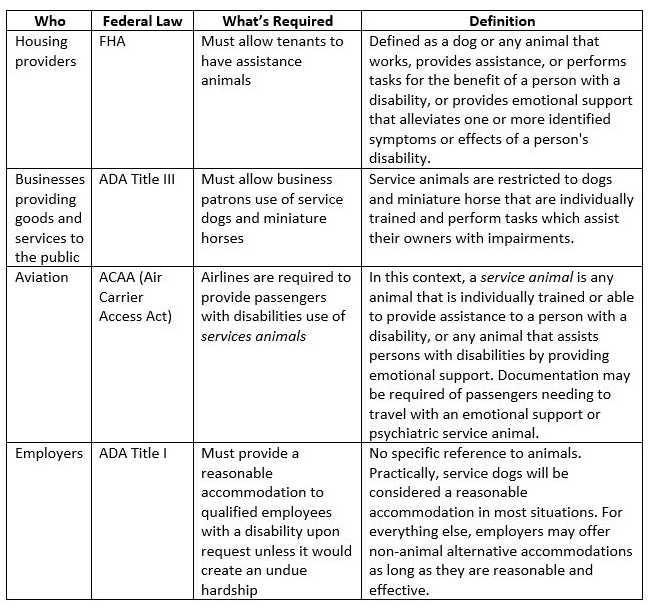
Acme’s pet restrictions are generally lawful. However, under the FHA, Acme must allow tenants and applicants with a disability to live with assistance animals that meet their disability-related needs. The only exception to this requirement is if the assistance animal would pose a direct threat to others or would cause substantial physical damage to property.
What constitutes an assistance animal is interpreted broadly. It could be a dog or any other animal that “works, provides assistance, or performs tasks for the benefit of a person with a disability, or provides emotional support that alleviates one or more identified symptoms or effects of a person’s disability.” Assistance animals will typically perform functions like providing protection or rescue assistance, fetching items, alerting persons to impending seizures, or providing emotional support to persons with disabilities who have a disability-related need for such support. In this context, assistance animals are sometimes referred to as “service animals,” “assistive animals,” “support animals,” or “therapy animals.” However, the preferred term is assistance animals to avoid confusion with other laws.
Service Animals And Public Accommodations Under The ADA
The legal requirements differ depending on whether you are considering accommodations in public places or in the workplace.
In Public Places
Title III of the ADA requires businesses that provide goods or services to the public to allow service animals to accompany people with disabilities in all areas of its facility in which the public is normally allowed access. Going back to Acme, this means that it must accommodate service animals in its leasing office and fitness center for visitors and patrons with a disability.
However, under Title III, service animals are limited to only individually trained dogs and, with some exceptions, miniature horses. Most often, service animals perform functions like guiding the blind, alerting the deaf, pulling wheelchairs, providing seizure alerts, or calming a person during an anxiety attack. Service animals do not include untrained comfort animals, which are generally animals that provide psychological comfort by their existence. In other words, no rabbit, bird, cat, monkey, or untrained dog can qualify as a service animal under the ADA in this context.
So how would Acme know if a dog or miniature horse is a service animal? Under the ADA, Acme is allowed to ask whether the animal is a service animal and what tasks the animal has been trained to perform, but nothing more. Acme cannot require proof of disability, certification, or make any other inquiry.
However, if the owner cannot maintain control of the service animal, or if the service animal proves dangerous or disruptive by its conduct, then Acme can expel it from the premises. Because of this limited inquiry, and the fact that many pet owners are apparently now attempting to pass their pets off as service animals, a growing number of states are making it a crime to misrepresent a pet as a service animal or misrepresent oneself as a person with a disability to gain access with a dog. Arizona, California, Minnesota, New Jersey, and Texas now have criminal penalties including jail time for such misrepresentations, with more states looking to follow.
In The Workplace
What about employees who request to bring animals into the workplace? Assume that one of Acme’s employees says that she has an anxiety disorder and would like to bring her pet rabbit to work. She explains that it helps mitigate the disorder and allows her to perform her duties. Must Acme allow the rabbit in the workplace? To answer this question, employers must turn to Title I of the ADA.
Title I of the ADA requires that Acme, when asked, provide reasonable accommodations to qualified employees with a disability in order to allow the employee to perform the essential functions of the job. Acme is obligated to provide reasonable accommodations unless it would create an undue hardship.
When such requests are made, the employer should engage in an interactive discussion with the employee to learn about the employee’s disability, how it is impacts the employee’s major life functions, and how it may be impeding getting the employee’s job duties done. In this process, it is important to highlight that employers must only provide a reasonable accommodation, and not the preferred accommodation requested by the employee if effective alternatives exist. In other words, if the employer can provide an alternative to the accommodation requested that is effective in allowing the employee to perform the job functions and is more in line with the needs of the employer, then the employer can provide that alternative and meet its ADA obligations.
As a practical matter, after engaging in the interactive process, most employers will discover that there are likely reasonable alternatives to permitting comfort animals in the workplace—but few to none regarding service dogs. In the rare case of a comfort animal request, some employers have offered less disruptive alternatives such as the use of a pet monitor at work or the use of a stuffed animal likeness. To date, there are no known cases in which a court has found an employer in violation of the ADA for denying the work presence of an untrained comfort animal where an alternative has been offered.
In contrast, a trained service dog accompanying an employee to their job has long been viewed as a “reasonable accommodation” under Title I of the ADA, even though not specifically listed as part of that section. There are a number of cases in which employers have been found to have violated the law by not permitting service dogs in job interviews or at work. In fact, the EEOC is currently pursuing a federal lawsuit against a trucking company for violating the ADA by not allowing a military veteran truck driver to complete his training with a trained service dog who provides “emotional support” and mitigates his post-traumatic stress and mood disorder.
However, employers may still deny these animals in the workplace if the employer can show the rare circumstance that it would create an undue hardship to operation of the employer’s business. Under the ADA, undue hardship is defined as an “action requiring significant difficulty or expense” when considered in light of a number of factors. Examples of undue hardship in this context may include safety issues caused by the presence of the dog, the presence of other employees with dog allergies, or coworker phobias. Claiming undue hardship is a very narrow exception under the law and businesses who wish to use it should seek advice from legal counsel.
Conclusion
As with any regulated area, businesses subjected to the above laws should seek the assistance of counsel when drafting policies and developing staff training materials. Based on the multiple laws and definitions regarding assistive and service animals, it is no wonder that businesses, employers, and the general public are often confused about their rights and obligations. To help clarify, below is a chart that may help provide some order: