This week’s GSB OTA & Travel Distribution Update for the week ending June 23, 2017 is below. A variety of stories this week.
Time to Take French Legislative Prohibitions Seriously [OTA/PARITY]
(“Expedia fined in France over hotel price parity clauses”, Mlex, June 23, 2017)
Expedia learned first-hand this past week that France’s Loi Macron legislation is indeed the “law of the land” – at least for now. Last week, a French Court of Appeals ruled that Expedia’s rate parity provisions violated the legislation’s ban on rate parity and fined Expedia one million euros. Recall that France was one of three EU countries whose competition authorities agreed in 2015 to Booking.com’s proposed “narrow” (direct channel only) approach to rate parity, but then soon thereafter passed legislation banning rate parity altogether. Many have questioned the effect of the French legislation given the inconsistent prior administrative resolution. For now, we have a sense as to how French courts might view rate parity.
Airbnb Rolls Out Hotel-Like Services [SHORT-TERM RENTALS]
(“Airbnb is reportedly creating a fancier service for people who prefer hotels,” Bloomberg, June 23, 2017)
In a move targeting more traditional, higher-paying (historically, non-Airbnb) hotel guests, Airbnb quietly launched this past week a beta test of its new “select” program for hosts that satisfy a pre-determined set of quality standards (e.g. matching bed linens, lush towels and single use toiletries). Hosts who are invited to be part of this distinct program will be subject to physical inspections by Airbnb representatives. Those passing the inspection can expect preferred and distinct placement on the Airbnb website and a variety of “preferred perks” – use of a professional photographer, interior decorator, contracted “hotel like” cleaning services, etc. According to a report last week in Seattle’s weekly business publication, Puget Sound Business Journal, Seattle has been identified as a test market for this new “select” program and a well-known local cleaning service has been retained by Airbnb to clean hosts’ homes and apartments.
Adequacy of OTA Disclosures Questioned Again [OTA]
(“Frustrated United customers say they didn’t realize they were purchasing ‘basic economy’ tickets (UAL, EXPE, PCLN), Business Insider, June 21, 2017)
Those of you who have been frustrated by OTAs’ general reluctance to conspicuously post certain disclosures, disclaimers or other important information (e.g. resort fees or other mandatory charges, tax inclusive rates, etc.) prior to booking will appreciate the challenges that United Airlines is apparently now experiencing with OTAs and the adequacy (or inadequacy) of disclosures around United’s basic economy fairs. An interesting read.
——-
Other news:
Airbnb Is Testing a Feature That Would Let You Split the Cost With Friends
Fortune Magazine, June 23, 2017
One less hassle?
TRVL is the best travel platform you’re not using (yet)
The Next Web, June 23, 2017
From the moment I saw it, I was instantly enamored with TRVL. The brainchild of Dutch entrepreneur Jochem Wijnands, TRVL is a sort of mashup that turns each user into a travel agent with the potential to earn money for their recommendations. Think of it as TripAdvisor meets Airbnb and Skyscanner.
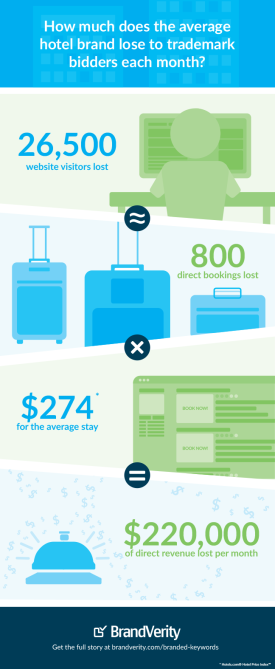
The report assesses the paid search landscape on branded keywords of over 250 consumer-facing brands. Looking at Q1 2015, it found that trademark bidding has cost the typical brand tens of thousands of visitors each month. The full report is available for download today at https://www.brandverity.com/branded-keywords/.
I’d imagine that every hotel and restaurant owner/operator is interested to know how to save money on his or her state taxes (while still following all of the applicable laws and rules, of course). As a former Washington Department of Revenue auditor, I’ve seen many exemptions, credits, and preferential tax rates go unused – primarily because businesses just didn’t know that they existed! This post provides a brief explanation of some Washington tax incentives (both old and new) that the hotel and restaurant industry should be taking full advantage of.
Sales/Use Tax Exemption for Items Imparting Flavor or Supporting Food
The Washington legislature recently enacted a measure providing a retail sales and use tax exemption on purchases by restaurants of the following two types of items:
- • Items used to impart flavor to foods that are completely or substantially consumed by combustion during the cooking process. Such items could include charcoal, charcoal briquettes, wood chips, grape vines, and the like.
- • Items comprised entirely of wood that support the food during the cooking process. Such items could include wood planks, etc.
This exemption expires July 1, 2017.
Commute Trip Reduction Credit
Also recently passed by the state legislation was a bill extending the life of the Commute Trip Reduction B&O tax credit. This credit is a great incentive for those taxpayers who help subsidize the cost of employee public transportation, carpooling, or non-motorized commuting. For each employee, the credit is capped at $60 or 50% of the transportation cost paid (whichever is lower) annually. Be sure to submit your application to the Department of Revenue by January 31, 2014 to get your 2013 credit!
Syrup Tax Credit
2009, the buyer is entitled to a B&O tax credit of 100% of the syrup tax paid. The credit can be taken directly on the excise tax return as well.Although not part of the new legislative changes, the syrup tax credit is another great incentive to take advantage of if you are in the restaurant industry. This is a Washington B&O tax credit that is available to any buyer of carbonated beverage syrup who uses the syrup in making carbonated beverages that are then sold (provided that the syrup tax has already been paid). As of July 1,
Lodging for Continuous Periods Greater than 30 days
Hotels and similar short-term accommodation providers are generally required to collect sales tax on charges for room rentals of 30 days or less, but not for continuous periods of more than 30 days. A recently issued Washington Tax Determination provides a favorable application of this law to a hotel that provided blocks of rooms to a corporate customer. In the determination, an airline had a long-term contract in place with a hotel to provide rooms for their off-duty flight crews. The contract was for a term of more than 30 days and the hotel was to provide the airline a set number of rooms on an ongoing basis. The hotels did not set aside specific rooms for the airline, but the airline was guaranteed the availability of the number of rooms specified and was required to pay for them even if they went unused.
The Appeals division ruled in favor of the airline, explaining that the law does not require a specific hotel guest to be in continuous occupancy of the same hotel room for a continuous 30-day period to qualify for the sales tax exemption. This treatment applies retroactively, so there may be refunds available to the extent sales tax has been charged on corporate contracts or other bookings of one or more hotel rooms for a continuous period of at least 30 days.
Awareness of these potential tax savings is just part of the process; implementing the exemptions and credits is the more difficult part. Contact Clark Nuber or your tax provider to “serve up” assistance in these areas.
]]>